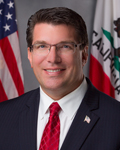
Photo of Jay Obernolte
R California House · District 33

Rep. Jay Obernolte

Compare
Total votes
15,100
all sessions
Attendance
94%
662 missed
Near the chamber average
With party
97%
of cast votes
Lower than 88% of chamber peers
Bipartisan score
2%
crosses aisle rarely
Higher than 92% of chamber peers
Sponsored
811
bills & resolutions
Lower than 99% of chamber peers
Committees
0
assignments
811 bills and resolutions

Sponsored bills

Total
811
Primary
150
Co-sponsor
661
This page
811
matching current filters
Co-sponsor ACR 113
Signed into law · California House · Co-sponsor
Relative to India's Independence Day.

This measure would recognize August 15, 2019, as India's Independence Day, and urge all Californians to join in celebrating India's independence.

Signed into law Sep 9, 2019 1 co-sponsor
Co-sponsor AJR 14
Signed into law · California House · Co-sponsor
Relative to Special Olympics.

This measure would call for continued support and recognition of the many benefits provided by Special Olympics.

Signed into law Sep 9, 2019 1 co-sponsor
Co-sponsor AJR 23
Introduced · California House · Co-sponsor
Relative to domestic terrorism.

This measure would call for groups and organizations across the United States who act under the banner of Antifa to be designated as domestic terrorist organizations, would unequivocally condemn the violent actions of Antifa groups as unacceptable acts for anyone in the United States, would express the need for peaceful communication of varied ideas, and would urge any group or organization in the United States to voice its opinions without using violence or threatening the health, safety, or well-being of other persons, groups, or law enforcement officers in the United States. The measure would further call upon the President of the United States, the United States Congress, and the Governor to redouble efforts, using all available and appropriate tools, to combat the spread of all forms of domestic terrorism, including White supremacist terrorism.

Introduced Sep 4, 2019 1 co-sponsor
Co-sponsor ACR 87
Passed · California House · Co-sponsor
Upholding democracy through civic education in public schools.

This measure would endorse activities in public schools that instruct pupils in upholding and sustaining American democracy, encourage, in the strongest terms, California schools to pursue certain recognized designations that reflect specified ethos and values, and encourage publicly elected officials to conduct themselves in ways that strengthen civic engagement and participation in civil society.

Passed Sep 4, 2019 1 co-sponsor
Co-sponsor AB 213
Passed · California House · Co-sponsor
Local government finance: property tax revenue allocations: vehicle license fee adjustments.

Existing property tax law requires the county auditor, in each fiscal year, to allocate property tax revenue to local jurisdictions in accordance with specified formulas and procedures, and generally provides that each jurisdiction be allocated an amount equal to the total of the amount of revenue allocated to that jurisdiction in the prior fiscal year, subject to certain modifications, and that jurisdiction's portion of the annual tax increment, as defined. Existing property tax law also requires that, for purposes of determining property tax revenue allocations in each county for the 1992–93 and 1993–94 fiscal years, the amounts of property tax revenue deemed allocated in the prior fiscal year to the county, cities, and special districts be reduced in accordance with certain formulas. It requires that the revenues not allocated to the county, cities, and special districts as a result of these reductions be transferred to the Educational Revenue Augmentation Fund in that county for allocation to school districts, community college districts, and the county office of education. Beginning with the 2004–05 fiscal year and for each fiscal year thereafter, existing law requires that each city, county, and city and county receive additional property tax revenues in the form of a vehicle license fee adjustment amount, as defined, from a Vehicle License Fee Property Tax Compensation Fund that exists in each county treasury. Existing law requires that these additional allocations be funded from ad valorem property tax revenues otherwise required to be allocated to educational entities. Existing law, for the 2006–07 fiscal year, and for each fiscal year thereafter, requires the vehicle license fee adjustment amount to be the sum of the vehicle license fee adjustment amount for the prior fiscal year, if specified provisions did not apply, and the product of that sum and the percentage change from the prior fiscal year in the gross taxable valuation within the jurisdiction of the entity. Existing law establishes a separate vehicle license fee adjustment amount for a city that was incorporated after January 1, 2004, or on or before January 1, 2012. This bill, for the 2019–20 fiscal year, would instead require the vehicle license fee adjustment amount to be the sum of the vehicle license fee adjustment amount in the 2018–19 fiscal year, the product of that sum and the percentage change in gross taxable assessed valuation within the jurisdiction of that entity between the 2018–19 fiscal year to the 2018–19 fiscal year, and the product of the amount of specified motor vehicle license fee revenues that the Controller allocated to the applicable city in July 2010 and 1.17. This bill, for the 2020–21 fiscal year, and for each fiscal year thereafter, would require the vehicle license fee adjustment amount to be the sum of the vehicle license fee adjustment amount for the prior fiscal year and the product of the amount as so described and the percentage change from the prior fiscal year in gross taxable assessed valuation within the jurisdiction of the entity. By imposing additional duties upon local tax officials with respect to the allocation of ad valorem property tax revenues, this bill would impose a state-mandated local program. The California Constitution requires the state to reimburse local agencies and school districts for certain costs mandated by the state. Statutory provisions establish procedures for making that reimbursement. This bill would provide that, if the Commission on State Mandates determines that the bill contains costs mandated by the state, reimbursement for those costs shall be made pursuant to the statutory provisions noted above.


Passed Aug 30, 2019 1 co-sponsor
Primary AB 1349
Signed into law · California House · Lead sponsor
Civil actions: discovery.

Existing law governs discovery in civil actions, and allows a party to obtain discovery from another party through written interrogatories and requests for admission, among others. Under existing law, each response by the responding party to these discovery requests is required to include the same number or letter, and be in the same sequence, as the corresponding discovery request, as specified, but is not required to repeat the text of the particular discovery request. In order to facilitate the discovery process, this bill would, upon request in one of the aforementioned discovery methods, require a party to provide the requesting party with the document propounding or responding to the discovery request in electronic format within 3 court days of the request, except as specified. If a responding party requests and receives a discovery request in electronic format, the bill would require the responding party to include the text of the interrogatory immediately preceding any response. The bill would also provide that a party may provide the requested electronic format in any format, and may transmit the document by any method, as agreed upon by the parties, except as specified.

Signed into law Aug 30, 2019 0 co-sponsors
Primary AB 1737
Passed · California House · Lead sponsor
Courts: unexpended funds.

Existing law requires the Judicial Council to adopt a budget and allocate funding for trial courts. Existing law requires the Judicial Council, when allocating funding to trial courts, to set a preliminary allocation, which includes an estimate of available trial court reserves as of June 30 of the prior fiscal year. Existing law requires each court's preliminary allocation to be offset by the amount of reserves in excess of the amount authorized to be carried over. Existing law authorizes a trial court to carry over unexpended funds in an amount not to exceed 1% of the court's operating budget from the prior fiscal year. Existing law exempts certain funds from the calculation of the 1% authorized to be carried over from the prior fiscal year. This bill would repeal the 1% limitation described above, and, instead, would allow the Judicial Council to authorize a trial court to carry unexpended funds over from one fiscal year to the next. The bill would also make conforming changes.

Passed Aug 30, 2019 0 co-sponsors
Primary AB 1638
Signed into law · California House · Lead sponsor
Search warrants: vehicle recording devices.

Existing law allows a search warrant to be issued upon probable cause, supported by affidavit, naming or describing the person to be searched or searched for, and particularly describing the property, thing, or things and the place to be searched. Existing law also specifies the grounds upon which a search warrant may be issued, including, among other grounds, when the property or things to be seized constitute evidence showing that a felony has been committed. This bill would authorize a search warrant to be issued on the grounds that the property or things to be seized are data, from a recording device, as defined, installed by the manufacturer of a motor vehicle, that constitutes evidence that tends to show the commission of a felony or misdemeanor offense involving a motor vehicle, resulting in death or serious bodily injury, as defined, to any person.

Signed into law Aug 30, 2019 0 co-sponsors
Co-sponsor AB 976
Passed · California House · Co-sponsor
Artificial Intelligence in State Government Services Commission.

Existing law establishes, within the Government Operations Agency, the Department of Technology under the supervision of the Director of Technology, who also serves as the State Chief Information Officer. The department is generally responsible for the approval and oversight of information technology projects by, among other things, consulting with state agencies during initial project planning to ensure that project proposals are based on well-defined programmatic needs. This bill would establish in state government the Artificial Intelligence in State Government Services Commission comprised of 8 members, as specified, and would require the advisory commission to annually convene a public process to gather input on how artificial intelligence and data science could be used to improve state services. This bill would require the commission to propose a plan for soliciting artificial intelligence and data science related demonstration projects for critical state services and incorporating successful artificial intelligence and data science related demonstration projects into existing state government services. The bill would require the commission to establish guiding principles for the proposed plan on or before November 1, 2020. The bill would require the commission to submit its recommendations based on input gathered from the public process to the Legislature and the Governor by November 1, 2021, and by November 1 of every year thereafter. The bill would make related findings and declarations. The bill would repeal its provisions on January 1, 2025.

Passed Aug 30, 2019 1 co-sponsor
Showing 81 to 90 of 811 bills
Previous 1 8 9 10 82 Next