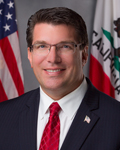
Photo of Jay Obernolte
R California House · District 33

Rep. Jay Obernolte

Compare
Total votes
15,100
all sessions
Attendance
94%
662 missed
Near the chamber average
With party
97%
of cast votes
Lower than 88% of chamber peers
Bipartisan score
2%
crosses aisle rarely
Higher than 92% of chamber peers
Sponsored
811
bills & resolutions
Lower than 99% of chamber peers
Committees
0
assignments
811 bills and resolutions

Sponsored bills

Total
811
Primary
150
Co-sponsor
661
This page
811
matching current filters
Primary AB 1013
Signed into law · California House · Lead sponsor
State agencies: grant applications.

Existing law authorizes various state agencies to award grant money for various purposes. This bill would prohibit a state agency from permitting an evaluator to review a discretionary grant application submitted by an organization or a person for which the evaluator was a representative, voting member, or staff member within the 2-year period preceding receipt of that application.

Signed into law Oct 3, 2019 0 co-sponsors
Co-sponsor AB 1132
Signed into law · California House · Co-sponsor
Telecommunications: caller identification fraud.

Under existing law, the Public Utilities Commission has regulatory authority over public utilities, including telephone corporations. Existing law, with specified exceptions, directs the commission to require any call identification service offered by a telephone corporation, or by any other person or corporation that makes use of the facilities of a telephone corporation, to allow the caller to withhold, on an individual basis, the display of the caller's telephone number from the telephone instrument of the individual receiving the call. However, existing law prohibits a caller from withholding the display of the caller's business telephone number when that number is being used for telemarketing purposes. Existing federal law, the Truth in Caller ID Act of 2009, with certain exceptions, makes it unlawful for any person within the United States, in connection with any telecommunications service or internet protocol enabled voice service, to cause any caller identification service to knowingly transmit misleading or inaccurate caller identification information with the intent to defraud, cause harm, or wrongfully obtain anything of value. This bill would prohibit a caller from entering, or causing to be entered, false government information into a caller identification system with the intent to mislead, cause harm, deceive, or defraud the recipient of the call. The bill would prohibit a person or entity from making a call knowing that false government information was entered into the caller identification system with the intent to mislead, cause harm, deceive, or defraud the recipient of the call. The bill would make the violation of these prohibitions subject to a civil penalty of up to $10,000 for each violation. The bill would authorize a city attorney, district attorney, or the Attorney General to bring an action to enforce the bill's prohibitions and, if in investigating a complaint over the unlawful use of an automatic dialing announcing device the commission determines that a violation of these prohibitions may have occurred, the bill would require the commission to give notice of the potential violation to the district attorney for the county in which the call was received and to the Attorney General. The bill would provide that its requirements and remedies are in addition to any other applicable law prohibiting the same or similar activity.

Signed into law Oct 2, 2019 1 co-sponsor
Co-sponsor ACR 129
Signed into law · California House · Co-sponsor
Relative to Leyte Landing Commemoration Day.

This measure would designate October 20, 2019, and each 20th day of October thereafter, as Leyte Landing Commemoration Day in recognition of the significance of the Leyte landing in liberating the Philippines from Japanese occupation and would also honor the significant contributions to California made by generations of Filipino Americans since that time.

Signed into law Sep 26, 2019 1 co-sponsor
Co-sponsor AB 39
Passed · California House · Co-sponsor
Education finance: local control funding formula: aspirational funding level: reports.

(1) Existing law establishes a public school financing system that requires state funding for county superintendents of schools, school districts, and charter schools to be calculated pursuant to a local control funding formula, as specified. Existing law requires funding pursuant to the local control funding formula to include, in addition to a base grant, supplemental and concentration grant add-ons that are based on the percentage of pupils who are English learners, foster youth, or eligible for free or reduced-price meals, as specified, served by the county superintendent of schools, school district, or charter school. Existing law specifies the amount of the base grant in the 2013–14 fiscal year, as provided, and requires that amount to be adjusted for changes in cost of living in subsequent fiscal years. Existing law requires the Superintendent of Public Instruction to compute the supplemental and concentration grant add-ons as certain percentages of the amount of the base grant. This bill would express the intent of the Legislature to increase the base grants to amounts equal to the national average per-pupil funding level, as provided. The bill would express the intent of the Legislature to apply a cost-of-living adjustment separate from, in addition to, and above the specified cost-of-living adjustment described above for purposes of certain funding provisions. (2) Commencing with the first fiscal year after full implementation of the local control funding formula, existing law requires the Superintendent of Public Instruction, within 3 business days of the first principal, 2nd principal, and annual apportionments for each fiscal year, to publish on the State Department of Education's internet website the amount of a county office of education's, school district's, or charter school's funding derived from its local control funding formula allocation that is attributable to the supplemental and concentration grants. Commencing July 1, 2020, this bill would require the Superintendent to additionally publish on the department's internet website (A) the amount of a county office of education's, school district's, or charter school's funding derived from its local control funding formula allocation that is attributable to base grants and (B) the unduplicated pupil counts and percentages calculated for each school district, charter school, and county office of education. The bill would prohibit the Superintendent from publishing this information for any necessary small school, as defined.


Passed Sep 14, 2019 1 co-sponsor
Co-sponsor SB 58
Failed · California Senate · Co-sponsor
Alcoholic beverages: hours of sale.

The Alcoholic Beverage Control Act provides that any on- or off-sale licensee, or agent or employee of the licensee, who sells, gives, or delivers to any person any alcoholic beverage between the hours of 2 a.m. and 6 a.m. of the same day, and any person who knowingly purchases any alcoholic beverages between those hours, is guilty of a misdemeanor. Existing law provides for moneys collected as fees pursuant to the act to be deposited in the Alcohol Beverage Control Fund, with those moneys generally allocated to the Department of Alcoholic Beverage Control upon appropriation by the Legislature. This bill, beginning January 1, 2022, and before January 2, 2027, would require the Department of Alcoholic Beverage Control to conduct a pilot program that would authorize the department to issue an additional hours license to an on-sale licensee located in a qualified city that would authorize, with or without conditions, the selling, giving, or purchasing of alcoholic beverages at the licensed premises between the hours of 2 a.m. and 3 a.m., upon completion of specified requirements by the qualified city in which the licensee is located. The bill would impose specified fees related to the license to be deposited in the Alcohol Beverage Control Fund. The bill would require the applicant to notify specified persons of the application for an additional hours license and would provide a procedure for protest and hearing regarding the application. The bill would require the Department of the California Highway Patrol and each qualified city that has elected to participate in the program to submit reports to the Legislature and specified committees regarding the regional impact of the additional hours licenses, as specified. The bill would provide that any person under 21 years of age who enters and remains in the licensed public premises during the additional serving hour without lawful business therein is guilty of a misdemeanor, as provided. The pilot program would apply to Cathedral City, Coachella, Fresno, Long Beach, Los Angeles, Oakland, Palm Springs, Sacramento, San Francisco, and West Hollywood. This bill would impose a state-mandated local program by creating new crimes. The California Constitution requires the state to reimburse local agencies and school districts for certain costs mandated by the state. Statutory provisions establish procedures for making that reimbursement. This bill would provide that no reimbursement is required by this act for a specified reason. This bill would make legislative findings and declarations as to the necessity of a special statute for the qualified cities.

Failed Sep 14, 2019 1 co-sponsor
Co-sponsor AB 1514
Signed into law · California House · Co-sponsor
Deaf and Disabled Telecommunications Program.

Under existing law, the Public Utilities Commission has regulatory authority over public utilities, including telephone corporations. Existing law requires the commission to design and implement a program to provide a telecommunications device capable of serving the needs of individuals who are deaf or hearing impaired, together with a single party line, at no charge additional to the basic exchange rate, to any subscriber who is certified as an individual who is deaf or hearing impaired by a licensed physician and surgeon, audiologist, or a qualified state or federal agency, as determined by the commission. Existing law also authorizes a physician assistant to certify the needs of an individual who has been diagnosed by a physician and surgeon as being deaf or hard of hearing to participate in the program after reviewing the medical records or copies of the medical records containing that diagnosis. This bill would additionally authorize a nurse practitioner to certify for this purpose the needs of an individual who has been diagnosed by a physician and surgeon as being deaf or hard of hearing to participate in the program after reviewing the medical records or copies of the medical records containing that diagnosis. Existing law requires the commission to design and implement a program whereby specialized or supplemental telephone communications equipment may be provided to subscribers who are certified to be disabled at no charge additional to the basic exchange rate. Existing law requires that the certification, including a statement of visual or medical need for specialized telecommunications equipment, be provided by a licensed optometrist, physician and surgeon, or physician assistant, acting within the scope of practice of the applicable license, or by a qualified state or federal agency as determined by the commission. This bill would additionally authorize a nurse practitioner to certify a subscriber to be disabled for this purpose. Existing law additionally requires the commission to design and implement a program to provide access to a speech-generating device to any subscriber who is certified as having a speech disability at no charge additional to the basic exchange rate. Existing law requires that the certification be provided by a licensed physician, licensed speech-language pathologist, or qualified state or federal agency. This bill would additionally authorize a nurse practitioner to certify a subscriber as having a speech disability for this purpose. This bill would incorporate additional changes to Section 2881 of the Public Utilities Code proposed by AB 497 to be operative only if this bill and AB 497 are enacted and this bill is enacted last. This bill would declare that it is to take effect immediately as an urgency statute.

Signed into law Sep 12, 2019 1 co-sponsor
Co-sponsor AJR 16
Signed into law · California House · Co-sponsor
Relative to the Armenian Genocide.

This measure would, among other things, designate the year 2019 as "State of California Year of Commemoration of the Anniversary of the Armenian Genocide of 1915–1923," would designate April 24, 2019, as "State of California Day of Commemoration of the 104th Anniversary of the Armenian Genocide of 1915–1923," and would call upon the President of the United States and the United States Congress to formally and consistently reaffirm the historical truth that the atrocities committed against the Armenian people constituted genocide.

Signed into law Sep 11, 2019 1 co-sponsor
Co-sponsor AJR 17
Passed · California House · Co-sponsor
Relative to missing and murdered Native American women and girls.

This measure would request the President and the Congress of the United States to enact legislation that would strengthen the communication between federal, state, local, and tribal officials, and that would require the United States Department of Justice, United States Department of the Interior, and United States Department of Health and Human Services to seek recommendations from tribes in enhancing the safety of Native American women and girls. The measure would also request that the Attorney General of the State of California begin the collection of data as it relates to missing and murdered Native American women and girls.

Passed Sep 11, 2019 1 co-sponsor
Showing 71 to 80 of 811 bills
Previous 1 7 8 9 82 Next