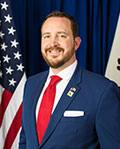
Photo of Devon Mathis
R California Assembly · District 33

Asm. Devon Mathis

Contact Email
Compare
Total votes
23,116
all sessions
Attendance
85%
2,834 missed
Near the chamber average
With party
97%
of cast votes
Near the chamber average
Bipartisan score
2%
crosses aisle rarely
Near the chamber average
Sponsored
2,082
bills & resolutions
Higher than 76% of chamber peers
Committees
0
assignments
2,082 bills and resolutions

Sponsored bills

Total
2,082
Primary
225
Co-sponsor
1,857
This page
2,082
matching current filters
Co-sponsor AB 2302
Signed into law · California Assembly · Co-sponsor
Child abuse: sexual assault: mandated reporters: statute of limitations.

Existing law, the Child Abuse and Neglect Reporting Act, makes certain persons, including teachers and social workers, mandated reporters. Under existing law, mandated reporters are required to report whenever the mandated reporter, in his or her professional capacity or within the scope of his or her employment, has knowledge of or observes a child whom the mandated reporter knows or reasonably suspects has been the victim of child abuse or neglect. Failure by a mandated reporter to report an incident of known or reasonably suspected child abuse or neglect is a misdemeanor. Existing law generally requires prosecution of a misdemeanor to commence within one year after commission of the offense. Under existing law, if the mandated reporter intentionally conceals his or her failure to report an incident known by the mandated reporter to be abuse or severe neglect, it is a continuing offense until discovered by the appropriate law enforcement agency. This bill would allow a case involving the failure to report an incident known or reasonably suspected by the mandated reporter to be sexual assault, as defined, to be filed at any time within 5 years from the date of occurrence of the offense.

Signed into law Sep 30, 2018 1 co-sponsor
Co-sponsor AB 1762
Signed into law · California Assembly · Co-sponsor
State parks: visitors: animals: dogs.

Under existing law, the Department of Parks and Recreation administers and manages the state park system. Existing law permits visitors to bring animals into units of the state park system when the Director of Parks and Recreation determines that it is in the public interest, subject to certain conditions. This bill would require the department to establish and maintain on its Internet Web site a comprehensive, up-to-date list of each unit with information on whether the unit or a portion of the unit allows dogs and additional specified information.

Signed into law Sep 29, 2018 1 co-sponsor
Co-sponsor AB 1921
Vetoed · California Assembly · Co-sponsor
CalWORKs: housing assistance.

Existing law establishes the California Work Opportunity and Responsibility to Kids (CalWORKs) program under which, through a combination of federal, state, and county funds, each county provides cash assistance and other benefits to qualified low-income families. The CalWORKs program also provides a nonrecurring special needs benefit for permanent housing assistance to pay for last month's rent and security deposits, up to 2 months of rent arrearages, or standard costs of deposits for utilities, as specified. Existing law requires payments to providers for temporary shelter and permanent housing and utilities to be made on behalf of the families requesting these payments. Existing law prohibits payments from being made to a housing provider unless it is a commercial establishment, shelter, or person in the business of renting properties who has a history of renting properties. This bill, commencing July 1, 2019, would remove the requirement that a person in the business of renting properties have a history of renting properties in order to receive payments and would additionally authorize payments to a housing provider with which the families requesting assistance have executed a valid lease, sublease, or shared housing agreement. Because this bill would increase the administrative duties of counties, it would impose a state-mandated local program. This bill would authorize the State Department of Social Services to implement these provisions through an all-county letter or similar instruction from the Director of Social Services until final regulations are adopted, and would require the department to adopt emergency regulations on or before July 1, 2020. The California Constitution requires the state to reimburse local agencies and school districts for certain costs mandated by the state. Statutory provisions establish procedures for making that reimbursement. This bill would provide that, if the Commission on State Mandates determines that the bill contains costs mandated by the state, reimbursement for those costs shall be made pursuant to the statutory provisions noted above. Existing law continuously appropriates moneys from the General Fund to defray a portion of county costs under the CalWORKs program. This bill would, instead, provide that the continuous appropriation would not be made for purposes of implementing the bill.

Vetoed Sep 29, 2018 1 co-sponsor
Co-sponsor SB 1019
Vetoed · California Senate · Co-sponsor
Youth mental health and substance use disorder services.

Existing law establishes the Investment in Mental Health Wellness Act of 2013. Existing law provides that funds appropriated by the Legislature to the California Health Facilities Financing Authority and the Mental Health Services Oversight and Accountability Commission for the purposes of the act be made available to selected counties or counties acting jointly, except as otherwise provided, and used to provide, among other things, a complete continuum of crisis services for children and youth 21 years of age and under regardless of where they live in the state. The act requires the commission to allocate funds to triage personnel, as specified. This bill would require the commission, when making these funds available on and after July 1, 2021, to allocate at least 12 of those funds to local educational agency and mental health partnerships, as specified. The bill would require this funding to be made available to support prevention, early intervention, and direct services, as determined by the commission. The bill would require the commission, in consultation with the Superintendent of Public Instruction, to consider specified criteria when determining grant recipients. The bill would require the commission to provide a status report to the fiscal and policy committees of the Legislature, as specified, no later than March 1, 2022.

Vetoed Sep 29, 2018 1 co-sponsor
Co-sponsor AB 2832
Signed into law · California Assembly · Co-sponsor
Recycling: lithium-ion vehicle batteries: advisory group.

The Rechargeable Battery Recycling Act of 2006 requires every retailer, as defined, to have in place a system for the acceptance and collection of used rechargeable batteries for reuse, recycling, or proper disposal. Existing law requires the system for the acceptance and collection of used rechargeable batteries to include, at a minimum, specified elements, including, among others, the take-back at no cost to the consumer of a used rechargeable battery of the type or brand that the retailer sold or previously sold. Existing law defines "rechargeable battery" for purposes of these provisions to mean a small, nonvehicular, rechargeable nickel-cadmium, nickel metal hydride, lithium-ion, or sealed lead-acid battery, or a battery pack containing these types of batteries. This bill would require the Secretary for Environmental Protection, on or before April 1, 2019, to convene the Lithium-Ion Car Battery Recycling Advisory Group to review, and advise the Legislature on, policies pertaining to the recovery and recycling of lithium-ion batteries sold with motor vehicles in the state, and would require the secretary to appoint members to the committee from specified departments, vocations, and organizations. The bill would require the advisory group to consult with specified entities and, on or before April 1, 2022, to submit policy recommendations to the Legislature aimed at ensuring that as close to 100% as possible of lithium-ion batteries in the state are reused or recycled at end-of-life in a safe and cost-effective manner. The bill would require the policy recommendations to reflect specified considerations. The bill would repeal these provisions on January 1, 2027.


Signed into law Sep 27, 2018 1 co-sponsor
Co-sponsor AB 3176
Signed into law · California Assembly · Co-sponsor
Indian children.

(1) Existing federal law, the Indian Child Welfare Act of 1978 (ICWA) , governs the proceedings for determining the placement of an Indian child when that child is removed from the custody of his or her parent or guardian. Existing law specifies that the state is committed to protecting the essential tribal relations and best interest of an Indian child by promoting practices in accordance with ICWA. Existing law requires a court in all Indian child custody proceedings to, among other things, comply with ICWA. Under existing law, a determination by an Indian tribe that an unmarried person who is under 18 years of age, is either a member of an Indian tribe, or is eligible for membership in an Indian tribe and a biological child of a member of an Indian tribe, constitutes a significant political affiliation with the tribe and requires application of ICWA to the proceedings. Under existing law, a court, a county welfare department, and the probation department have an affirmative and continuing duty to inquire as to whether a child is or may be an Indian child in all dependency proceedings and in any juvenile wardship proceeding if the child is at risk of entering foster care or is in foster care. Under existing law, if a court, social worker, or probation officer knows or has reason to know that an Indian child is involved in a custody proceeding, a notice meeting specified requirements is required to be sent to the minor's parents or legal guardian, Indian custodian, and the minor's tribe. Existing law also requires the notice to be sent to all tribes of which the child may be a member or eligible for membership, as provided. In accordance with federal law, this bill would revise and recast those provisions. Among other things, the bill would revise the specific steps a social worker, probation officer, or court is required to take in making an inquiry of a child's possible status as an Indian child. The bill would also revise the various notice requirements that are mandated during an Indian child custody proceeding, including a proceeding for an emergency removal of an Indian child from the custody of his or her parents or Indian custodian. The bill would require the State Department of Social Services to adopt any regulations necessary to implement these provisions, and would require the Judicial Council to adopt any forms or rules of court necessary to implement these provisions. The bill would make other conforming changes. (2) This bill would incorporate additional changes to Section 212.5 of the Welfare and Institutions Code proposed by AB 1930 to be operative only if this bill and AB 1930 are enacted and this bill is enacted last. (3) This bill would incorporate additional changes to Section 361.2 of the Welfare and Institutions Code proposed by AB 1930 to be operative only if this bill and AB 1930 are enacted and this bill is enacted last. (4) By increasing the duties on county welfare departments, this bill would impose a state-mandated local program. The California Constitution requires the state to reimburse local agencies and school districts for certain costs mandated by the state. Statutory provisions establish procedures for making that reimbursement. This bill would provide that no reimbursement is required by this act for a specified reason.

Signed into law Sep 27, 2018 1 co-sponsor
Showing 1,261 to 1,270 of 2,082 bills