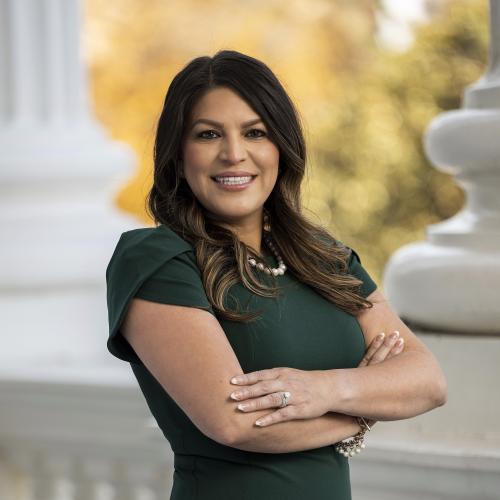
Photo of Esmeralda Soria
D California Assembly · District 27

Asm. Esmeralda Soria

Compare
Total votes
9,034
all sessions
Attendance
93%
572 missed
Near the chamber average
With party
99%
of cast votes
Near the chamber average
Bipartisan score
0%
crosses aisle rarely
Near the chamber average
Sponsored
783
bills & resolutions
Near the chamber average
Committees
12
assignments
783 bills and resolutions

Sponsored bills

Total
783
Primary
78
Co-sponsor
705
This page
783
matching current filters
Co-sponsor ACR 141
Signed into law · California Assembly · Co-sponsor
Relative to Vesak Day.

This measure would recognize the significance of Vesak Day to people of Buddhist faith and extend sincere best wishes to the state's Buddhist community in celebrating Vesak Day.

Signed into law May 18, 2026 1 co-sponsor
Co-sponsor HR 111
Passed · California Assembly · Co-sponsor
Relative to International Day Against Homophobia, Biphobia, Interphobia, and Transphobia.

Maddy summaryThis House Resolution recognizes May 17, 2026, as the International Day Against Homophobia, Biphobia, Interphobia, and Transphobia within the California Legislature. The measure formally acknowledges the ongoing discrimination faced by LGBTQ+ individuals globally and reaffirms the state's commitment to equality and civil rights. By adopting this resolution, the Assembly encourages all Californians to support inclusive practices and stand against hate toward the LGBTQ+ community.

Passed May 18, 2026 1 co-sponsor
Primary AB 2566
In committee · California Assembly · Lead sponsor
Huron Hawk Conservancy.

Existing law authorizes various conservancies to acquire, manage, direct the management of, and conserve lands in the state. This bill, upon appropriation by the Legislature or approval of a general obligation bond, as provided, would establish the Huron Hawk Conservancy within the Natural Resources Agency for specified purposes related to the Huron Hawk area, as defined, including to acquire and manage public lands within the Huron Hawk area and to provide recreational, open space, wildlife habitat restoration and protection, and lands for educational uses within the area. The bill would require the conservancy to be governed by a board of directors composed of designated membership, including certain members appointed by certain local agencies. The bill would set forth the powers, duties, and limitations of the board of directors and the conservancy, as provided. The bill would create the Huron Hawk Conservancy Fund and would make moneys in the fund available for expenditure by the conservancy, upon appropriation by the Legislature, for the purposes of these provisions. The bill would authorize the conservancy to accept revenue generated and contributed to the conservancy by member agencies, as defined, which the bill would require to be deposited into the fund. The bill would also authorize the conservancy to accept revenue, money, grants, goods, and services contributed to the conservancy by a public agency, private entity, or person, and would require the revenue, money, and grants to be deposited into the fund. By imposing new duties on local agencies, this bill would create a state-mandated local program. The California Constitution requires the state to reimburse local agencies and school districts for certain costs mandated by the state. Statutory provisions establish procedures for making that reimbursement. This bill would provide that, if the Commission on State Mandates determines that the bill contains costs mandated by the state, reimbursement for those costs shall be made pursuant to the statutory provisions noted above.

In committee May 14, 2026 0 co-sponsors
Primary AB 2276
In committee · California Assembly · Lead sponsor
Vehicles: active intelligent speed assistance devices.

Existing law requires, until January 1, 2033, a person who has been convicted on or after January 1, 2019, of driving a motor vehicle at any time when that person's driving privilege is suspended or revoked as a result of a conviction for driving while under the influence of an alcoholic beverage or any drug, as specified, to install for a period of time, as ordered by the court, an ignition interlock device (IID) on the vehicle they operate. Existing law specifies periods for which a person convicted of one or more prior violations of specified crimes is required to install an IID. A violation of the Vehicle Code is a crime punishable as an infraction, unless otherwise specified. This bill would require the Department of Motor Vehicles to establish, until January 1, 2033, a pilot program in the Counties of Los Angeles, San Diego, Fresno, Santa Clara, Shasta, Kern, and San Bernardino that would impose a similar requirement for persons convicted of specified driving offenses relating to excessive speed, reckless driving, and exhibitions of speed to install for a period of time, as ordered by the court, a certified active intelligent speed assistance device (ISA) on any vehicle the person operates, as specified. The bill would make the installation of an ISA discretionary for a first offender, as specified. The bill would make tampering with the ISA device, as specified, operating a motor vehicle not equipped with a device, or willfully failing to return the device to the vendor upon completion punishable as a misdemeanor. The bill would impose a fee schedule to be adopted by certified ISA manufacturers and their agents for the ISA and other related costs. The bill would impose specified notice requirements on ISA providers related to the fee schedule and instructions for applying for reduced device costs. The bill would make confidential all documents, records, information, or data maintained by an ISA provider related an offender, as specified. The bill would also require ISA providers to securely maintain all collected data and impose certain data sharing requirements. The bill would make related findings and declarations. By creating new crimes related to the ISA program, this bill would impose a state-mandated local program. The bill would require, by July 1, 2031, the department to report data to the Transportation Agency regarding the implementation and efficacy of the pilot program, as specified, and require the Transportation Agency to report to the Legislature on the outcomes of the pilot program by July 1, 2032. Existing constitutional provisions require that a statute that limits the right of access to the meetings of public bodies or the writings of public officials and agencies be adopted with findings demonstrating the interest protected by the limitation and the need for protecting that interest. This bill would make legislative findings to that effect. The California Constitution requires the state to reimburse local agencies and school districts for certain costs mandated by the state. Statutory provisions establish procedures for making that reimbursement. This bill would provide that no reimbursement is required by this act for a specified reason.


In committee May 14, 2026 0 co-sponsors
Primary AB 2743
In committee · California Assembly · Lead sponsor
Buy California Program: task forces: events drawing significant world attention.

Existing law establishes within the Department of Food and Agriculture a public and private collaboration known as the "Buy California Program" to encourage consumer nutritional food awareness and foster purchases of high-quality California agricultural products. Existing law establishes various marketing advisory and promotional councils or commissions for specific food products in order to, among other things, promote cooperation among the industry and maintain stable agricultural markets. This bill would authorize the Department of Food and Agriculture to establish a task force, comprising members who currently serve on a marketing advisory and promotional council or commission and are appointed by the Secretary of Food and Agriculture, for the purpose of providing the secretary with recommendations regarding how to best use available resources of the Buy California Program to capitalize on marketing possibilities for California agricultural products during a single, specific, and identifiable event drawing significant world attention, as defined.

In committee May 14, 2026 0 co-sponsors
Co-sponsor AB 1823
In committee · California Assembly · Co-sponsor
State government: State Government Strategic Planning and Performance and Review Act: strategic plans: equity.

Existing law creates, within the Government Operations Agency, a Chief Equity Officer, who is appointed by, and serves at the pleasure of, the Governor. Existing law requires the Chief Equity Officer to improve equity and inclusion throughout state government operations and authorizes the Chief Equity Officer to engage with state entities for these purposes. The State Government Strategic Planning and Performance and Review Act requires each agency, department, office, or commission for which strategic planning efforts are recommended, as specified, to develop a strategic plan and to report to the Governor and the Joint Legislative Budget Committee by April 1 each year on the steps being taken to develop and adopt a strategic plan. The act requires the report to include a description of the elements to be included in the strategic plan, the process for developing and adopting the strategic plan, and the timetable for the plan's completion. This bill would additionally require every state agency or department subject to the Governor's authority to take specified actions in regard to any strategic plan to more effectively advance racial equity, as specified, and to undertake a racial equity analysis before implementing any budget or before any regulation takes effect, by the agency's or department's diversity, equity, and inclusion officer or comparable position. If that position does not exist within the agency or department, the bill would require the analysis to be performed by an individual who has demonstrated expertise, and demonstrated satisfaction of appropriate criteria, in specified areas including analyzing, implementing, or developing public policies that impact racial equity.

In committee May 14, 2026 1 co-sponsor
Co-sponsor AB 2082
In committee · California Assembly · Co-sponsor
Rural Farmworker Women's Health Act of 2026.

Existing law requires the State Department of Public Health to develop a coordinated state strategy for addressing the health-related needs of women, as specified. This bill, the Rural Farmworker Women's Health Act of 2026, would require the department to, beginning January 1, 2028, and upon appropriation by the Legislature for this purpose, establish a program to work with local nonprofit organizations who have a history of serving farmworker communities to provide free menstrual products in rural or agricultural communities. The bill would require the department to prioritize those communities with the highest rates of poverty.

In committee May 14, 2026 1 co-sponsor
Co-sponsor HR 95
Passed · California Assembly · Co-sponsor
Relative to National Public Works Week.

Maddy summaryThis bill designates the week of May 17 to May 24, 2026, as National Public Works Week throughout California to honor the contributions of public works professionals. It directly affects engineers, managers, and employees in government and the private sector who maintain essential infrastructure like transportation systems, water supplies, and public buildings. The resolution requests that the Governor issue a proclamation encouraging the public to observe the week with educational programs and activities that highlight the importance of these workers.

Passed May 14, 2026 1 co-sponsor
Primary AB 2581
In committee · California Assembly · Lead sponsor
Housing: affordable housing tenants: home ownership.

Existing law prescribes the general responsibilities and roles of the Department of Housing and Community Development and the California Housing Finance Agency in carrying out state housing policies and programs. Existing law establishes various programs to promote development of affordable housing for tenants and homeowners, including the Multifamily Housing Program, low-income housing tax credits, and the Joe Serna, Jr. Farmworker Housing Grant Program. This bill would, by January 1, 2028, require the department and the agency to develop and implement strategies, as specified, to promote the movement of tenants of deed-restricted affordable housing into home ownership through existing home ownership programs implemented by the department or the agency.

In committee May 14, 2026 0 co-sponsors
Co-sponsor ACR 176
Passed · California Assembly · Co-sponsor
Relative to Second Chance Month.

Maddy summaryThis bill designates April 2026 as Second Chance Month in California to raise awareness about opportunities for individuals reentering society after incarceration. The measure is a ceremonial proclamation that does not alter laws, allocate funding, or change government operations. Its primary purpose is to encourage public recognition of the challenges faced by formerly incarcerated people and to highlight available support resources during that specific month.

Passed May 13, 2026 1 co-sponsor
Showing 111 to 120 of 783 bills
Previous 1 … 11 12 13 … 79 Next