

Existing law establishes, among various other programs intended to address homelessness in this state, the Homeless Housing, Assistance, and Prevention program for the purpose of providing jurisdictions with one-time grant funds to support regional coordination and expand or develop local capacity to address their immediate homelessness challenges informed by a best-practices framework focused on moving homeless individuals and families into permanent housing and supporting the efforts of those individuals and families to maintain their permanent housing. Existing law provides for the allocation of funding under the program among continuums of care, cities, counties, and tribes in 4 rounds, which are to be administered by the Interagency Council on Homelessness. This bill would require applications or planning materials for additional state funding appropriated on or after July 1, 2024, as specified, to include data and a narrative summary of specific and quantifiable steps that the applicant has taken to improve the delivery of housing and services to people experiencing homelessness or at risk of homelessness on transit facilities owned and operated by a transit agency, as defined.
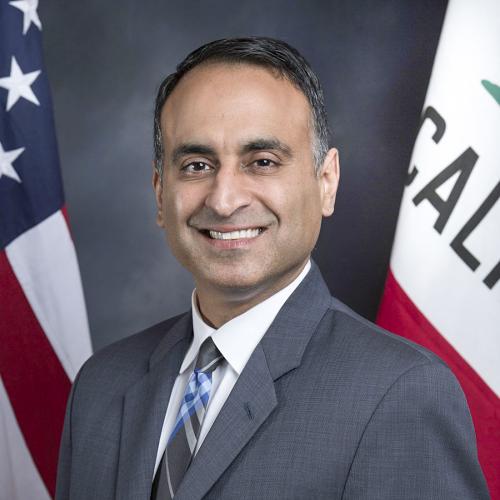
Asm. Ash Kalra
Sponsored bills
Existing law requires each campus of the California Community Colleges and the California State University, and requests each campus of the University of California, to clearly highlight the courses that exclusively use digital course materials, as specified, and clearly communicate to students that the course materials for these courses are free of charge and therefore not required to be purchased. This bill would, commencing July 1, 2024, require each campus of the California Community Colleges and the California State University, and request each campus of the University of California, to prominently display the estimated costs for each course of all required course materials and fees directly related to those materials, for no less than an annually increasing percentage, up to 75% by January 1, 2028, of the total number of courses on the online campus course schedule for which a faculty member or course instructor has been assigned. The bill would define, for purposes of this requirement, "course materials" to include digital or physical textbooks, devices such as calculators and remote attendance platforms, and software subscriptions. By imposing new duties on community college districts, the bill would impose a state-mandated local program. The California Constitution requires the state to reimburse local agencies and school districts for certain costs mandated by the state. Statutory provisions establish procedures for making that reimbursement. This bill would provide that, if the Commission on State Mandates determines that the bill contains costs mandated by the state, reimbursement for those costs shall be made pursuant to the statutory provisions noted above.
(1) Existing law establishes the Department of Industrial Relations in the Labor and Workforce Development Agency, administered by the Director of Industrial Relations, and vests it with various powers and duties to foster, promote, and develop the welfare of the wage earners of California, to improve their working conditions, and to advance their opportunities for profitable employment. Existing law establishes within the department, among other entities, the Division of Labor Standards Enforcement, the Division of Workers' Compensation, and the Division of Occupational Safety and Health, with enforcement duties and powers, as prescribed. Existing law authorizes the Division of Labor Standards Enforcement, the head of which is the Labor Commissioner, to enforce the Labor Code and all labor laws of the state the enforcement of which is not specifically vested in any other officer, board, or commission. Existing law relating to payment of wages for general occupations provides that nothing in those provisions limits the authority of the district attorney of any county or prosecuting attorney of any city to prosecute actions, either civil or criminal, for violations or to enforce those provisions independently and without specific direction of the Division of Labor Standards Enforcement. This bill, until January 1, 2029, would authorize a public prosecutor, as defined, to prosecute an action, either civil or criminal, for a violation of specified provisions of the Labor Code or to enforce those provisions independently. The bill would require moneys recovered by public prosecutors under the Labor Code to be applied first to payments due to affected workers. The bill would also require all civil penalties recovered pursuant to those provisions to be paid to the General Fund of the state, unless otherwise specified. The bill, except as specified, would limit the action of a public prosecutor under the bill to redressing violations occurring within the public prosecutor's geographic jurisdiction. The bill would authorize a public prosecutor, in addition to any other remedies available, to seek injunctive relief to prevent continued violations. This bill would provide that, in any action initiated by a public prosecutor or the Labor Commissioner to enforce the Labor Code, any individual agreement between a worker and employer that purports to limit representative actions or to mandate private arbitration shall have no effect on the authority of the public prosecutor or the Labor Commissioner to enforce the code. The bill would further provide that any subsequent appeal of the denial of any motion or other court filing to impose such restrictions on a public prosecutor, a division, or the Department of Justice shall not stay the trial court proceedings, notwithstanding specified law. (2) Existing law prohibits any person or employer from engaging in willful misclassification, as defined, of an individual as an independent contractor instead of an employee and in specified acts relating to the misclassified individual's compensation. Existing law, if the Labor and Workforce Development Agency or a court makes one of several prescribed determinations regarding the violation of those prohibitions, subjects the violator to specified civil penalties. Existing law also authorizes the Labor Commissioner to determine such a violation through investigation and informal hearing and, on making that determination, to issue a citation to assess those civil penalties pursuant to prescribed procedures for issuing, contesting, and enforcing judgments. This bill would authorize the Labor Commissioner or a public prosecutor, as defined, to enforce these willful misclassification provisions through specified methods, including by investigating an alleged violation, ordering temporary relief, issuance of a citation, and filing a civil action. The bill would also permit specified employees, the Labor Commissioner, or a public prosecutor to alternatively recover certain penalties as damages payable to the employee.
Existing law prescribes periods for commencement of various actions. Among others, an action upon book account must be commenced within 4 years of the date of the last item on the account, as specified. Existing law defines "book account" for these purposes as a detailed statement constituting the principal record of transactions between a debtor and a creditor. This bill would exclude consumer debt from the definition of "book account." The bill would define consumer debt to mean any obligation or alleged obligation, incurred on or after July 1, 2024, of a consumer to pay money arising out of a transaction in which the money, property, insurance, or services that are the subject of the transaction are primarily for personal, family, or household purposes and where the obligation to pay appears on the face of a note or written contract. Existing law permits actions to recover money damages. Under existing case law, courts recognize that common counts may be used to do so as a simplified form of pleading to assert the existence of various forms of monetary indebtedness. This bill would prohibit the use of common counts, as defined, to recover consumer debt, as defined.
Existing provisions of the California Constitution provide that the University of California constitutes a public trust and require the university to be administered by the Regents of the University of California (regents) , a corporation in the form of a board, with full powers of organization and government, subject to legislative control only for specified purposes, including any competitive bidding procedures as may be applicable to the university by statute for specified purposes, including the purchasing of materials, goods, and services. Existing law requires the regents, except as provided, to let all contracts involving an expenditure of $100,000 or more annually for goods and materials or services, excepting personal or professional services, to the lowest responsible bidder meeting certain specifications, or to reject all bids. Existing policy of the regents establishes a general prohibition on contracting out for services and functions that can be performed by university staff, with certain exceptions, establishes employment standards for contract employees, and provides for the conversion of contract employees to university employment under prescribed circumstances. This bill would make it unlawful for any vendor, as defined, to accept payment from the university pursuant to a contract for prescribed services if the vendor is performing services or supplying the university with employees to perform services who are paid less than the higher of the total compensation rate specified in the vendor's contract with the university or as required by university policy. The bill would require a vendor to provide those employees with prescribed written notice relating to compensation. The bill would require a vendor, twice yearly, to provide basic payroll information, as defined, to the university and members of any joint labor-management committee, as defined. The bill would also require a vendor to provide specified additional written notice, including specific text, relating to the release of basic payroll information, to all employees who agree to perform services for the university or continue doing so. The bill would also require basic payroll information for an individual employee who performs services for the university, on request, to be made available for inspection by that individual employee or that individual employee's authorized representative or to be furnished to that individual employee or that individual employee's authorized representative. The bill would require an auditor, vendor, the university, or any other person who conducts or receives an audit or other finding with regard to whether a vendor has compensated employees at the total compensation rate required by the vendor's contract with the university or university policy to provide that audit or other finding to the university and members of any joint labor-management committee. This bill would authorize an aggrieved employee, as defined, to bring a civil action against a vendor if an aggrieved employee first provides a vendor with written notice of an alleged violation of these provisions, as specified, and provides the vendor the opportunity to correct and cure the violation and the vendor fails to provide prescribed documentation. The bill would require a vendor who receives written notice from an aggrieved employee to provide a copy of that notice to the president of the university within 5 business days. The bill would establish remedies, including penalties and restitution, for prevailing claimants. The bill would require a prevailing claimant to notify the president of the university of the decision. The bill would make its provisions severable.
Existing law requires an employer to provide an employee, at the time of hiring, a written notice including specified information in the language that the employer normally uses to communicate employment-related information to the employee. Existing law requires the Labor Commissioner to prepare a template that includes the information and to make the template available to employers in a manner as determined by the commissioner. This bill would require an employer to include in the written notice information regarding the existence of a federal or state disaster declaration applicable to the county or counties in which the employee will be employed, as specified. This bill would require an employer, beginning on March 15, 2024, to give an employee admitted pursuant to the federal H-2A agricultural visa, on the day that the H-2A employee begins work for the employer in the state or on the first day that the employee begins work for another H-2A employer, additional information in a separate and distinct section of the notice described above, in Spanish, and, if requested by the employee, in English, describing an agricultural employee's additional rights and protection under California law, as specified. The bill would provide employers who employ both H-2A and non-H-2A employees with the option to provide the notice to non-H-2A employees in English or Spanish, at the employee's request, or in the language that the employer normally uses to communicate employment-related information to non-H-2A employees. The bill would require the Labor Commissioner to create a template for the notice that complies with this requirement and to post the template on its internet website commencing March 1, 2024. Existing law specifies that for purposes of these provisions, the term "employee" does not include, among other persons, an employee who is covered by a valid collective bargaining agreement if the agreement expressly provides for the wages, hours of work, and working conditions of the employee, and if the agreement provides premium wage rates for all overtime hours worked and a regular hourly rate wage. This bill would, in addition, exclude an H-2A employee from the definition of "employee" if they are covered by an agreement that provides for wage rates of not less than the federal H-2A program wage required to be paid during the contract period.
Existing law prohibits the sale and distribution of certain consumer products that include chemicals such as phthalates, polybrominated diphenyl ether, and perfluoroalkyl and polyfluoroalkyl substances. Existing law prohibits the sale of certain products to persons under 21 years of age, such as alcohol and tobacco, among others. Existing law, the California Age-Appropriate Design Code Act, requires, beginning July 1, 2024, a business that provides an online service, product, or feature likely to be accessed by children to comply with specified requirements. On or after July 1, 2024, this bill, to be known as Tyler's Law, would prohibit a person, retailer, or online marketplace from selling sodium nitrite to a person under 18 years of age and sodium nitrite in concentrations greater than 10% to a person 18 years of age or older. The bill would establish a defense to the former prohibition if the purchaser acknowledged before purchase they were at least 18 years of age through an effective system, as specified, and the person, retailer, or online marketplace took all reasonable precautions and exercised due diligence to ensure the product would be sold and delivered to a person at least 18 years of age, or the purchaser acknowledged before purchase they were at least 18 years of age and the person, retailer, or online marketplace complies with the requirements of the California Age-Appropriate Design Code Act. The bill would exclude from these provisions the sale of sodium nitrite to a business.
Existing law establishes various holidays in this state, including Lunar New Year. Existing law requires community colleges to close on specified holidays, including February 12, known as "Lincoln Day," and the third Monday in February, known as "Washington Day." Existing law entitles certain community college employees to be given time off with pay for specified holidays, including for Lincoln Day and Washington Day. This bill would authorize the governing board of a community college district, pursuant to a memorandum of understanding, to replace closing on Lincoln Day or Washington Day with the date corresponding with the second new moon following the winter solstice, or the third new moon following the winter solstice should an intercalary month intervene, known as "Lunar New Year." The bill would require that certain community college employees, in lieu of a paid holiday for Lincoln Day or Washington Day, receive a paid holiday for the Lunar New Year if the governing board of the community college replaces closing on Lincoln Day or Washington Day with closing on Lunar New Year.
Existing law creates various transit districts and prescribes requirements applicable to their labor relations, including those that address the recognition and certification of exclusive employee representatives, unit determinations, and procedures for meeting and conferring on matters subject to collective bargaining. Existing law establishes the Public Employment Relations Board (PERB) in state government as a means of resolving disputes and enforcing the statutory duties and rights of specified public employers and employees under various acts regulating collective bargaining. Existing law includes within PERB's jurisdiction the resolution of disputes alleging violation of rules and regulations adopted by a public agency, as defined, concerning unit determinations, representations, recognition, and elections, as specified. Existing law authorizes PERB to adopt rules and regulations to carry out its purposes, as provided. Existing law does not apply the above provisions to employees of specified public transit agencies. This bill would require a public transit employer, at least 10 months before beginning a procurement process to acquire or deploy any autonomous transit vehicle technology for public transit services that would eliminate job functions or jobs of a workforce, to provide written notice to the exclusive employee representative of the workforce affected by the autonomous transit vehicle technology of its determination to begin that procurement process. The bill would require the public transit employer and exclusive employee representative, upon written request by the exclusive employee representative, to commence collective bargaining within a specified time period on certain subjects, including creating plans to train and prepare the affected workforce to fill new positions created by the autonomous transit vehicle technology. The bill would vest PERB with jurisdiction to process unfair practice charges alleging violations of these provisions, but only as to transit district employers where PERB has jurisdiction to process unfair practice charges. Should an employee organization file an unfair practice charge with PERB, the bill would require PERB's powers and duties to apply, as appropriate, and would require PERB's regulations to apply. The bill would authorize PERB to make additional emergency regulations, as specified.
Existing law prohibits the state from seeking a criminal conviction or sentence on the basis of race, ethnicity, or national origin. Existing law authorizes a defendant to file a motion in the trial court or, if judgment has been imposed, to file a petition for writ of habeas corpus to allege a violation of this prohibition. This bill would additionally authorize a defendant in specified circumstances to raise a claim alleging a violation of this prohibition on direct appeal from the conviction or sentence. The bill would authorize the defendant to move to stay the appeal and request remand to the superior court to file a motion.