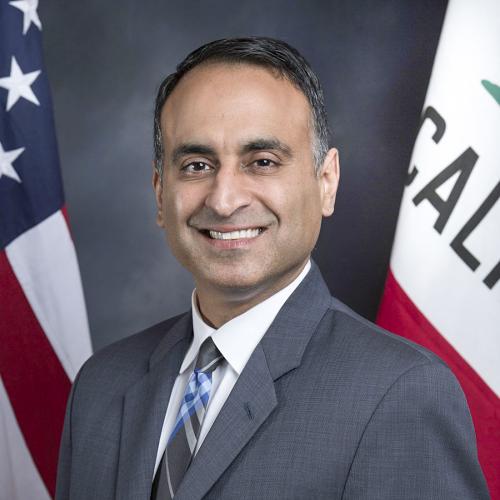
Photo of Ash Kalra
D California Assembly · District 25 On the 2026 ballot

Asm. Ash Kalra

Compare
Total votes
23,603
all sessions
Attendance
97%
541 missed
Near the chamber average
With party
99%
of cast votes
Near the chamber average
Bipartisan score
0%
crosses aisle rarely
Near the chamber average
Sponsored
2,377
bills & resolutions
Higher than 97% of chamber peers
Committees
12
assignments
2,377 bills and resolutions

Sponsored bills

Total
2,377
Primary
290
Co-sponsor
2,087
This page
2,377
matching current filters
Co-sponsor HR 70
Passed · California Assembly · Co-sponsor
Relative to Direct Support Professional Recognition Week.

Maddy summaryThis is a symbolic resolution, not a substantive bill. It designates September 7-13, 2025, as "Direct Support Professional Recognition Week" in California. The resolution acknowledges direct support professionals who assist Californians with intellectual and developmental disabilities (IDD) through the state's Lanterman Act system, which serves over 450,000 residents. It formally recognizes their role in enabling community inclusion and independence but does not create new policies, funding, or legal obligations.

Passed Sep 4, 2025 1 co-sponsor
Co-sponsor HR 71
Passed · California Assembly · Co-sponsor
Relative to National Fried Rice Day.

Maddy summaryThis symbolic resolution recognizes September 20, 2025, as National Fried Rice Day in California, highlighting the dish's cultural significance to Asian American communities and its connection to California's rice-growing economy (noting the state's status as the second-largest rice producer). It has no legal effect or policy changes - it serves solely to celebrate culinary traditions and community diversity. The resolution was adopted by the California Assembly with no opposing votes.

Passed Sep 4, 2025 1 co-sponsor
Co-sponsor AB 1229
Passed · California Assembly · Co-sponsor
Adult Reentry Grant Program.

The Budget Act of 2018 appropriated $50,000,000 to the Board of State and Community Corrections for a grant program, known as the Adult Reentry Grant Program, for the purpose of awarding competitive grants to community based organizations to support offenders formerly incarcerated in state prison. The Budget Act of 2018 allocated a specified amount of those funds for, among other things, rental assistance, rehabilitation of existing property or buildings, and to support the warm hand-off and reentry of offenders transitioning from prison to communities. Subsequent budget acts have continued to fund the program. This bill, instead, commencing July 1, 2026, and upon appropriation of funds, would transfer the administration of the grant program to the Department of Housing and Community Development. The bill would require the department, on or before December 1, 2026, to modify the grant program to provide 5-year renewable grants to geographically diverse regional administrators responsible for funding permanent supportive housing and reentry services for eligible people, as specified. The bill would require the department to issue proposed guidelines or a draft notice, as specified, establishing the grant program and require the department to competitively score applicants applying for grant funds as regional administrators. The bill would require the department to work collaboratively with the State Department of Health Care Services, Department of Corrections and Rehabilitation, and homeless continuums of care, and seek to work collaboratively with county probation departments, to establish a process for referrals of people eligible to participate in the program, as specified. The bill would also require the department to establish specified benchmarks to promote and track ideal outcomes from the program. This bill would require the department to distribute program funds by executing contracts with awarded regional administrators and would impose certain requirements on those regional administrators. The bill would prescribe eligibility requirements for a person scheduled for release from, or who has been be formerly incarcerated in, state prison, to participate in the program. The bill would require program funds to be used for specified purposes, including specified administrative fees, permanent housing, rental and operating subsidies, incentives to landlords, and voluntary multidisciplinary services, as specified. The bill would require the department, upon implementation of the program, to design an evaluation and hire an independent evaluator to assess outcomes from the program, and would require the evaluation to be submitted to specified committees of the Legislature. This bill would require the board to continue to oversee and administer existing program grants that have not yet expired, using resources allocated to the board through funds allocated by the Budget Act of 2025. This bill would require the Department of Corrections and Rehabilitation to establish a process to engage an individual scheduled for discharge, within at least 210 days of the scheduled release date, for the purpose of assessing the individual's risk of homelessness upon discharge, as specified.

Passed Sep 3, 2025 1 co-sponsor
Co-sponsor AB 1234
Passed · California Assembly · Co-sponsor
Employment: nonpayment of wages: complaints.

Existing law authorizes the Labor Commissioner to investigate employee complaints and to provide for a hearing in any action to recover wages, penalties, and other demands for compensation. Existing law requires the Labor Commissioner to determine all matters arising under the commissioner's jurisdiction. Existing law makes any employer or other person acting on behalf of an employer who violates or causes to be violated specified provisions regulating hours and days of work in any order of the Industrial Welfare Commission to be subject to a civil penalty, as specified. This bill would revise and recast the provisions relating to the process for the Labor Commissioner to investigate, hold a hearing, and make determinations relating to an employee's complaint. The bill would set forth timelines for the Labor Commissioner to notify parties of an employee complaint, as provided, and for the defendant to respond, as provided. The bill would require the Labor Commissioner, if the Labor Commissioner determines to prosecute the action or that no action will be taken, to notify the parties within 30 days of receipt of the defendant's answer. If the Labor Commissioner does not make either of those determinations, the bill would require the Labor Commissioner, within 90 days of receipt of the defendant's answer, to conduct an investigation of the employee complaint, make an estimated appraisal of the amount of wages, damages, penalties, expenses, and other compensation owed, and to determine all the parties liable for the assessment. The bill would set forth a process for the Labor Commissioner's investigation, assessment, and determination, including authorizing the Labor Commissioner to issue a subpoena for records and requiring the Labor Commissioner to issue a formal complaint. This bill would require the Labor Commissioner, within 90 days of the issuance of the formal complaint, to set a hearing date and would set forth procedures for the hearing. The bill would require the Labor Commissioner, within 15 days of the hearing, or upon a failure of the defendant to answer or appear, to file in the office of the Division of Labor Standards Enforcement a copy of the order, decision, or award. This bill would authorize the Labor Commissioner, in an order, decision, or award granted pursuant to specified provisions to impose an administrative fee of up to 30% of the award, as provided. The bill would require the administrative fee to be deposited into the Wage Recovery Fund, which would be created by the bill. The bill would require the money in the fund, upon appropriation, to be disbursed by the Labor Commissioner only to persons determined by the Labor Commissioner to have been damaged by the failure to pay wages and penalties and for other damages by an employer. The bill would require a disbursement to be made pursuant to a claim for recovery from the fund in accordance with procedures prescribed by the Labor Commissioner and would require any disbursed funds subsequently recovered by the Labor Commissioner from a liable party, as provided, to be returned to the fund. The bill would require the Labor Commissioner to waive any or all of the administrative fee upon request by a defendant, if specified conditions are met. This bill would classify an appeal filed in a superior court relating to the Labor Commissioner's order, decision, or award as an unlimited civil case. The bill would grant a court hearing the action jurisdiction over the entire wage dispute, including related wage claims not raised in front of the Labor Commissioner, but would prohibit the court from consolidating the action with any other actions not arising out of, or related to, the underlying order, decision, or award, absent an executed agreement in writing by all parties.


Passed Sep 3, 2025 1 co-sponsor
Co-sponsor HR 65
Passed · California Assembly · Co-sponsor
Relative to Filipino American History Month.

Maddy summaryThis House Resolution designates a month as Filipino American History Month in California. It recognizes the historical contributions of Filipino Americans to the state, including early settlement (dating to 1587), agricultural labor, community building (such as "Little Manila" in Stockton), and military service during World War II. As a symbolic resolution, it does not create new laws, policies, or direct effects on any specific group.

Passed Sep 2, 2025 1 co-sponsor
Co-sponsor SB 442
Passed · California Senate · Co-sponsor
Grocery retail store and retail drug establishment employees: self-service checkout.

Existing law imposes certain requirements on grocery employers, as defined, upon the purchase or change in control of a grocery establishment, including requiring a successor grocery employer to retain eligible grocery workers for a specified period after transfer of the grocery establishment. This bill would prohibit a grocery retail store or a retail drug establishment, as those terms are defined, from providing a self-service checkout option for customers unless specified conditions are satisfied, including having at least one manual checkout station staffed by an employee who is available to any given customer at the time that a self-service checkout option is made available to that customer. This bill would require a grocery retail store or retail drug establishment that offers self-service checkout to include self-service checkout in the employer's illness and prevention program, as required by regulations of the Division of Occupational Safety and Health. The bill also would require a grocery retail store or retail drug establishment that intends to implement self-checkout to notify workers and their collective bargaining representatives at least 60 days in advance of the implementation, as specified. The bill would not preempt any city, county, or city and county ordinance that provides equal or greater protection to workers. This bill would make an employer who violates the bill's provisions subject to a civil penalty of $1,000 per violation per day, not to exceed an aggregate penalty of $200,000.

Passed Aug 29, 2025 1 co-sponsor
Co-sponsor SB 550
Passed · California Senate · Co-sponsor
California State University, San Jose: legal partnership pilot program.

The Donahoe Higher Education Act establishes the segments of postsecondary education in the state, including the University of California and the California State University, and sets forth the missions and functions of those segments. Existing law states that the University of California has exclusive jurisdiction in public higher education over, among others, instruction in the profession of law. This bill would authorize the Trustees of the California State University to establish a legal education pilot program, consisting of the California State University, San Jose, and a law school accredited by the Committee of Bar Examiners of the State Bar of California as an independent nonprofit institution, to operate for a period of 6 academic years. The bill would require the legal education pilot program to commence only if the trustees approve the program, the governing board of the law school approves the program, and the law school has been continuously accredited for a minimum of 5 years before the first cohort graduates from a joint degree program. The bill would authorize the California State University, San Jose, as part of the legal education pilot program, to partner with the nonprofit law school to jointly award a juris doctor degree and to jointly provide certificate and legal education programs at the undergraduate level. The bill would require the California State University, San Jose, and the nonprofit law school to submit certain information, including an administrative plan and enrollment projections, to the trustees and the governing board of the law school before the trustees and governing board vote to approve the pilot program. The bill would require the Legislative Analyst's Office to conduct an interim evaluation and a final evaluation of the program, as provided. This bill would make these provisions inoperative on July 1, 2041, and would repeal it as of January 1, 2042. This bill would make legislative findings and declarations as to the necessity of a special statute for the California State University, San Jose.

Passed Aug 29, 2025 1 co-sponsor
Primary AB 1109
Passed · California Assembly · Lead sponsor
Evidentiary privileges: union agent-represented worker privilege.

Existing law governs the admissibility of evidence in court proceedings and generally provides a privilege as to communications made in the course of certain relations, including the attorney-client, physician-patient, and psychotherapist-patient relationship, as specified. Under existing law, the right of any person to claim those evidentiary privileges is waived with respect to a communication protected by the privilege if any holder of the privilege, without coercion, has disclosed a significant part of the communication or has consented to a disclosure. This bill would establish a privilege between a union agent, as defined, and a represented employee or represented former employee to refuse to disclose any confidential communication between the employee or former employee and the union agent made while the union agent was acting in the union agent's representative capacity, except as specified. The bill would permit a represented employee or represented former employee to prevent another person from disclosing a privileged communication, except as specified. The bill would further provide that this privilege may be waived in accordance with existing law and does not apply in criminal proceedings.

Passed Aug 29, 2025 0 co-sponsors
Co-sponsor AB 485
Passed · California Assembly · Co-sponsor
Labor Commissioner: unsatisfied judgments: nonpayment of wages.

Existing law establishes the Division of Labor Standards Enforcement, under the direction of the Labor Commissioner, within the Department of Industrial Relations and sets forth its powers and duties regarding the enforcement of labor laws. Existing law authorizes the Labor Commissioner to investigate employee complaints and to take various actions against an employer with respect to unpaid wages. Existing law generally prohibits an employer with an unsatisfied final judgment for nonpayment of wages from continuing to conduct business in California, unless that employer has obtained a bond from a surety company and filed that bond with the Labor Commissioner, as prescribed. Under existing law, if an employer in the long-term care industry that is also required to obtain a license from the State Department of Public Health or the State Department of Social Services has violated the above provision governing unsatisfied judgments (unsatisfied judgment provision) , either of those departments may deny a new license or the renewal of an existing license for that employer. Existing law further requires the Labor Commissioner, upon finding that an employer in the long-term care industry is violating the unsatisfied judgment provision, to notify those departments. This bill would repeal the above-described provision applicable to employers in the long-term care industry. The bill would require a state agency, if an employer that is required to obtain a license or permit from that state agency is found to have violated the unsatisfied judgment provision, to deny a new license or permit or the renewal of an existing license or permit for that employer. The bill would also require the Labor Commissioner, upon finding that an employer is conducting business in violation of that provision, to notify the applicable state agency with jurisdiction over that employee's license or permit. The bill would additionally permit the State Public Health Officer to exempt a hospital employer from the bill's requirements upon a determination that a denial, suspension, or revocation of the hospital's license, permit, or renewal could have imminent or substantial adverse effects upon public health or safety or would violate constitutional law.

Passed Aug 29, 2025 1 co-sponsor
Primary AB 347
Passed · California Assembly · Lead sponsor
Pupil instruction: animal dissection.

Existing law authorizes a pupil with a moral objection to dissecting or otherwise harming or destroying an animal to refrain from participation in an educational project that involves the harmful or destructive use of animals. Existing law authorizes, if the pupil chooses to refrain and a teacher believes that an adequate alternative education project is possible, the teacher to work with the pupil to develop and agree upon an alternative education project in order to obtain the knowledge, information, or experience required by the course of study in question. Existing law requires each teacher teaching a course that uses live or dead animals or animal parts to inform the pupils of their rights pursuant to these provisions. Existing law applies these provisions to all levels of instruction in all public schools operating programs in kindergarten and grades 1 to 12, inclusive. Existing law requires the Superintendent of Public Instruction to establish and implement a system of complaint processing, known as the Uniform Complaint Procedures, for specified educational programs. This bill, commencing July 1, 2026, if a pupil chooses to refrain from participation in an assignment or assessment involving the dissection of animals, would require a teacher to provide an alternative assignment or assessment. The bill would prohibit a pupil's grades from being impacted as a means of penalizing the pupil for exercising their rights concerning the dissection of animals. The bill would require a teacher to provide, at a pupil's request, any sourcing information provided by the vendor or provider of the animals and information about the chemicals used to preserve the animals for dissection to which the pupil may be exposed. The bill would require a teacher, or a public school on behalf of the teacher, to provide written notice of the pupils' rights that includes specified information, including, among other things, the above-described rights and the complaint procedures described below. The bill would require, by the start of the 2026–27 school year, the State Department of Education to develop a template that a teacher, or a public school on behalf of the teacher, would be authorized to use to provide this written notice and to make the template available on its internet website. The bill would apply the above-described provisions to all public schools operating programs in kindergarten or any of grades 1 to 12, inclusive, including, but not limited to, public schools operated by school districts, county offices of education, charter schools, or state special schools, to the extent that the public school chooses to offer a course of study that uses live or dead animals or animal parts for purposes of dissection. The bill would encourage, by July 1, 2028, public schools to explore using effective alternative methods in lieu of using live or dead animals or animal parts for dissection in a course of study, except as provided. The bill would require, commencing July 1, 2026, the Uniform Complaint Procedures to apply to pupils' rights to refrain from participation in an assignment or assessment involving the dissection of animals and to choose an alternative assignment or assessment.

Passed Aug 29, 2025 0 co-sponsors
Showing 361 to 370 of 2,377 bills
Previous 1 … 36 37 38 … 238 Next