

The California Uniform Controlled Substances Act classifies controlled substances into 5 designated schedules, and places cannabis and cannabis products under Schedule I. The act prohibits prescribing, administering, dispensing, or furnishing a controlled substance to or for any person or animal, unless otherwise specified. The Veterinary Medicine Practice Act provides for the licensure and regulation of veterinarians and the practice of veterinary medicine by the Veterinary Medical Board, which is within the Department of Consumer Affairs. The act authorizes the board to revoke or suspend the license of a person to practice veterinary medicine, or to assess a fine, for specified causes, including violating a statute related to controlled substances. The act also makes a violation of its provisions a misdemeanor. This bill would authorize the board to revoke or suspend a veterinarian license, or to assess a fine, for accepting, soliciting, or offering any form of remuneration from or to a Medicinal and Adult-Use Cannabis Regulation and Safety Act (MAUCRSA) licensee if the veterinarian or his or her immediate family has a financial interest, as defined, with the MAUCRSA licensee. The bill would authorize the board to revoke or suspend a veterinarian license, or to assess a fine, for discussing medicinal cannabis with a client while the veterinarian is employed by, or has an agreement with, a MAUCRSA licensee. The bill would authorize the board to revoke or suspend a license, or to assess a fine, for distributing any form of advertising for cannabis in California. The bill would prohibit a licensed veterinarian from dispensing or administering cannabis or cannabis products to an animal patient. Because a violation of the Veterinary Medicine Practice Act's provisions is a crime, the bill would expand the scope of that crime, thereby imposing a state-mandated local program. The bill would also prohibit the Veterinary Medical Board from disciplining, or denying, revoking, or suspending the license of, a licensed veterinarian solely for discussing the use of cannabis on an animal for medicinal purposes, absent negligence or incompetence. The bill would require the board to adopt guidelines for these discussions on or before January 1, 2020, and would require the board to post the guidelines on its Internet Web site. The California Constitution requires the state to reimburse local agencies and school districts for certain costs mandated by the state. Statutory provisions establish procedures for making that reimbursement. This bill would provide that no reimbursement is required by this act for a specified reason.
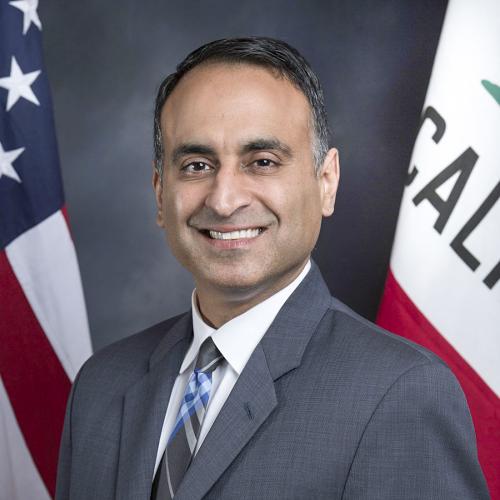
Asm. Ash Kalra
Sponsored bills
Existing law requires specified businesses and other establishments, including, among others, airports, intercity passenger rail or light rail stations, bus stations, and truck stops, to post a notice, as developed by the Department of Justice, that contains information relating to slavery and human trafficking, including information regarding specified nonprofit organizations that a person can call for services or support in the elimination of slavery and human trafficking. Existing law makes a business or establishment that fails to comply with the requirements of these provisions liable for a civil penalty of $500 for a first offense, and $1,000 for each subsequent offense. This bill would require, on or before January 1, 2021, specified businesses or other establishments that operate an intercity passenger rail, light rail, or bus station to provide training to new and existing employees who may interact with, or come into contact with, a victim of human trafficking or who are likely to receive, in the course of their employment, a report from another employee about suspected human trafficking, in recognizing the signs of human trafficking and how to report those signs to the appropriate law enforcement agency, as specified. Because the bill would require local government agencies to perform additional duties, it would impose a state-mandated local program. The California Constitution requires the state to reimburse local agencies and school districts for certain costs mandated by the state. Statutory provisions establish procedures for making that reimbursement. This bill would provide that, if the Commission on State Mandates determines that the bill contains costs mandated by the state, reimbursement for those costs shall be made pursuant to the statutory provisions noted above.
Existing law requires the Department of Industrial Relations, by interagency agreement with the State Department of Public Health, to establish a repository of current data on toxic materials and harmful physical agents in use or potentially in use in places of employment in the state. That repository is known as the Hazard Evaluation System and Information Service (HESIS) . Existing law requires the HESIS, among other things, to provide information and collect and evaluate data relating to possible hazards to employees resulting from exposure to toxic materials or harmful physical agents. Existing law establishes the Division of Occupational Safety and Health within the Department of Industrial Relations and requires the division to, among other things, monitor, analyze, and propose health and safety standards for workers. This bill would require the State Department of Public Health to consider a report from a laboratory of an employee's blood lead level at or above 25 micrograms per deciliter to be injurious to the health of the employee and to report that case within 5 business days to the Division of Occupational Safety and Health. The bill would further require that the above-described report constitute a serious violation and would subject the employer or place of employment to an investigation, as provided, by the division, and would require the division to make any citations or fines imposed as a result of the investigation publicly available on an annual basis.
Existing law prohibits specified conduct inside public buildings owned and occupied, or leased and occupied, by the state. Existing law provides that a judicial officer has the power to preserve and enforce order in judicial proceedings and to compel obedience to judicial orders, as specified. This bill would clarify the power of judicial officers to prevent activities that threaten access to courthouses, including by protecting the privilege from arrest. The bill would provide that no person shall be subject to civil arrest in a courthouse while attending a court proceeding or having legal business in the courthouse, and that a violation of these provisions constitutes contempt of court. The bill would also authorize the Attorney General to bring a civil action to obtain equitable and declaratory relief for a violation of this section, and it would allow a party in a successful action to enforce liability for a violation of this section to recover court costs and reasonable attorney's fees. By expanding the scope of an existing crime, this bill would impose a state-mandated local program. The California Constitution requires the state to reimburse local agencies and school districts for certain costs mandated by the state. Statutory provisions establish procedures for making that reimbursement. This bill would provide that no reimbursement is required by this act for a specified reason.
The California Constitution requires members of the retirement board of a public pension or retirement system to discharge their duties with respect to the system solely in the interest of, and for the exclusive purposes of providing benefits to, participants and their beneficiaries, minimizing employer contributions thereto, and defraying reasonable expenses of administering the system. Existing statutory law establishes various public employee retirement systems and provides for the administration of the State Teachers' Retirement System by the Teachers' Retirement Board and for the administration of the Public Employees' Retirement System, among other public employee retirement systems, by the Board of Administration of the Public Employees' Retirement System. This bill would, until January 31, 2035, require climate-related financial risk, as defined, to be analyzed to the extent the boards identify the risk as a material risk to the Public Employees' Retirement Fund or the Teachers' Retirement Fund. The bill, by January 1, 2020, and every 3 years thereafter, would require each board to publicly report on the climate-related financial risk of its public market portfolio, including alignment of the Public Employees' Retirement Fund and the Teachers' Retirement Fund with a specified climate agreement and California climate policy goals and the exposure of the fund to long-term risks, as specified. The bill would provide that it does not require either board to take action unless the board determines in good faith that the action is consistent with its fiduciary responsibilities. The bill would make related legislative findings and declarations.
Existing law establishes the Department of Industrial Relations and creates the Division of Labor Standards Enforcement within it. Existing law commits to the division the general responsibility for enforcing provisions of the Labor Code not specifically vested in any other officer, board, or commission, which includes a variety of provisions relating to wages and hours of employment. This bill would require the Division of Labor Standards Enforcement, upon appropriation of funds by the Legislature, to establish and maintain a Domestic Work Enforcement Pilot Program in collaboration with qualified organizations, as defined. The bill would require the program to increase the capacity and expertise of the division to improve education and enforcement of labor standards in the domestic work industry. Among other things, the program would be required to address the education of employees and employers regarding minimum wage, overtime, sick leave, recordkeeping, retaliation, and wage adjudication. The bill would require qualified organizations that collaborate with the division in connection with the program to issue reports and meet quarterly with the division to review the implementation and success of the program.
Existing law requires the adopted course of study for grades 1 to 12, inclusive, to include, among other subjects, the social sciences. Existing law encourages instruction in the area of social sciences for grades 7 to 12, inclusive, that may include instruction on the Vietnam War, including a component drawn from personal testimony of Southeast Asians who were involved in the Vietnam War and men and women who contributed to the war effort on the homefront, as specified. Existing law requires the State Board of Education, with the assistance of the Superintendent of Public Instruction, to establish a list of textbooks and other instructional materials that highlight the contributions of minorities in the development of California and the United States. Existing law establishes the Instructional Quality Commission and requires the commission to, among other things, recommend curriculum frameworks to the state board. This bill would require the commission to develop and submit to the state board, on or before December 31, 2022, and the state board to adopt, modify, or revise, on or before March 31, 2023, a model curriculum relative to the Vietnamese American refugee experience and a model curriculum relative to the Cambodian genocide, as specified, for use in elementary schools, middle schools, and high schools. The bill would encourage a school district, charter school, or county office of education that maintains kindergarten or any of grades 1 to 12, inclusive, that does not otherwise offer a standards-based curriculum relative to the Vietnamese American refugee experience, Vietnamese boat people, and the Republic of Vietnam Armed Forces, or that does not otherwise offer a standards-based curriculum relative to the Cambodian genocide, to offer a course of study based on the respective model curriculum. The bill would require the model curricula to be developed with participation from specified entities and individuals. The bill would provide that implementation of its provisions is subject to the receipt of grants, donations, or other financial support from private or public sources for its purposes, including, but not limited to, an appropriation in the annual Budget Act or another statute. The bill would require the commission to develop a model curriculum in Hmong history and cultural studies, as provided. The bill would require the commission, on or before December 31, 2022, to submit the model curriculum to the state board for adoption, and would require the state board to adopt, modify, or reject the model curriculum on or before March 31, 2023. The bill would require the Superintendent, following the adoption of the model curriculum, to post the model curriculum on the State Department of Education's Internet Web site for use on a voluntary basis by educators. The bill, beginning in the school year following the adoption of the model curriculum, would encourage local educational agencies, as defined, to use the model curriculum to provide instruction in kindergarten and grades 1 to 12, inclusive. The bill would provide that implementation of its provisions is subject to the receipt of grants, donations, or other financial support from private or public sources for its purposes, including, but not limited to, an appropriation in the annual Budget Act or another statute.
The Dymally-Alatorre Bilingual Services Act, among other things, generally requires every state agency, as defined, directly involved in certain activities involving contact with a substantial number of non-English-speaking people, and every local agency, as defined, serving a substantial number of non-English-speaking people, to employ a sufficient number of qualified bilingual persons in public contact positions. For specified provisions of the act, the act defines a "substantial number of non-English-speaking people" as members of a group who either do not speak English, or who are unable to effectively communicate in English because it is not their native language, and who comprise 5% or more of the people served by the statewide or any local office or facility of a state agency. This bill would modify the definition of "substantial number of non-English-speaking people" to reduce that percentage from 5% to 3%.
Existing law requires, upon court order or, in certain cases, upon request of a party to the action, an official court reporter or reporter pro tempore to take down in shorthand all testimony, objections made, rulings of the court, exceptions taken, arraignments, pleas, sentences, arguments of the attorneys to the jury, and statements and remarks made and oral instructions given by the judge or other judicial officer. Existing law requires shorthand reporters to be licensed and regulated by the Court Reporters Board of California, which is within the Department of Consumer Affairs. Existing law prohibits a person from being appointed to the position of official reporter of any court unless the person has first obtained a license to practice as a certified shorthand reporter from the board. Existing law requires applicants and licensees to pay a fee that is deposited into the Court Reporters' Fund, which is a continuously appropriated fund, except fine and penalty money in the fund is not continuously appropriated. Existing law makes a violation of these provisions a misdemeanor. This bill would prohibit an individual or entity that engages in any act that constitutes shorthand reporting, or that employs or contracts with another party to perform shorthand reporting, as specified, from engaging in specified business practices. Because a violation of these provisions would be a crime, the bill would impose a state-mandated local program. The bill would also authorize the Attorney General, a district attorney, a city attorney, or the board to bring a civil action for a violation of these provisions and would subject an individual or entity that violates these provisions to a civil fine not exceeding $10,000 per violation, as specified. The California Constitution requires the state to reimburse local agencies and school districts for certain costs mandated by the state. Statutory provisions establish procedures for making that reimbursement. This bill would provide that no reimbursement is required by this act for a specified reason.
The California Constitution authorizes the Legislature to permit private, nonprofit organizations to conduct raffles as a funding mechanism to support beneficial and charitable works, if, among other conditions, at least 90% of the gross receipts from the raffle go directly to beneficial or charitable purposes in California. The California Constitution further authorizes the Legislature to amend the percentage of gross receipts required to be dedicated to beneficial or charitable purposes by a statute passed by a 23 vote of each house of the Legislature. Existing statutory law implements those provisions and requires the Department of Justice to administer and enforce those provisions. Existing statutory law, until December 31, 2018, authorizes a major league sports raffle at a home game conducted by an eligible organization, as defined, for the purpose of directly supporting specified beneficial or charitable purposes in California, or financially supporting another private, nonprofit, eligible organization, as defined, that performs those purposes if, among other requirements, 50% of the gross receipts generated from the sale of raffle tickets are used to benefit or provide support for beneficial or charitable purposes, as defined, the other 50% is paid to the winner, and the winners of the prizes are determined by a manual draw, as specified. Existing law authorizes a loan from the General Fund to the Major League Sporting Event Raffle Fund to address departmental workload related to the Department of Justice's initial implementation of enforcement activities relating to these provisions and requires the loan to be repaid to the General Fund by no later than December 31, 2018. This bill would extend the operation of those provisions until January 1, 2024. The bill would also extend the date by which the loan from the General Fund to the Major League Sporting Event Raffle Fund must be repaid to the General Fund to no later than December 31, 2023. By extending the operation of provisions that revise the percentage of gross receipts required to go to beneficial or charitable purposes pursuant to the California Constitution, this bill would require a 23 vote of each house. Existing law requires an eligible organization to annually file a report for each of the eligible organization's last 3 fiscal years that includes specified information, including, among other things, the aggregate gross receipts from the operation of raffles and the charitable or beneficial purposes for which proceeds of the raffles were used. Existing law requires the department to make these reports available to the public pursuant to the online search portal of the Attorney General's Registry of Charitable Trusts. Under existing law, the failure to submit these reports is grounds for denial of an annual registration. This bill would instead require an eligible organization to file with the department and post on a specified Internet Web site, each season or year, a report that includes, among other things, the total number of raffles conducted for the season or year, the gross receipts generated from the sale of raffle tickets for the season or year, and for each raffle, each eligible recipient organization, and the amount each eligible recipient organization received. The bill would instead require the department to post the reports on its Internet Web site, but not on the online search portal of the Attorney General's Registry of Charitable Trusts. The bill would further authorize the imposition of penalties for the failure to submit these reports, as specified. Existing law authorizes the department to require the payment of fees to cover the reasonable costs of the department in administering and enforcing the above-described provisions, including a minimum annual registration fee of $5,000 to be paid by an eligible organization and a fee of $100 for every individual raffle conducted by the eligible organization at an eligible location, a minimum annual registration fee of $10 to be paid by a person affiliated with the eligible organization who conducts the manual raffle draw, and a minimum annual registration fee of $5,000 to be paid by a manufacturer or distributor of raffle-related products or services. Existing law authorizes the department to audit the records and other documents of a registrant to ensure compliance and authorizes the department to charge a registrant the direct costs associated with that audit. This bill would increase the department's authority to assess fees for those purposes by doubling the amounts specified above. The bill would provide that the department is entitled to reimbursement from a registrant for all actual, reasonable, and direct costs of an audit, as specified. This bill would declare that it is to take effect immediately as an urgency statute.