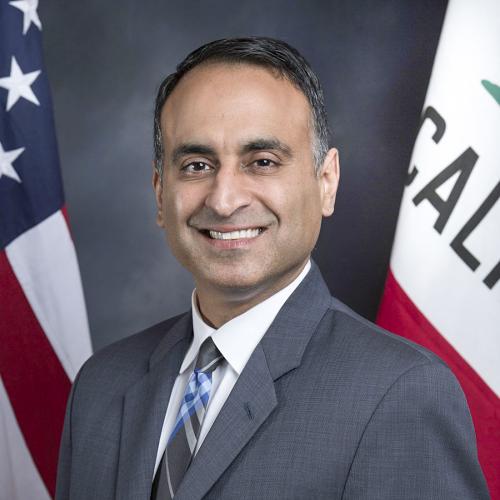
Photo of Ash Kalra
D California Assembly · District 25 On the 2026 ballot

Asm. Ash Kalra

Compare
Total votes
23,603
all sessions
Attendance
97%
541 missed
Near the chamber average
With party
99%
of cast votes
Near the chamber average
Bipartisan score
0%
crosses aisle rarely
Near the chamber average
Sponsored
2,377
bills & resolutions
Higher than 97% of chamber peers
Committees
12
assignments
2,377 bills and resolutions

Sponsored bills

Total
2,377
Primary
290
Co-sponsor
2,087
This page
2,377
matching current filters
Co-sponsor AJR 21
Passed · California Assembly · Co-sponsor
Relative to reparations for descendants of enslaved persons.

This measure would formally apologize for California's past complicity in enabling and furthering the practice of slavery and would urge the United States Congress and the President of the United States to enact House Resolution 40 to study the legacy of slavery and provide recommendations on redress for descendants of enslaved persons.

Passed Sep 4, 2019 1 co-sponsor
Co-sponsor AJR 22
Passed · California Assembly · Co-sponsor
Relative to the 76th anniversary of the repeal of the Chinese Exclusion Act.

This measure would mark December 17, 2019, as the 76th anniversary of the repeal of the Chinese Exclusion Act to honor the contributions of all immigrants and refugees in our communities. The measure would also declare the opposition of the Legislature to executive orders and a presidential proclamation signed by President Trump relating to immigration, call upon the President to revoke those orders and that proclamation, condemn the expansion of deportations being undertaken under the current presidential administration, stand in firm opposition to the President's proposal for construction of a wall along the southern border with Mexico, and reaffirm that the state is open and welcoming to immigrants and refugees who are integral to life in our state.

Passed Sep 4, 2019 1 co-sponsor
Co-sponsor AJR 7
Passed · California Assembly · Co-sponsor
Relative to the Green New Deal.

This measure would encourage the United States Congress to adopt climate policies, including those that might be adopted under the Green New Deal, that build upon California's programs that have reduced greenhouse gas emissions while improving air and water quality, create new green jobs, and improve disadvantaged communities and that just climate actions offer the nation an opportunity to achieve community-mindful policies that California has successfully adopted while growing its economy.

Passed Sep 4, 2019 1 co-sponsor
Co-sponsor AB 10
Passed · California Assembly · Co-sponsor
Income taxes: credits low-income housing: farmworker housing.

(1) Existing law establishes a low-income housing tax credit program pursuant to which the California Tax Credit Allocation Committee (CTCAC) provides procedures and requirements for the allocation, in modified conformity with federal law, of state insurance, personal income, and corporation tax credit amounts to qualified low-income housing projects that have been allocated, or qualify for, a federal low-income housing tax credit, and farmworker housing. Existing law limits the total annual amount of the state low-income housing credit for which a federal low-income housing credit is required to the sum of $70,000,000, as increased by any percentage increase in the Consumer Price Index for the preceding calendar year, any unused credit for the preceding calendar years, and the amount of housing credit ceiling returned in the calendar year, and authorizes CTCAC, for calendar years beginning in 2020, to allocate an additional $500,000,000 to specified low-income housing projects and, for calendar years beginning in 2021, requires this additional amount only to be available for allocation pursuant to an authorization in the annual Budget Act or related legislation, and specified regulatory action by CTCAC. This bill would remove the requirement that, beginning in the 2021 calendar year, the above-described additional $500,000,000 allocation only be available pursuant to an authorization in the annual Budget Act or related legislation, and specified regulatory action by CTCAC. (2) This bill would take effect immediately as a tax levy.

Passed Aug 30, 2019 1 co-sponsor
Primary AB 50
Passed · California Assembly · Lead sponsor
Medi-Cal: Assisted Living Waiver program.

Existing law establishes the Medi-Cal program, which is administered by the State Department of Health Care Services and under which qualified low-income individuals receive health care services. The Medi-Cal program is, in part, governed and funded by federal Medicaid program provisions. Existing law requires the State Department of Health Care Services to develop a federal waiver program, known as the Assisted Living Waiver program, to test the efficacy of providing an assisted living benefit to beneficiaries under the Medi-Cal program. Existing law requires that the benefit include, but not be limited to, the care and supervision activities specified for residential care facilities for the elderly. Existing law requires implementation of the program only to the extent federal financial participation is available and funds are appropriated or otherwise available for the program. This bill would require the department to submit to the federal Centers for Medicare and Medicaid Services a request for amendment of the Assisted Living Waiver program with specified amendments. The bill would require, as part of the amendments, the department to increase the number of participants in the program from the currently authorized 5,744 participants to 18,500, to be phased in, as specified. The bill would require the department to increase its provider reimbursement tiers to compensate for mandatory minimum wage increases, as specified. The bill would require the department, before the submission of the waiver amendment request, to notify specified legislative committees about certain information relating to the increase in the participant population and the regional expansion, to conduct open in-person meetings with stakeholders, and to release a draft of the proposed waiver amendments for stakeholder comment, as specified. The bill would require the department to establish requirements and procedures to allow a person on the Assisted Living Waiver program's waiting list to know their position on the waiting list. If the Assisted Living Waiver program is combined with, or converted to, another program or programs providing for Medicaid home and community-based services, the bill would require these requirements to apply to the combined or converted program. The bill would condition implementation of the waiver amendments on obtaining the necessary federal approvals and on the availability of federal financial participation. The bill would require implementation of the waiver amendments to commence within 6 months of the department's receipt of authorization for the necessary resources, as specified. The bill would also make legislative findings and declarations relating to the Assisted Living Waiver program.

Passed Aug 30, 2019 0 co-sponsors
Primary AB 572
Passed · California Assembly · Lead sponsor
California Deforestation-Free Procurement Act: public works projects: wood and wood products.

Existing law governs the bidding and awarding of public contracts by various state agencies. Existing law imposes requirements on contractors awarded various public contracts, including, among others, certifying that no equipment, materials, supplies, apparel, garments, or accessories provided under specified contracts are produced by sweatshop labor, forced labor, convict labor, indentured labor under penal sanction, abusive forms of child labor, or exploitation of children in sweatshop labor. This bill would establish the California Deforestation-Free Procurement Act. The bill would require a contractor, as defined, and specified subcontractors, for any contract entered into, extended, or renewed on or after January 1, 2022, contracting with a state agency for the procurement of products comprised wholly or in part of forest-risk commodities to certify that the commodities were not grown, derived, harvested, reared, or produced on land where tropical deforestation occurred on or after January 1, 2020. The bill would exempt a credit card purchase of goods of $2,500 or less, not to exceed a total of $7,500 of goods per contractor per year, from these certification requirements. The bill would require specified contractors to have a No Deforestation, No Peat, No Exploitation policy, as specified, and would require the contractors to make the policy and corresponding data publicly available. The bill would require, on or before July 1, 2021, the Department of General Services to issue an informational notice or memorandum on a Deforestation-Free Code of Conduct to be used by contractors that includes, among other things, a list of forest-risk commodities subject to these provisions. This bill would impose sanctions on contractors who knew or should have known that a product furnished to the state was comprised wholly or in part of a forest-risk commodity in violation of these provisions. The bill would specify that any person who certifies as true any material matter that the person knows to be false is guilty of a misdemeanor. By creating a new crime, this bill would impose a state-mandated local program. The State Contract Act governs the bidding and award of public works contracts by specific state agencies and requires an awarding department, before entering into any contract for a project, to prepare full, complete, and accurate plans, specifications, and estimates of cost. The act prohibits, except in specified circumstances, a state agency responsible for letting public works contracts from drafting bid specifications in a manner that limits the bidding to any one concern or product, except under certain circumstances. This bill would prohibit a state agency from including in bid specifications for public works projects any wood or wood products whose importation and use are prohibited under the federal Lacey Act. The California Constitution requires the state to reimburse local agencies and school districts for certain costs mandated by the state. Statutory provisions establish procedures for making that reimbursement. This bill would provide that no reimbursement is required by this act for a specified reason.


Passed Aug 30, 2019 0 co-sponsors
Co-sponsor AB 526
Passed · California Assembly · Co-sponsor
Medi-Cal: California Special Supplemental Nutrition Program for Women, Infants, and Children.

Existing law establishes the Medi-Cal program, which is administered by the State Department of Health Care Services and under which qualified low-income individuals receive health care services. The Medi-Cal program is, in part, governed and funded by federal Medicaid program provisions. Existing federal law authorizes a state to provide in its Medicaid state plan that in determining eligibility under the federal Medicaid program for a child, the state is authorized to rely on a finding made within a reasonable period from an Express Lane agency, as defined, when it determines whether a child satisfies one or more components of eligibility for medical assistance under the federal Medicaid program. Existing law establishes the California Special Supplemental Nutrition Program for Women, Infants, and Children (WIC Program) , which is administered by the State Department of Public Health and counties and under which nutrition and other assistance are provided to eligible low-income pregnant women, low-income postpartum and lactating women, and low-income infants and children under 5 years of age, who have been determined to be at nutritional risk. Existing law requires the former Managed Risk Medical Insurance Board and former State Department of Health Services, in collaboration with program offices for the WIC Program and other designated entities, to design, promulgate, and implement policies and procedures for an automated enrollment gateway system, subject to appropriation, allowing children applying to the WIC Program to obtain presumptive eligibility for, and to facilitate application for enrollment in, the Medi-Cal program or the former Healthy Families Program, to the extent federal financial participation is available, as specified. This bill would delete the above-described provisions relating to the automated enrollment gateway system and would instead require the State Department of Health Care Services, in collaboration with the same designated entities, to design, promulgate, and implement policies and procedures for an automated enrollment pathway, designating the WIC Program and its local WIC agencies as Express Lane agencies and using WIC eligibility determinations to meet Medi-Cal eligibility requirements. The bill would require the pathway to perform specified functions to streamline Medi-Cal enrollment and maximize health care coverage. The bill would require that benefits for applicants enrolling in the Medi-Cal program using the pathway be provided immediately through accelerated enrollment for children and presumptive eligibility for pregnant women. The bill would also require the pathway to modify the existing WIC enrollment system and Medi-Cal eligibility and enrollment systems to electronically transfer to the WIC Program the Medi-Cal eligibility determinations and contact information of Medi-Cal enrollees who are eligible for the WIC Program for the purpose of local WIC agencies contacting prospective WIC enrollees to complete their enrollment in the WIC Program. The bill would, while the automated enrollment pathway is being developed, require the department, in coordination with the WIC Program and local WIC agencies to, among other things, conduct regular data matches to identify which WIC recipients are not enrolled in the Medi-Cal program and which Medi-Cal beneficiaries are eligible for, but not enrolled in, the WIC Program, and to provide specified notices about program eligibility to those persons. The bill would require the department to seek approval of any amendments to the state plan necessary to implement these provisions, and would condition their implementation on the department obtaining all necessary federal approvals. The bill would also require the department to complete the project approval lifecycle process, as specified, for the automated enrollment pathway prior to implementing these provisions. Because counties are responsible for making eligibility determinations under the Medi-Cal program, by revising eligibility requirements, this bill would impose a state-mandated local program. The California Constitution requires the state to reimburse local agencies and school districts for certain costs mandated by the state. Statutory provisions establish procedures for making that reimbursement. This bill would provide that, if the Commission on State Mandates determines that the bill contains costs mandated by the state, reimbursement for those costs shall be made pursuant to the statutory provisions noted above.

Passed Aug 30, 2019 1 co-sponsor
Co-sponsor AB 388
Passed · California Assembly · Co-sponsor
Alzheimer's disease.

Existing law authorizes any postsecondary higher educational institution with a medical center to establish diagnostic and treatment centers for Alzheimer's disease, and requires the State Department of Public Health to administer grants to the postsecondary higher educational institutions that establish a center pursuant to these provisions. Until January 1, 2025, this bill would require the department to implement the action agenda items in the Healthy Brain Initiative, as defined, to the extent resources are available. The bill would require the department to annually notify the Legislature about activities conducted pursuant to these provisions. Until January 1, 2025, the bill would also, upon appropriation by the Legislature, require the department to establish a pilot program in up to 8 local health jurisdictions, as specified, and award participating local health jurisdictions one-time grant funding over 3 consecutive fiscal years, to develop local initiatives that are consistent with the Healthy Brain Initiative. The bill would require the department to conduct an evaluation of the pilot program and produce a report, to be submitted to the Legislature by January 1, 2023, describing best practices and making recommendations regarding which solutions and innovations are most feasible to replicate.

Passed Aug 30, 2019 1 co-sponsor
Co-sponsor AB 243
Passed · California Assembly · Co-sponsor
Implicit bias training: peace officers.

Existing law requires every peace officer to participate in expanded training prescribed by the Commission on Peace Officer Standards and Training that includes and examines evidence-based patterns, practices, and protocols that make up racial and identity profiling, including implicit bias. Once basic training is completed, existing law requires specified peace officers to complete a refresher course on racial and identity profiling at least every 5 years. This bill would require those peace officers currently required to take the refresher course every 5 years, and additional peace officers, as specified, to instead take refresher training on racial and identity profiling, including the understanding of implicit bias and the promotion of bias-reducing strategies, at least every 2 years. The bill would require this training to include implicit association testing before and after the training. By imposing additional training duties on local law enforcement entities, this bill would impose a state-mandated local program. The California Constitution requires the state to reimburse local agencies and school districts for certain costs mandated by the state. Statutory provisions establish procedures for making that reimbursement. This bill would provide that, if the Commission on State Mandates determines that the bill contains costs mandated by the state, reimbursement for those costs shall be made pursuant to the statutory provisions noted above.

Passed Aug 30, 2019 1 co-sponsor
Showing 1,801 to 1,810 of 2,377 bills