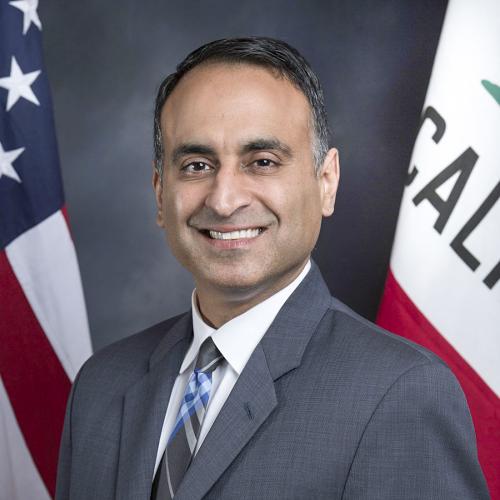
Photo of Ash Kalra
D California Assembly · District 25 On the 2026 ballot

Asm. Ash Kalra

Compare
Total votes
23,729
all sessions
Attendance
97%
547 missed
Higher than 75% of chamber peers
With party
99%
of cast votes
Near the chamber average
Bipartisan score
0%
crosses aisle rarely
Near the chamber average
Sponsored
2,377
bills & resolutions
Higher than 97% of chamber peers
Committees
12
assignments
2,377 bills and resolutions

Sponsored bills

Total
2,377
Primary
290
Co-sponsor
2,087
This page
2,377
matching current filters
Co-sponsor AB 1253
Passed · California Assembly · Co-sponsor
Personal income taxes: additional tax.

The Personal Income Tax Law and California Constitution imposes taxes based upon taxable income of individuals, estates, and trusts at specified rates. This bill, for taxable years beginning on or after January 1, 2020, in addition to those taxes, would impose an additional tax of at the rates of 1%, 3%, and 3.5% on that portion of a taxpayer's taxable income over specified thresholds, as provided. This bill would include a change in state statute that would result in a taxpayer paying a higher tax within the meaning of Section 3 of Article XIIIA of the California Constitution, and thus would require for passage the approval of 23 of the membership of each house of the Legislature. This bill would take effect immediately as a tax levy.

Passed Aug 3, 2020 1 co-sponsor
Co-sponsor AB 828
Passed · California Assembly · Co-sponsor
Temporary moratorium on foreclosures and unlawful detainer actions: coronavirus (COVID-19).

Existing law confers a power of sale upon a mortgagee, trustee, or any other person to be exercised after a breach of the obligation for which the mortgage or transfer is a security. Existing law requires a trustee, mortgagee, or beneficiary to first file a record in the office of the recorder a notice of default, and establishes other requirements and procedures for completion of a foreclosure sale. This bill would prohibit a person from taking any action to foreclose on a residential real property while a state or locally declared state of emergency related to the COVID-19 virus is in effect and until 91 days after the state of emergency has ended, including, but not limited to, causing or conducting the sale of the real property or submitting for recordation a notice of default. Existing property tax law attaches taxes that are owed on that property as a lien against that property. Existing law generally requires the tax collector to attempt to sell residential property that has become tax defaulted 5 years or more after that property has become tax defaulted. This bill would require a tax collector to suspend the sale, and not attempt to sell, tax-defaulted properties while a state or locally declared state of emergency related to the COVID-19 virus is in effect and until 91 days after the state of emergency has ended. Existing law requires a county recorder to record any instrument, paper, or notice that is authorized or required to be recorded upon payment of proper fees and taxes. This bill would prohibit a party from submitting to a county recorder any instrument, paper, or notice that constitutes a notice of default, a notice of sale, or a trustee's deed upon sale for residential real property during the above-specified declared state of emergency relating to the COVID-19 virus. The bill would provide that any action for foreclosure on a mortgage or deed of trust of residential real property is stayed and the court may take no action unless the court finds that the action is required to further public health and safety and would extend the period for exercising rights, including right of redemption, until 90 days after the state of emergency ends. Existing law establishes a procedure, known as an unlawful detainer action, that a landlord must follow in order to evict a tenant. Existing law provides that a tenant is subject to such an action if the tenant continues to possess the property without permission of the landlord in specified circumstances, including when the tenant has violated the lease by defaulting on rent or failing to perform a duty under the lease. This bill would prohibit a party from submitting for filing a residential unlawful detainer complaint except to address issues of damage to the property, nuisance, or health and safety during the timeframe in which a state of emergency related to the COVID-19 virus is in effect and 91 days thereafter. The bill would prohibit a court from issuing a summons on a complaint for a residential unlawful detainer unless the court finds it is necessary to address damage to the property, nuisance, or health and safety, and would prohibit a court from entering a default or default judgment for restitution in an unlawful detainer action unless it is necessary to protect public health and safety. The bill would authorize a period of rent deferment of up to 12 months from 90 days after the state of emergency ends for a tenant who provides specified documentation to their landlord showing economic hardship resulting from COVID-19, including a substantial reduction in income or substantial out-of-pocket medical expenses. The bill would prohibit the imposition of late fees, fines, or interest during that time. The bill would make these provisions effective in a jurisdiction in which a state or locally declared state of emergency is in effect until 91 days after the state of emergency ends and would repeal these provisions on January 1, 2022. By expanding the crime of perjury, the bill would impose a state-mandated local program. The bill would contain related findings regarding the economic hardships imposed by the COVID-19 virus. This bill would declare that it is to take effect immediately as an urgency statute. The California Constitution requires the state to reimburse local agencies and school districts for certain costs mandated by the state. Statutory provisions establish procedures for making that reimbursement. This bill would provide that no reimbursement is required by this act for a specified reason.

Passed Jul 28, 2020 1 co-sponsor
Co-sponsor AB 31
Passed · California Assembly · Co-sponsor
Sales and use taxes: exemption: menstrual hygiene products.

Existing sales and use tax laws impose a tax on retailers measured by the gross receipts from the sale of tangible personal property sold at retail in this state, or on the storage, use, or other consumption in this state of tangible personal property purchased from a retailer for storage, use, or other consumption in this state. Those laws provide various exemptions from those taxes, including, until July 1, 2023, an exemption for the sale of, or the storage, use, or other consumption of, menstrual hygiene products, defined as tampons, specified sanitary napkins, menstrual sponges, and menstrual cups. Existing law requires the Department of Finance, beginning on May 15, 2020, to estimate the total dollar amount of revenue that would have been credited to the Local Revenue Fund 2011 if not otherwise exempted under the sales and use tax exemption for menstrual hygiene products and requires the Controller to transfer that amount from the General Fund to the Local Revenue Fund 2011, a continuously appropriated fund, no later than June 30 of each fiscal year. This bill would establish a similar exemption for the sale of, or the storage, use, or other consumption of, menstrual hygiene products beginning July 1, 2023, and would define menstrual hygiene products to additionally include menstrual underwear. The bill would provide that the Department of Finance is required to calculate, and the Controller is required to transfer, the total dollar amount of revenue prior to January 1, 2024, that would have been credited to the Local Revenue Fund 2011 if not otherwise exempted under the sales and use tax with respect to menstrual hygiene products, as specified. The Bradley-Burns Uniform Local Sales and Use Tax Law authorizes counties and cities to impose local sales and use taxes in conformity with the Sales and Use Tax Law, and existing laws authorize districts, as specified, to impose transactions and use taxes in accordance with the Transactions and Use Tax Law, which generally conforms to the Sales and Use Tax Law. Amendments to the Sales and Use Tax Law are automatically incorporated into the local tax laws. Existing law requires the state to reimburse counties and cities for revenue losses caused by the enactment of sales and use tax exemptions. This bill would provide that, notwithstanding Section 2230 of the Revenue and Taxation Code, no appropriation is made and the state shall not reimburse any local agencies for sales and use tax revenues lost by them pursuant to this bill. This bill would take effect immediately as a tax levy.

Passed Jul 23, 2020 1 co-sponsor
Co-sponsor AB 2882
Passed · California Assembly · Co-sponsor
Hazardous emissions and substances: schoolsites: private and charter schools.

(1) The California Environmental Quality Act (CEQA) requires a lead agency to prepare, or cause to be prepared by contract, and certify the completion of, an environmental impact report on a project, as defined, that it proposes to carry out or approve that may have a significant effect on the environment, or to adopt a negative declaration if it finds that the project will not have that effect. CEQA prohibits an environmental impact report or negative declaration from being approved for any project involving the purchase of a schoolsite or the construction of a new elementary or secondary school by a school district unless specified conditions are met, relating to, among other things, whether the property is located on a former hazardous waste disposal site or solid waste disposal site, a hazardous substances release site, or a site that contains a pipeline that carries specified substances, and the property's proximity to facilities that might reasonably be anticipated to emit hazardous air emissions or handle hazardous or extremely hazardous materials, substances, or waste, as provided. This bill would additionally prohibit an environmental impact report or negative declaration from being approved for any project involving the purchase of a schoolsite or the construction of a new elementary or secondary school by a charter school, unless those same conditions are met. By imposing new requirements on charter schools, lead agencies, cities, and counties, the bill would impose a state-mandated local program. (2) Existing law prohibits the governing board of a school district from approving a project for the acquisition of a schoolsite, unless specified conditions are met, including, among others, that the school district, as the lead agency, determines that the property to be purchased or built upon is not the site of a former hazardous waste disposal site or solid waste disposal site, a hazardous substances release site, or a site that contains a pipeline that carries specified substances, and that the school district, as the lead agency, has not identified specified facilities within one-fourth mile of the proposed schoolsite that might reasonably be anticipated to emit hazardous air emissions or handle hazardous or extremely hazardous materials, substances, or waste, as provided. This bill would additionally impose that prohibition on the governing body of a charter school and would require the determination and identification described above to be made by the lead agency. The bill would impose that prohibition, and related requirements, additionally on a private school. By imposing new requirements on cities and counties, the bill would impose a state-mandated local program. The California Constitution requires the state to reimburse local agencies and school districts for certain costs mandated by the state. Statutory provisions establish procedures for making that reimbursement. This bill would provide that with regard to certain mandates no reimbursement is required by this act for a specified reason. With regard to any other mandates, this bill would provide that, if the Commission on State Mandates determines that the bill contains costs so mandated by the state, reimbursement for those costs shall be made pursuant to the statutory provisions noted above.

Passed Jul 16, 2020 1 co-sponsor
Primary AB 2485
Passed · California Assembly · Lead sponsor
Teacher credentialing: subject matter competence.

Existing law establishes the Commission on Teacher Credentialing and requires the commission, among other duties, to establish standards for the issuance and renewal of credentials, certificates, and permits. Existing law specifies the minimum requirements for the preliminary multiple or single subject teaching credential, including a subject matter competence requirement demonstrated by either completion of a subject matter program that has been approved by the commission or passage of a subject matter examination. This bill would authorize a candidate for the preliminary multiple or single subject teaching credential to demonstrate subject matter competence by completing higher education coursework in the subject matters related to the content area of the credential, as provided. The bill would require the commission to adopt regulations for this purpose and would prohibit a program of professional preparation from verifying a candidate's subject matter competence in this manner until those regulations are adopted. The bill would additionally authorize a candidate to demonstrate subject matter competence through a combination of a subject matter program, a subject matter examination, and higher education coursework in the subject matters related to the content area of the credential. The bill would repeal these provisions on January 1, 2024.

Passed Jul 7, 2020 0 co-sponsors
Co-sponsor ACA 11
Signed into law · California Assembly · Co-sponsor
A resolution to propose to the people of the State of California an amendment to the Constitution of the State, by adding Sections 2.1, 2.2, and 2.3 to Article XIIIA thereof, relating to tax limitation.

The California Constitution limits the amount of ad valorem taxes on real property to 1% of the full cash value of that property, defined as the county assessor's valuation of real property as shown on the 1975–76 tax bill and, thereafter, the appraised value of the property when purchased, newly constructed, or a change in ownership occurs after the 1975 assessment, subject to an annual inflation adjustment not to exceed 2%. The California Constitution authorizes the Legislature to authorize a person over 55 years of age or any severely and permanently disabled person residing in property eligible for the homeowner's exemption to transfer the base year value of that property to a replacement dwelling of equal or lesser value located in the same county, or another county that has adopted an ordinance allowing base years value transfers from other counties, as provided. The California Constitution also provides that the purchase or transfer of the principal residence, and the first $1,000,000 of other real property, of a transferor in the case of a transfer between parents and their children, or between grandparents and their grandchildren if all the parents of those grandchildren are deceased, is not a "purchase" or "change in ownership" for purposes of determining the "full cash value" of property for taxation. This measure, beginning on and after April 1, 2021, would authorize an owner of a primary residence who is over 55 years of age, severely disabled, or a victim of a wildfire or natural disaster, as defined, to transfer the taxable value, defined as the base year value plus inflation adjustments, of their primary residence to a replacement primary residence located anywhere in the state, regardless of the location or value of the replacement primary residence, that is purchased or newly constructed as that person's principal residence within 2 years of the sale of the original primary residence. The measure would limit a person who is over 55 years of age or severely disabled to 3 transfers under these provisions. The measure, beginning on and after February 16, 2021, would exclude from the terms "purchase" and "change in ownership" for purposes of determining the "full cash value" of property the purchase or transfer of a family home or family farm, as those terms are defined, of the transferor in the case of a transfer between parents and their children, or between grandparents and their grandchildren if all the parents of those grandchildren are deceased. In the case of a transfer of a family home, the measure would require that the property continue as the family home of the transferee. The measure would require that the taxable value of the property be determined as provided. In the case of property tax benefits provided to a family home under these provisions, the bill would require the transferee to claim the homeowner's or disabled veteran's exemption within one year of the transfer. The measure would specify that the above-described provisions relating to transfers between parents or grandparents and children or grandchildren would apply to transfers occurring on or before February 15, 2021. The measure would establish the California Fire Response Fund in the State Treasury. The measure would require the Controller to annually transfer a specified amount, based on calculations by the Director of Finance, of the additional revenues and savings that accrued to the state from the implementation of this measure's provisions from the General Fund to that fund. However, the measure would provide that, if the amount required to be transferred to the California Fire Response Fund exceeds the amount transferred for the previous fiscal year by more than 10%, that excess amount would not be transferred to the California Fire Response Fund. The measure would require the Legislature to appropriate moneys in the fund solely for the purpose of funding fire suppression staffing by the Department of Forestry and Fire Protection and underfunded special districts that provide fire protection services, as provided. The measure would also establish the County Revenue Protection Fund and continuously appropriate moneys in that fund for the purpose of reimbursing eligible local agencies, as provided. The measure would require the Controller to annually transfer a specified amount, based on the above-described calculations by the Director of Finance, from the General Fund to that fund. The measure would require each county to annually determine the gain of the county and any local agency within the county resulting from the implementation of this measure and, if that amount of gain is negative, provide that specified eligible local agencies may receive a reimbursement from the County Revenue Protection Fund. The measure would require the California Department of Tax and Fee Administration to provide a reimbursement to each eligible local agency that has a negative gain, determined every 3 years based on the aggregate gain of the eligible local agency, as provided, and require the Controller to transfer any remaining balance in the County Revenue Protection Fund to the General Fund at the end of each 3-year period, to be available for appropriation for any purpose.


Signed into law Jul 1, 2020 1 co-sponsor
Co-sponsor ACA 6
Signed into law · California Assembly · Co-sponsor
A resolution to propose to the people of the State of California an amendment to the Constitution of the State, by amending Sections 2 and 4 of Article II thereof, relating to elections.

The California Constitution requires the Legislature to provide for the disqualification of electors while mentally incompetent or imprisoned or on parole for the conviction of a felony. Existing statutory law, for purposes of determining who is entitled to register to vote, defines imprisoned as currently serving a state or federal prison sentence. This measure would instead direct the Legislature to provide for the disqualification of electors who are serving a state or federal prison sentence for the conviction of a felony. This measure would also delete the requirement that the Legislature provide for the disqualification of electors while on parole for the conviction of a felony. The measure would provide for the restoration of voting rights upon completion of the prison term.

Signed into law Jun 25, 2020 1 co-sponsor
Showing 1,651 to 1,660 of 2,377 bills