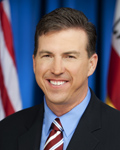
Photo of Kevin Mullin
D California Assembly · District 22 · Former member

Asm. Kevin Mullin

Compare
Total votes
31,650
all sessions
Attendance
97%
797 missed
Near the chamber average
With party
99%
of cast votes
Higher than 88% of chamber peers
Bipartisan score
0%
crosses aisle rarely
Lower than 90% of chamber peers
Sponsored
2,233
bills & resolutions
Near the chamber average
Committees
0
assignments
2,233 bills and resolutions

Sponsored bills

Total
2,233
Primary
287
Co-sponsor
1,946
This page
2,233
matching current filters
Co-sponsor AB 1
Signed into law · California Assembly · Co-sponsor
Developmental services: Medi-Cal: funding.

The Lanterman Developmental Disabilities Services Act requires the State Department of Developmental Services to contract with regional centers to provide services and supports to individuals with developmental disabilities. Under existing law, regional centers purchase needed services for individuals with developmental disabilities through approved service providers or arrange for those services through other publicly funded agencies. Existing law establishes specified rates and wages to be paid to certain service providers and the rates to be paid for certain developmental services. Existing law requires that rates to be paid to other developmental service providers either be set by the department or negotiated between the regional center and the service provider. Existing law establishes the Medi-Cal program, administered by the State Department of Health Care Services, under which basic health care services are provided to qualified low-income persons. The Medi-Cal program is, in part, governed and funded by federal Medicaid Program provisions. Existing law requires, except as otherwise provided, Medi-Cal provider payments to be reduced, as specified. This bill would appropriate a specified sum to the State Department of Developmental Services to, commencing July 1, 2016, among other things, increase rates and wages for certain developmental services providers and fund incentive payments for competitive integrated employment opportunities and internships for individuals with developmental disabilities. The bill would require the department to submit a rate study to specified committees of the Legislature on or before March 1, 2019, regarding community-based services for individuals with developmental disabilities. The bill would require each regional center to report specified information to the department regarding increased funding for regional center operations. The bill would, for dates of service on or after August 1, 2016, increase the payment rates for intermediate care facilities and skilled nursing facilities that provide services to developmentally disabled individuals under the Medi-Cal program, as specified. The bill would also prohibit the State Department of Health Care Services from seeking to retroactively implement certain Medi-Cal provider payment reductions and limitations with regards to reimbursements for services provided by skilled nursing facilities that are distinct parts of general acute care hospitals for dates of service on or after June 1, 2011, and on or before September 30, 2013, and from seeking to recoup overpayments, as specified. Existing law requires the department and regional centers to annually collaborate to compile specified data relating to purchase of service authorization, utilization, and expenditure by each regional center. Existing law requires each regional center to annually report to the department regarding the regional center's implementation of these requirements, including whether the data indicates a need to reduce disparities in the purchase of services among consumers in the regional center's catchment area and the regional center's recommendations and plan to promote equity, and reduce disparities, in the purchase of services. Existing law requires the department to consult with specified stakeholders to review the data, develop recommendations to help reduce disparities in purchase of service expenditures, and encourage development and expansion of culturally appropriate services, among other things, and to report the status of its efforts during the 2016–17 legislative budget subcommittee hearing process. The bill would also require the department, subject to available funding, to allocate funding to regional centers to assist in implementing specified recommendations and plans, including the recommendations and plans of the regional centers to promote equity, and reduce disparities, in the purchase of services. Existing law requires an entity that receives payments between $250,000 and $500,000 per year from one or more regional centers to obtain either an independent audit or an independent review report of its financial statements, and requires an entity that receives payments that are equal to or more than $500,000 per year to obtain an independent audit. This bill would instead require an entity that receives payments between $500,000 and $2,000,000 from one or more regional centers to obtain an independent review report of its financial statements, and would authorize these entities to apply for, and require the regional center to grant, a 2-year exemption from this requirement if the regional center does not find issues in the independent review report that have an impact on regional center services. The bill would require an entity that receives payments from one or more regional centers that are equal to or more than $2,000,000 to obtain an independent audit and would authorize these entities to apply for, and require the regional center to grant, a 2-year exemption from the audit requirement if the audit resulted in an unmodified opinion, an unmodified opinion with additional communication, or a qualified opinion with issues that are not material. The bill would require a regional center to annually report to the State Department of Developmental Services any exemptions granted pursuant to these provisions.

Signed into law Mar 1, 2016 1 co-sponsor
Primary AB 2047
In committee · California Assembly · Lead sponsor
Sales and Use Tax Law.

The Sales and Use Tax Law imposes a tax on retailers measured by the gross receipts from the sale of tangible personal property sold at retail in this state, or on the storage, use, or other consumption in this state of tangible personal property purchased from a retailer for storage, use, or other consumption in this state. This bill would make nonsubstantive changes to the provision designating the Sales and Use Tax Law.

In committee Feb 18, 2016 0 co-sponsors
Co-sponsor ACR 9
Signed into law · California Assembly · Co-sponsor
Relative to Pet Care Education Month.

This measure would declare the month of January 2016 as Pet Care Education Month and would request Californians to observe the month by ensuring that their companion animals receive the proper preventative care by establishing a financial plan for pet health emergencies and by contributing to charitable organizations that provide low-cost spay and neuter services and vaccinations or funds to help low-income individuals pay for veterinary care.

Signed into law Feb 10, 2016 1 co-sponsor
Primary AB 378
Failed · California Assembly · Lead sponsor
State Highway 101 Route corridor.

Existing law provides that the Department of Transportation has full possession and control of the state highway system. Existing law imposes various requirements for the development and implementation of transportation projects. This bill would require the department, in coordination with the City/County Association of Governments of San Mateo County and the San Mateo County Transportation Authority, to create an integrated corridor management team to consider transportation projects addressing congestion relief in the State Highway Route 101 corridor located within the County of San Mateo.

Failed Feb 1, 2016 0 co-sponsors
Primary AB 1263
died · California Assembly · Lead sponsor
Election day procedures: privileges of voters.

Existing law allows a voter, without loss of pay, to take off enough working time that, when added to the voting time available outside of working hours, will enable the voter to vote if he or she does not have sufficient time outside of working hours to vote at a statewide election. Existing law provides that no more than 2 hours of the time taken off for voting shall be without loss of pay. This bill would make technical, nonsubstantive changes to those provisions.

died Feb 1, 2016 0 co-sponsors
Primary AB 49
died · California Assembly · Lead sponsor
Livestock drugs: antibiotics.

Under existing law, the Department of Food and Agriculture is responsible for enforcing provisions relating to the importation of animals, milk and milk products, produce dealers, and other agricultural regulations. Existing law requires the Secretary of Food and Agriculture to make and enforce provisions relating to the manufacture, sale, and use of livestock drugs. This bill would make various legislative findings and declarations relating to the nontherapeutic use of antibiotics in livestock, and would declare the intent of the Legislature to enact legislation that would address the overuse of antibiotics in livestock production.

died Feb 1, 2016 0 co-sponsors
Primary AB 674
Failed · California Assembly · Lead sponsor
Electricity: distributed generation.

Under existing law, the Public Utilities Commission has regulatory authority over public utilities, including electrical corporations, as defined. Existing law authorizes the Public Utilities Commission to fix the rates and charges for every public utility, and requires that those rates and charges be just and reasonable. Existing law requires the Public Utilities Commission to require each electrical corporation under the operational control of the Independent System Operator as of January 1, 2001, to modify tariffs so that all customers that install new distributed energy resources, as defined, in accordance with specified criteria are served under rates, rules, and requirements identical to those of a customer within the same rate schedule that does not use distributed energy resources, and to withdraw any provisions in otherwise applicable tariffs that activate other tariffs, rates, or rules if a customer uses distributed energy resources. Existing law provides, notwithstanding these requirements, that a customer that installs new distributed energy resources not be exempted from (1) reasonable interconnection charges, (2) charges imposed pursuant to the Reliable Electric Service Investment Act, and (3) charges imposed to repay the Department of Water Resources for electricity procurement expenses incurred in response to the electricity crisis of 2000–01. Existing law requires the Public Utilities Commission, in establishing the rates applicable to customers that install new distributed energy resources, to create a firewall that segregates distribution cost recovery so that any net costs, taking into account the actual costs and benefits of distributed energy resources, proportional to each customer class, as determined by the Public Utilities Commission, resulting from the tariff modifications granted to members of each customer class may be recovered only from that class. This bill would, to the extent authorized by federal law, require the Public Utilities Commission, by July 1, 2016, to do both of the following for those electrical corporation customers that install clean distributed energy resources, as defined, after January 1, 2016: (1) require each electrical corporation to collect all applicable nonbypassable charges fixed, implemented, administered, or imposed by the Public Utilities Commission based only on the actual metered consumption of electricity delivered to the customer through the electrical corporation's transmission or distribution system, which charges are to be at the same rate per kilowatthour as paid by other customers that do not employ a clean distributed energy resource, and (2) calculate a reserve capacity for standby service, if applicable, based on the capacity needed by an electrical corporation to serve a customer's electrical demand during an outage of the clean distributed energy resource providing electric service for that customer. The bill would require each electrical corporation to identify the total amount of nonbypassable charges that would be collected each year from customers served by clean distributed energy resources installed after January 1, 2016, based on gross consumption without any adjustment for the generation of the clean distributed energy resources. The bill would require that this total amount be fully recovered from customers in the same customer class as those customers served by clean distributed energy resources installed after January 1, 2016, and would prohibit any amount from being shifted to any other customer class. The bill would require a customer served by a clean distributed energy resource, upon request, to provide relevant data to the Public Utilities Commission and the State Air Resources Board and the facility be subject to onsite inspection, to verify equipment operation and performance, including capacity, thermal output, and usage to verify criteria air pollutant and greenhouse gases emissions performance. The bill would require the State Energy Resources Conservation and Development Commission to report to the Legislature and the relevant policy committees of the Legislature on the impact of its provisions on specified issues by July 1, 2021. Under existing law, a violation of the Public Utilities Act or any order, decision, rule, direction, demand, or requirement of the commission is a crime. Because the provisions of this bill would be a part of the act and because a violation of an order or decision of the commission implementing its requirements would be a crime, the bill would impose a state-mandated local program by creating a new crime. The California Constitution requires the state to reimburse local agencies and school districts for certain costs mandated by the state. Statutory provisions establish procedures for making that reimbursement. This bill would provide that no reimbursement is required by this act for a specified reason.


Failed Feb 1, 2016 0 co-sponsors
Showing 1,291 to 1,300 of 2,233 bills