

Existing law, the Safe Neighborhoods and Schools Act, enacted as an initiative statute by Proposition 47, as approved by the electors in the November 4, 2014, statewide general election, makes the theft of property that does not exceed $950 in value petty theft and makes that crime punishable as a misdemeanor, with certain exceptions. The initiative statute defines shoplifting as entering a commercial establishment with the intent to commit larceny while that establishment is open during regular hours, where the value of the property that is taken or intended to be taken does not exceed $950. The initiative statute requires that shoplifting be punished as a misdemeanor. Existing law, as amended by Proposition 47, provides that a registered sex offender or a person with a prior conviction for certain serious or violent felonies, such as a sexually violent offense, who commits petty theft is subject to imprisonment in the county jail for up to one year or in the state prison for 16 months or 2 or 3 years. This bill would reinstate a provision of law that was repealed by Proposition 47 that provides that a person who has been convicted 3 or more times of petty theft, grand theft, or other specified crimes and who is subsequently convicted of petty theft is subject to imprisonment in a county jail not exceeding one year or in a county jail for 18 months or 2 or 3 years. The bill would also make this provision and the provision relating to a person with serious, violent, or sexual prior offenses applicable to a person whose prior or current conviction is for shoplifting. This bill would require the Secretary of State to place the provisions of the bill that amend the initiative statute on the ballot for the November 5, 2024, statewide general election.
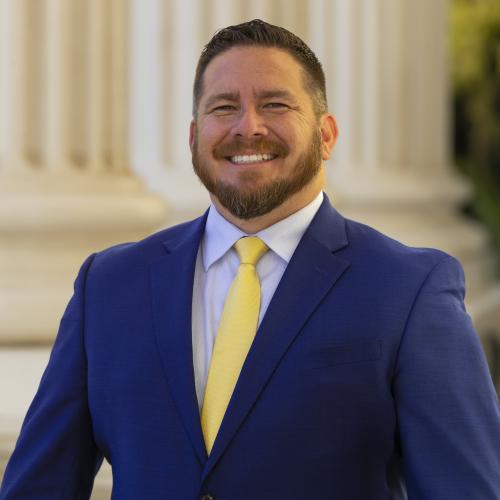
Asm. Juan Alanis
Sponsored bills
The California Global Warming Solutions Act of 2006 establishes the State Air Resources Board as the state agency responsible for monitoring and regulating sources emitting greenhouse gases. The act requires the state board to approve a statewide greenhouse gas emissions limit equivalent to the statewide greenhouse gas emissions level in 1990 and to ensure the statewide greenhouse gas emissions are reduced to at least 40% below the statewide greenhouse gas emissions limit by 2030. The act authorizes the state board to include the use of market-based compliance mechanisms in its regulation of greenhouse gas emissions. This bill would specify that transportation fuels are not subject to regulations implementing a market-based compliance mechanism for greenhouse gas emissions. Existing law authorizes the state board to adopt and implement motor vehicle fuel specifications for the control of air contaminants and sources of air pollution. Existing law authorizes the state board to grant variances from the gasoline specifications, as provided. This bill would require the state board to grant variances from gasoline specifications, including for gasoline imported from outside the state, whenever a refinery outage or other supply interruption would result in substantial short-term price increases, as specified. Existing law requires the state board to establish, by regulation, maximum standards for volatility of gasoline, as provided. Pursuant to these authorities, the state board has adopted the California Reformulated Gasoline regulations, which include regulations establishing the maximum Reid vapor pressure of gasoline for various regions of the state at specified time periods. This bill would require the state board to waive the Reid vapor pressure requirement on summer-blend gasoline under the California Reformulated Gasoline regulations and to allow for the early transition to winter-blend gasoline if the state board determines that the gasoline market is experiencing a sudden and unusual increase in gasoline prices.
Existing law makes it a crime to possess for sale or purchase for purpose of sale, transport, import, sell, furnish, administer, give away, manufacture, compound, convert, produce, derive, process, or prepare various controlled substances, including, among others, fentanyl, peyote, and various other opiates and narcotics. This bill, Alexandra's Law, would require the court to advise a person who is convicted of, or who pleads guilty or no contest to, the above crimes, as specified, of the danger of selling or administering illicit drugs and counterfeit pills and that, if a person dies as a result of that action, the defendant can be charged with homicide. The bill would require the court to read the advisory statement in a case in which the defendant exchanged a controlled substance containing fentanyl or its analogs for anything else of value, as specified. The bill would require the advisory statement to be included in a plea form, if used, and specified on the record. The bill would require that the fact the advisory was given be recorded in the abstract of conviction and would prohibit the advisement from being used as evidence in the prosecution of a minor in juvenile court.
Existing law provides that 8 hours of labor constitute a day's work unless it is otherwise expressly stipulated in a collective bargaining agreement, and requires that any work in excess of specified hours in one workday or one workweek be compensated at a rate higher than the regular rate of pay for the employee, as specified. Existing law authorizes, upon the proposal of an employer, employees of an employer to adopt a regularly scheduled alternative workweek that authorizes work by the affected employees for no longer than 10 hours per day within a 40-hour workweek without the payment to the affected employees of an overtime rate of compensation, as specified. Existing law prohibits an employer from employing an employee for a work period of more than 5 hours per day without providing the employee with a meal period, as specified, but, notwithstanding these provisions, existing law authorizes the Industrial Welfare Commission to adopt a working condition order permitting a meal period to commence after 6 hours of work if specified conditions are met. Under existing law, the Industrial Welfare Commission issues wage orders that regulates wages, hours, and working conditions in various occupations, including Wage Order No. 10-2001, which regulates the amusement and recreation industry. This bill would provide that these provisions do not apply to a person who is covered by a contract to play baseball at the minor league level with a labor organization that has at least 10 years of experience representing baseball players and who is compensated pursuant to the terms of a valid collective bargaining agreement that expressly provides for the wages, hours of work, working conditions of employees, payment for time worked during the off-season and spring training, and final and binding arbitration of disputes. The bill would require the Department of Industrial Relations to amend and republish Wage Order No. 10-2001 to provide that specified provisions of the wage order do not apply to a person subject to these provisions, as specified. Existing law requires an employer, semimonthly or at the time of payment of wages, to furnish an employee an accurate, itemized, written statement containing specified information regarding the amounts earned, hours worked, and the employee's identity, among other things, subject to certain variations. Existing law provides that an itemized wage statement furnished by an employer pursuant to these provisions is not required to show total hours worked by the employee if, among other things, the employee is exempt from the payment of minimum wage and overtime under specified law. This bill would provide that an itemized wage statement furnished by an employer pursuant to these provisions is not required to show total hours worked by an employee if the employee is exempt from the payment of minimum wage and overtime under the bill's provisions described above. Existing law, the Administrative Procedure Act, governs, among other things, the procedures for the adoption, amendment, or repeal of regulations by state agencies. Existing law also describes procedures for the promulgation of regulations by the Industrial Welfare Commission. This bill would exempt these provisions from the rulemaking procedures described above. Existing constitutional provisions require that a statute that limits the right of access to the meetings of public bodies or the writings of public officials and agencies be adopted with findings demonstrating the interest protected by the limitation and the need for protecting that interest. This bill would make legislative findings to that effect. This bill would declare that it is to take effect immediately as an urgency statute.
Existing law prohibits a local authority from enacting or enforcing an ordinance on matters covered by the Vehicle Code unless expressly authorized by the Vehicle Code. Existing law authorizes local authorities to adopt rules and regulations by ordinance or resolution regarding specified matters, including, among others, crossing guards, the operation of bicycles, the removal of illegally parked vehicles, and cruising, as defined. This bill would remove the authorization for a local authority to adopt rules and regulations by ordinance or regulation regarding cruising. Existing law makes it unlawful to operate a passenger vehicle, or commercial vehicle under 6,000 pounds, that has been modified from its original design so that any portion of the vehicle, other than the wheels, has less clearance from the surface of a level roadway than the clearance between the roadway and the lowermost portion of any rim of any wheel in contact with the roadway. This bill would repeal that prohibition. This bill would incorporate additional changes to Section 21100 of the Vehicle Code proposed by AB 825 and SB 50 to be operative only if this bill and AB 825, this bill and SB 50, or this bill, AB 825, and SB 50 are enacted and this bill is enacted last.
Existing law prohibits the possession, sale, and transport, as specified, of certain controlled substances. Existing law requires a person granted probation for controlled substance offenses to, as a condition of probation, secure education or treatment from a local community agency designated by the court, if the service is available and the person is likely to benefit from the service. This bill would require the court to order a person granted probation pursuant to those provisions for a violation of specified laws involving any amount of fentanyl, carfentanil, benzimidazole opiate, or any analog thereof, to successfully complete a fentanyl and synthetic opiate education program, if one is available. The bill would prohibit a defendant from being charged a fee for enrollment in that education program. The bill would require a court ordering a defendant to complete those courses to only order the defendant to participate in programs that include, among other things, information regarding the nature and addictive elements of fentanyl and other synthetic opiates and their danger to a person's life and health. The bill would require program providers to report an unexcused absence by a defendant from a fentanyl and synthetic opiate education program to the court and the probation department within 2 business days. The bill would require the court to only refer defendants to programs that are available at no cost to the participants. This bill would incorporate additional changes to Section 11373 of the Health and Safety Code proposed by SB 46 to be operative only if this bill and SB 46 are enacted and this bill is enacted last.
Existing law establishes the California Community Colleges, the California State University, and the University of California as the 3 segments of public postsecondary education in the state. Existing law requires the California State University and each community college district, and requests the University of California, with respect to each campus in their respective jurisdictions that administers a priority enrollment system, to grant priority registration for enrollment to specified individuals, including, among others, a member or former member of the Armed Forces of the United States, as specified. This bill would require the California State University, and request the University of California, with respect to each campus in their respective jurisdictions that administers a priority enrollment system, commencing with the 2025–26 academic year, to grant priority for registration for enrollment to first responders, as defined.
Existing law authorizes victims of domestic violence, sexual assault, stalking, human trafficking, and elder or dependent adult abuse, and members of their households, to complete an application to be approved by the Secretary of State for the purpose of enabling state and local agencies to respond to requests for public records without disclosing a program participant's changed name or location, subject to specified conditions. Existing law makes it a misdemeanor for any person to make a false statement in an application. This bill, beginning on July 1, 2024, would make victims of child abduction, as defined, and members of their households eligible for the protections of this address confidentiality program. By expanding the scope of the program to include victims of child abduction and their household members, this bill would impose new duties on local public officials and expand the scope of an existing crime, thereby imposing a state-mandated local program. The California Constitution requires the state to reimburse local agencies and school districts for certain costs mandated by the state. Statutory provisions establish procedures for making that reimbursement. This bill would provide that with regard to certain mandates no reimbursement is required by this act for a specified reason. With regard to any other mandates, this bill would provide that, if the Commission on State Mandates determines that the bill contains costs so mandated by the state, reimbursement for those costs shall be made pursuant to the statutory provisions noted above.
(1) Existing law, the Control, Regulate and Tax Adult Use of Marijuana Act (AUMA) , approved by the voters at the November 8, 2016, statewide general election, regulates the cultivation, distribution, transport, storage, manufacturing, testing, processing, sale, and use of marijuana for nonmedical purposes by people 21 years of age and older. The Medicinal and Adult-Use Cannabis Regulation and Safety Act (MAUCRSA) , among other things, consolidates the licensure and regulation of commercial medicinal and adult-use cannabis activities. Existing law requires the Department of Cannabis Control to implement a unique identification program for cannabis and cannabis products and requires the program to include the identification of permitted cannabis plants at a cultivation site during the cultivation period. Existing law requires a unique identifier to be issued for each cannabis plant and to be attached at the base of each plant or as otherwise required by law or regulation. This bill would instead require the unique identifier to be recorded in a manner as determined by the department by regulation. (2) AUMA authorizes the Legislature to amend its provisions by a 23 vote of each house if the amendment furthers its purposes and intent. This bill would declare that its provisions further the purposes and intent of AUMA.
Existing federal law, the National Suicide Hotline Designation Act of 2020, designates the 3-digit telephone number "988" as the universal number within the United States for the purpose of the national suicide prevention and mental health crisis hotline system operating through the 988 Suicide and Crisis Lifeline, maintained by the Assistant Secretary for Mental Health and Substance Use, and the Veterans Crisis Line, which is maintained by the Secretary of Veterans Affairs. Existing law creates a separate surcharge, beginning January 1, 2023, on each access line for each month, or part thereof, for which a service user subscribes with a service supplier. Existing law sets the 988 surcharge for the 2023 and 2024 calendar years at $0.08 per access line per month and beginning January 1, 2025, at an amount based on a specified formula not to exceed $0.30 per access line per month. Existing law authorizes the 911 and 988 surcharges to be combined into a single-line item, as described. Existing law provides for specified costs to be paid by the fees prior to distribution to the Office of Emergency Services. Existing law, the Miles Hall Lifeline and Suicide Prevention Act, creates the 988 State Suicide and Behavioral Health Crisis Services Fund and requires the fees to be deposited along with other specified moneys into the fund. Existing law provides that, upon appropriation by the Legislature, the funds be used for specified purposes and in accordance with specified priorities. Existing law requires the Office of Emergency Services to require an entity seeking moneys available through the fund to annually file an expenditure and outcomes report containing specified information, including, among other things, the number of individuals served and the outcomes for individuals served, if known. This bill would require an entity seeking moneys from the fund to also include the number of individuals who used the service and self-identified as veterans or active military personnel in its annual expenditure and outcomes report.