

Existing law, the Cal Grant Program, establishes the Cal Grant A Entitlement Awards, the Cal Grant B Entitlement Awards, the California Community College Expanded Entitlement Awards, the California Community College Transfer Entitlement Awards, the Competitive Cal Grant A and B Awards, the Cal Grant C Awards, and the Cal Grant T Awards under the administration of the Student Aid Commission. Existing law, the Cal Grant Reform Act revises and recasts the provisions establishing and governing the existing Cal Grant Program into a new Cal Grant Program. Existing law specifies that the act becomes operative only if General Fund moneys over the multiyear forecasts beginning in the 2024–25 fiscal year are available to support ongoing augmentations and actions, and if funding is provided in the annual Budget Act to implement the act. Under either Cal Grant Program that is operative, existing law establishes eligibility requirements for awards under the program for participating students attending qualifying institutions, including, among others, California residency requirements, as provided. Existing law establishes the Middle Class Scholarship Program (MCSP) under the administration of the commission. Existing law makes an undergraduate student eligible for a scholarship award under the MCSP if the student is enrolled at the University of California or the California State University, or enrolled in upper division coursework in a community college baccalaureate program, and meets certain eligibility requirements, including, among others, that the applicant meets the eligibility requirements for a Cal Grant. This bill would extend Cal Grant and MCSP eligibility to a student who was not a resident of California at the time of high school graduation or its equivalent but meets all other applicable eligibility requirements and is a dependent natural or adopted child, stepchild, or spouse of a member of the Armed Forces of the United States stationed outside of California on active duty, if the member of the Armed Forces of the United States otherwise maintains California as their state of legal residence. The bill also would make conforming changes.
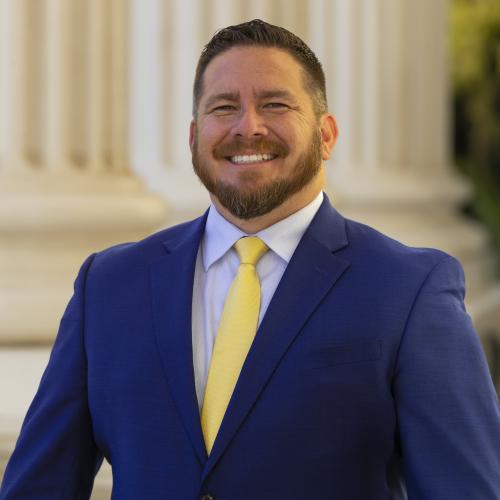
Asm. Juan Alanis
Sponsored bills
The Personal Income Tax Law imposes a tax on individual taxpayers measured by the taxpayer's taxable income for the taxable year, but excludes certain items of income from the computation of tax, including an exclusion for combat-related special compensation. This bill, for taxable years beginning on or after January 1, 2024, and before January 1, 2034, would exclude from gross income retirement pay received by a taxpayer from the federal government for service performed in the uniformed services, as defined, during the taxable year. The bill, for taxable years beginning on or after January 1, 2024, and before January 1, 2034, would also exclude from gross income annuity payments received by a qualified taxpayer, as defined, pursuant to a United States Department of Defense Survivor Benefit Plan during the taxable year. The bill would make related findings and declarations. Existing law requires any bill authorizing a new tax expenditure to contain, among other things, specific goals, purposes, and objectives that the tax expenditure will achieve, detailed performance indicators, and data collection requirements. This bill also would include additional information required for any bill authorizing a new tax expenditure. The bill would require the Franchise Tax Board and the Department of Veterans Affairs to provide any data requested by the Legislative Analyst to write the report, as provided, and would make taxpayer information received by the Legislative Analyst subject to limitation on the collection and use of that information. By expanding the scope of a crime, this bill would impose a state-mandated local program. The California Constitution requires the state to reimburse local agencies and school districts for certain costs mandated by the state. Statutory provisions establish procedures for making that reimbursement. This bill would provide that no reimbursement is required by this act for a specified reason. This bill would take effect immediately as a tax levy.
Existing law classifies certain substances, including cocaine, heroin, and fentanyl, as controlled substances and generally prohibits the possession, sale, transportation, and use of these substances. Existing law additionally prohibits the possession of certain of these controlled substances including cocaine, heroin, and methamphetamine while armed with a loaded and operable firearm. A violation of this prohibition is punishable as a felony punishable by incarceration in the state prison. This bill would additionally prohibit the possession of fentanyl, as specified, while armed with a loaded and operable firearm if the person has knowledge that the specific controlled substance is fentanyl. By expanding the application of an existing crime, this bill would impose a state-mandated local program. The California Constitution requires the state to reimburse local agencies and school districts for certain costs mandated by the state. Statutory provisions establish procedures for making that reimbursement. This bill would provide that no reimbursement is required by this act for a specified reason.
Existing law, the Safe Neighborhoods and Schools Act, enacted as an initiative statute by Proposition 47, as approved by the electors at the November 4, 2014, statewide general election, makes the theft of money, labor, or property petty theft punishable as a misdemeanor, whenever the value of the property taken does not exceed $950. Under existing law, if the value of the property taken exceeds $950, the theft is grand theft, punishable as a misdemeanor or a felony. Proposition 47 requires shoplifting, defined as entering a commercial establishment with the intent to commit larceny if the value of the property taken does not exceed $950, to be punished as a misdemeanor. Under existing law, if the value of all property taken over the course of distinct but related acts motivated by one intention, general impulse, and plan exceeds $950, those values may be aggregated into a single charge of grand theft. This bill would clarify that those values may be aggregated even though the thefts occurred in different places or from different victims. The bill would also, declarative of existing law, provide that circumstantial evidence may be used to prove that multiple thefts were motivated by one intention, general impulse, and plan. The bill would also authorize counties to operate a program to allow retailers to submit details of alleged shoplifting, organized retail theft, or grand theft directly to the county district attorney through an online portal on the district attorney's internet website. The bill would require counties that participate in the program to conduct an evaluation and collect specified information, and to report that information to the Assembly and Senate Public Safety Committees and the Board of State and Community Corrections, as specified.
Existing law requires the Department of Food and Agriculture, headed by the Secretary of Food and Agriculture, to promote and protect the agricultural industry of the state. Existing law authorizes the department to expend in accordance with law all money that is made available for its use. This bill would find and declare that it is a primary goal of the state to prevent the introduction, and suppress the spread, of invasive species within its borders. The bill would require, in carrying out this goal, the department, in collaboration with relevant state agencies and stakeholders, to develop and implement strategies to detect, control, monitor, and eradicate invasive species to protect the state's agriculture, environment, and natural resources. The bill would require the department, in consultation with other relevant state agencies, to allocate funds, if available, to implement and enforce these provisions.
(1) Existing law establishes various programs, including, among others, the Emergency Housing and Assistance Program and the homeless youth emergency service pilot projects to provide assistance to homeless persons. This bill would, upon appropriation of the Legislature, establish the California Housing Security Program to provide counties with funding to administer a housing subsidy to eligible persons, as specified, to reduce housing insecurity and help Californians meet their basic housing needs. To create the program, the bill would require the Department of Housing and Community Development, by January 1, 2026, to establish a 2-year pilot program, as specified, and to issue suggested guidelines to establish the program that include, among other things, criteria for program eligibility. The bill would specify that the subsidy would not be considered income for purposes of determining eligibility or benefits for any other public assistance program, nor would participation in other benefits exclude a person from eligibility for the subsidy. Under the bill, an undocumented person, as specified, who otherwise qualifies for the subsidy would be eligible for the subsidy. The bill would require the department, by January 1, 2026, to also provide each county selected to participate in the pilot program with a specified amount of funding for purposes of administering the housing subsidies. The bill would require, by July 1, 2026, a county participating in the pilot program, in consultation with specified entities, to perform prescribed duties, including reviewing the department's suggested guidelines and developing final guidelines to administer the housing subsidies based on the needs of the county. The bill would require participating counties, by January 1, 2027, to administer housing subsidies through the county and 2 or more grantees that are selected by the county to eligible persons, subject to specified requirements, including that the county is required to consider the final guidelines described above in selecting the grantees. The bill would provide that any resident of a county participating in the pilot program who meets specified eligibility requirements is eligible to apply for housing subsidies from the county or at least one of the selected grantees. Among other things, the bill would require a participating county to enter into a written agreement with the department to use program funds in a manner consistent with the bill's provisions, as specified, and would prohibit the department from providing program funds to a county that refuses or otherwise does not agree to use the funds in that manner. The bill would specify that a county is solely responsible for complying with the bill's provisions. The bill would define various terms for these purposes. (2) Existing law requires the department, on or before December 31 of each year, to submit an annual report to the Governor and both houses of the Legislature on the operations and accomplishments during the previous fiscal year of the housing programs administered by the department, as described, that includes specified information, including the number of individuals and households served and their income levels. The bill would additionally require the department, beginning January 1, 2028, and for the duration of the California Housing Security Program, to include specified programmatic performance metrics for the California Housing Security Program funds within that annual report. (3) This bill would make legislative findings and declarations as to the necessity of a special statute for the Counties of Los Angeles, San Diego, and Orange.
Maddy summaryThis California House Resolution condemns the July 13, 2024, assassination attempt on former President Donald J. Trump and calls for an end to political violence. The measure highlights the event where Trump was wounded while speaking at a rally in Butler, Pennsylvania, and notes that one attendee died and others were injured while trying to protect him. It urges the state to foster a political environment based on respectful discourse and nonviolence. The resolution is a formal statement of the Assembly's stance and does not create new laws or change existing policies.
Maddy summaryThis bill designates Thursday, July 25, 2024, as Hire a Veteran Day in California to honor veterans and encourage their employment. The measure is a commemorative resolution that does not create new laws, regulations, or funding but serves as an official state recognition of the date. By acknowledging this day, the Legislature aims to highlight the skills veterans bring to the workforce and support efforts to reduce veteran unemployment. The resolution requires no action from businesses or individuals other than observing the designated date.
This measure would recognize the importance of California Native American Day, celebrated this year on September 27, 2024, and the annual California Indian Cultural Awareness Conference, to the enhancement of awareness of California Indian culture.
Maddy summaryThis bill establishes Filipino American History Month to recognize the long-standing contributions of Filipinos to California and the United States. It directly affects state officials and the public by designating a specific month for commemoration and education. The resolution highlights historical milestones, including early Spanish-era interactions, the development of Filipino communities in cities like Stockton and San Francisco, and the significant roles Filipinos played in agriculture, shipbuilding, and military service during World War II. By formally acknowledging these events, the bill aims to promote awareness of Filipino American heritage within the state.