

Existing law requires, on or before January 1, 2020, the Superintendent of Public Instruction to recommend to the State Board of Education criteria for awarding a State Seal of Civic Engagement to pupils who have demonstrated excellence in civics education and participation and have demonstrated an understanding of the United States Constitution, the California Constitution, and the democratic system of government. This bill would establish the State Seal of Civic Engagement Resource Lead for the purpose of providing support and technical assistance to local educational agencies to improve equitable statewide access to the State Seal of Civic Engagement. The bill would, on or before July 1, 2024, require the Superintendent, in consultation with the executive director of the state board, to select a partnership, consisting of an applicant county office of education and a community organization, to administer the State Seal of Civic Engagement Resource Lead, as provided. The bill would require the State Seal of Civic Engagement Resource Lead to, among other duties, coordinate support, provide technical assistance, and deliver professional learning to improve equitable statewide access to the State Seal of Civic Engagement, research and publish best practices in the civic engagement of underserved pupil populations, as provided, and sponsor and promote civic engagement practicums to expand the breadth of support from local educational agencies and community partners for pupils pursuing the State Seal of Civic Engagement, as provided. The bill would require the State Seal of Civic Engagement Resource Lead to submit a report to the State Department of Education by January 1, 2027, that makes findings and recommendations related to evidence-based strategies to provide equitable pupil access to the State Seal of Civic Engagement throughout a local educational agency. The bill would require the department to submit this report to the appropriate fiscal and policy committees of the Legislature, as provided. The bill would make the implementation of these provisions contingent upon an appropriation by the Legislature for these purposes.
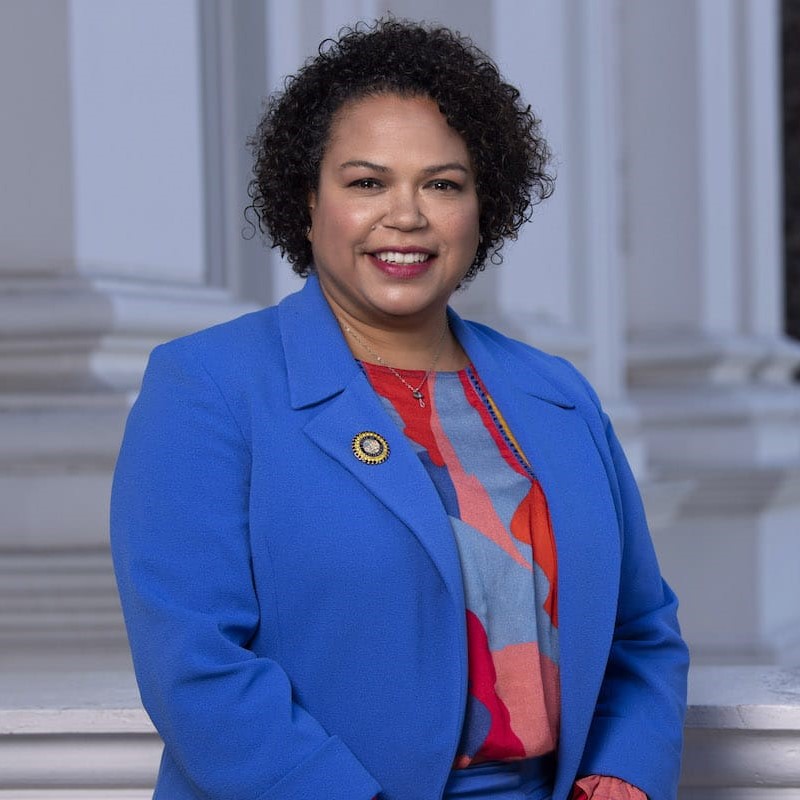
Asm. Mia Bonta
Sponsored bills
Existing law makes a person who violates any provision of law proscribing theft, embezzlement, forgery, or fraud, or identity theft, with respect to the property or personal identifying information of an elder or a dependent adult, and who knows or reasonably should know that the victim is an elder or a dependent adult, punishable as a misdemeanor or a felony, as specified. This bill would state the intent of the Legislature to enact legislation pertaining to scams targeting vulnerable seniors and their communities.
Existing law, the Planning and Zoning Law, requires each city, county, and city and county to prepare and adopt a general plan that contains certain mandatory elements, including a housing element. Existing law requires the housing element to identify the existing and projected housing needs of all economic segments of the community. Existing federal law requires a continuum of care, a group organized under the federal McKinney-Vento Homeless Assistance Act, to develop a plan that includes planning for and conducting, at least biennially, a point-in-time count of homeless persons within the geographic area. Existing law requires that information from the point-in-time count be used to, among other things, allocate funding for the Homeless Emergency Aid program and Homeless Housing, Assistance, and Prevention program. This bill would require a city, county, and city and county, within 60 days after the local continuum of care releases the results of a point-in-time count for a city, county, or city and county's jurisdiction, to, among other things, agendize the point-in-time count results at a meeting of the city, county, or city and county and present the steps the city, county, or city and county is taking to prevent and end homelessness, including, but not limited to, consideration of specified actions. By imposing new duties on local agencies, this bill would impose a state-mandated local program. The bill would include findings that changes proposed by this bill address a matter of statewide concern rather than a municipal affair and, therefore, apply to all cities, including charter cities. The California Constitution requires the state to reimburse local agencies and school districts for certain costs mandated by the state. Statutory provisions establish procedures for making that reimbursement. This bill would provide that, if the Commission on State Mandates determines that the bill contains costs mandated by the state, reimbursement for those costs shall be made pursuant to the statutory provisions noted above.
Existing law establishes the Medi-Cal program, which is administered by the State Department of Health Care Services and under which qualified low-income individuals receive health care services. The Medi-Cal program is, in part, governed and funded by federal Medicaid program provisions. Existing law requires the department to establish the Medically Tailored Meals Pilot Program and the Short-Term Medically Tailored Meals Intervention Services Program, to operate in specified counties and during limited periods for the purpose of providing medically tailored meal intervention services to eligible Medi-Cal beneficiaries with certain health conditions, including congestive heart failure, cancer, diabetes, chronic obstructive pulmonary disease, or renal disease. Existing law, subject to implementation of the California Advancing and Innovating Medi-Cal (CalAIM) initiative, authorizes a Medi-Cal managed care plan to elect to cover community supports approved by the department as cost effective and medically appropriate in a comprehensive risk contract that are in lieu of applicable Medi-Cal state plan services. Under existing law, community supports that the department is authorized to approve include, among other things, medically supportive food and nutrition services, including medically tailored meals. This bill would make medically supportive food and nutrition interventions, as defined, a covered benefit under the Medi-Cal program, upon issuance of final guidance by the department. The bill would require medically supportive food and nutrition interventions to be covered when determined to be medically necessary by a health care provider or health care plan, as specified. In order to qualify for coverage under the Medi-Cal program, the bill would require a patient to be offered at least 3 of 6 specified medically supportive food and nutrition interventions and for the interventions to be provided for a minimum duration of 12 weeks, as specified. The bill would only provide coverage for nutrition support interventions when paired with the provision of food through one of the 3 offered interventions. The bill would require a health care provider to match the acuity of a patient's condition to the intensity and duration of the medically supportive food and nutrition intervention and include culturally appropriate foods whenever possible. The bill would establish a medically supportive food and nutrition benefit advisory workgroup to advise the department in developing final guidance related to eligible populations, the duration and dosage of medically supportive food and nutrition interventions, the ratesetting process, determination of permitted providers, and continuing education for health care providers, as specified. The bill would require the workgroup to include certain stakeholders knowledgeable in medically supportive food and nutrition interventions and stakeholders from Medi-Cal consumer advocacy organizations. The bill would require the workgroup to meet at least quarterly and would require the department to issue final guidance on or before July 1, 2026. The bill would also include findings and declarations of the Legislature relating to the need for medically supportive food and nutrition intervention coverage under the Medi-Cal program.
Existing law establishes the Department of Housing and Community Development in the Business, Consumer Services, and Housing Agency and makes the department responsible for administering various housing programs throughout the state, including, among others, the Multifamily Housing Program, the Housing for a Healthy California Program, and the California Emergency Solutions Grants Program. Upon appropriation by the Legislature for this express purpose, this bill would require the department to create the Reentry Housing and Workforce Development Program, and would require the department to take specified actions to provide grants to applicants, as defined, for innovative or evidence-based housing, housing-based services, family reunification services, women services, and employment interventions to allow people with recent histories of incarceration to exit homelessness and remain stably housed. The bill would require the department to establish a process, in collaboration with the Department of Corrections and Rehabilitation and with counties in which recipients are operating, for referral of participants, in accordance with certain guidelines and procedures. The bill would require the department to score applicants to the program competitively according to specified criteria. The bill would require recipients of funds from the program to use those funds for, among other things, long-term rental assistance in permanent housing, incentives to landlords, and innovative or evidence-based services to assist participants in accessing permanent supportive housing. The bill would require the department to distribute funds allocated by executing contracts with awarded entities for a term of 5 years, subject to automatic renewal. The bill would require a recipient of the program to submit an annual report to the department. The bill would require the department to hire an independent evaluator to assess outcomes from the program and would require the department to submit the analysis of that assessment to specified committees of the Legislature.
Existing sales and use tax laws impose a tax on retailers measured by the gross receipts from the sale of tangible personal property sold at retail in this state, or on the storage, use, or other consumption in this state of tangible personal property purchased from a retailer for storage, use, or other consumption in this state. Those laws provide various exemptions from those taxes. This bill, beginning January 1, 2024, and until January 1, 2029, would exempt from those taxes the gross receipts from the sale in this state of, and the storage, use, or other consumption in this state of, zero-emission public transportation ferries, as defined, sold to a public agency, as specified. Existing law requires a bill that would authorize a new tax expenditure under the Sales and Use Tax Law to identify specific goals, purposes, and objectives that the tax expenditure will achieve, and detailed performance indicators and data collection requirements for determining whether the tax expenditure achieves these goals, purposes, and objectives. The bill would provide findings and declarations relating to the goals of the exemption for zero-emission public transportation ferries. Existing law imposes or dedicates certain state sales and use tax rates for local funding, including through the Local Revenue Fund 2011. This bill would specify that this exemption does not apply to those state sales and use tax rates imposed or dedicated for local government funding, including those rates for which revenues are deposited into the Local Revenue Fund 2011. The Bradley-Burns Uniform Local Sales and Use Tax Law authorizes counties and cities to impose local sales and use taxes in conformity with the Sales and Use Tax Law, and existing laws authorize districts, as specified, to impose transactions and use taxes in accordance with the Transactions and Use Tax Law, which generally conforms to the Sales and Use Tax Law. Amendments to the Sales and Use Tax Law are automatically incorporated into the local tax laws. This bill would specify that this exemption does not apply to local sales and use taxes or transactions and use taxes. This bill would take effect immediately as a tax levy.
Existing law establishes the California Community Colleges, under the administration of the Board of Governors of the California Community Colleges, as one of the segments of public postsecondary education in this state. Existing law requires the governing board of each community college district to charge students a fee of $46 per unit per semester, and requires or authorizes, as provided, the governing board to waive that fee for certain students. This bill would require community college districts to waive the fees for specified courses for students who are employed as childcare providers, as defined, at the time of enrollment. To the extent the bill would impose additional duties on community college districts, the bill would impose a state-mandated local program. The California Constitution requires the state to reimburse local agencies and school districts for certain costs mandated by the state. Statutory provisions establish procedures for making that reimbursement. This bill would provide that, if the Commission on State Mandates determines that the bill contains costs mandated by the state, reimbursement for those costs shall be made pursuant to the statutory provisions noted above.
Existing law establishes a workers' compensation system, administered by the Administrative Director of the Division of Workers' Compensation, to compensate an employee for injuries sustained in the course of employment. Existing law creates a rebuttable presumption that specified injuries sustained in the course of employment of a specified member of law enforcement or a specified first responder arose out of and in the course of employment. Existing law, until January 1, 2024, creates a rebuttable presumption of injury for various employees, including an employee who works at a health facility, as defined, to include an illness or death resulting from COVID-19, if specified circumstances apply. This bill would define "injury," for a hospital employee who provides direct patient care in an acute care hospital, to include infectious diseases, cancer, musculoskeletal injuries, post-traumatic stress disorder, and respiratory diseases. The bill would include the 2019 novel coronavirus disease (COVID-19) from SARS-CoV-2 and its variants, among other conditions, in the definitions of infectious and respiratory diseases. The bill would create rebuttable presumptions that these injuries that develop or manifest in a hospital employee who provides direct patient care in an acute care hospital arose out of and in the course of the employment. The bill would extend these presumptions for specified time periods after the hospital employee's termination of employment.
Existing law, the California Worker Adjustment and Retraining Act, governs relocations, terminations, and mass layoffs. Existing law prohibits an employer from ordering a mass layoff, relocation, or termination at a covered establishment unless, 60 days before the order takes effect, the employer gives prescribed written notice of the order to specified entities, including the local workforce investment board and the chief elected official of each city and county government within which the termination, relocation, or mass layoff occurs. Existing law exempts certain types of employment from the act, including seasonal employment where the employees were hired with the understanding that their employment was seasonal and temporary (seasonal employment exemption) . Existing law makes an employer who fails to give notice as required liable to each employee entitled to notice who lost their employment for prescribed compensation, calculated for the period of the employer's violation, up to a maximum of 60 days, or 12 the number of days that the employee was employed by the employer, whichever period is smaller. Existing law authorizes the Labor Commissioner to enforce specified provisions of existing law, as prescribed. Existing law defines terms for its purposes, including definitions for the terms "employer" and "employee." Existing law defines "mass layoff" for purposes of the act to mean a layoff during any 30-day period of 50 or more employees at a covered establishment, and defines "covered establishment" as an industrial or commercial facility that employs, or has employed within the preceding 12 months, 75 or more persons. This bill would require the prescribed notice 75 days before the order takes effect, and would make a conforming change to the calculation of employer liability. The bill would modify the requirement for notice to the local workforce investment board and the chief elected official of each city and county government within which the termination, relocation, or mass layoff occurs to apply only to a termination, relocation, or mass layoff that impacts 50 or more employees at a single location. The bill would require a labor contractor to remit to the employee the payment provided to the client employer in the full amount calculated, as specified, for a violation of the notice requirement, and would define a "labor contractor" for purposes of the act. This bill would additionally require for the application of the seasonal employment exemption that the season be complete. The bill would also exempt from the act employees who are employed by a labor contractor to fulfill the needs of a temporary project with a defined end date and are laid off because of the completion of the temporary employment contract, as specified. This bill would include within the term "employer" a client employer of a labor contractor. The bill would include within the term "employee" a person employed by a labor contractor and performing labor with the client employer for at least 6 months of the 12 months and for at least 60 hours preceding the date on which notice is required. The bill would revise the definition of "covered establishment" to instead mean a place of employment that employs, or has employed within the preceding 12 months, 75 or more persons, and would specify that a "covered establishment" may be a single location or a group of locations, as specified. The bill would revise the definition of "mass layoff" to also include employees reporting to a covered establishment. This bill would prohibit an employer from utilizing compliance with the act in connection with a severance agreement and waiver of an employee's right to claims. The bill would provide that any general release, waiver of claims, or nondisparagement or nondisclosure agreement that is made a condition of the payment of amounts for which the employer is liable is void as a matter of law and against public policy. The bill would prohibit an employer who is required to give notice from offering an employee a separate agreement that includes a general release, waiver of claims, or nondisparagement or nondisclosure agreement, unless the agreement is offered in exchange for reasonable consideration that is in addition to anything of value to which the individual already is entitled and includes a statement to this effect, as specified. The bill would provide that any agreement in violation of this prohibition is void as a matter of law and against public policy, and would make an employer who violates this provision subject to a civil penalty of up to $500 for each violation.
Existing law generally requires county boards of supervisors, city councils, and the governing boards of school districts, community college districts, and other special districts, if those bodies are elected using district-based elections, to adopt new boundaries for the districts following each federal decennial census. Notwithstanding that requirement, existing law authorizes a local jurisdiction other than a charter city to establish an independent redistricting commission to adopt new boundaries for the local jurisdiction's districts. This bill would require a county, general law city, charter city, or charter city and county that contains over 300,000 residents, and a school district or community college district that contains over 500,000 residents, to establish an independent redistricting commission to adopt district boundaries after each federal decennial census. The bill would require a county, general law city, charter city, or charter city or county with over 300,000 residents, and a school district or community college district with over 500,000 residents, that does not enact an ordinance, resolution, or charter amendment establishing an independent redistricting commission by January 1, 2030, and January 1 of every subsequent year ending in 0, to establish a 14-member independent redistricting commission according to specified procedures, including procedures for the random selection of the members of the commission from among applicants meeting certain qualifications. By requiring certain local jurisdictions to establish independent redistricting commissions to adopt district boundaries, the bill would impose a state-mandated local program. The bill would prohibit a member of an independent redistricting commission from communicating with any individual or organization regarding redistricting matters, except as provided. The bill would require the State Auditor to provide the contact information of any applicant to serve on the Citizens Redistricting Commission, which is responsible for adjusting the boundary lines of the congressional, legislative, and State Board of Equalization districts, to any city or county that has established an independent or hybrid redistricting commission, provided that the applicant has consented to share this information and the city or county has requested to receive this information, and to inform those applicants of opportunities to serve on an independent or hybrid redistricting commission. The bill would require the State Auditor to establish a database and create and advertise a process for this exchange of information. Under existing law, independent redistricting commissions have been established for the Counties of Los Angeles, San Diego, Riverside, Fresno, and Kern. The bill would exempt the Counties of Los Angeles, San Diego, Riverside, Fresno, and Kern from the bill's provisions requiring a county with over 300,000 residents to establish an independent redistricting commission, unless the existing law provisions establishing independent redistricting commissions for those counties are repealed or invalidated. The bill also would exempt a charter city with a population of at least 2,500,000 people from the bill's provisions if specified conditions are met, including if both this bill and Senate Bill 52 are enacted and if the city complies with certain provisions in Senate Bill 52 that require such cities to establish independent redistricting commissions. This bill would incorporate additional changes to Section 23003 of the Elections Code proposed by Assembly Bill 764 to be operative only if this bill and Assembly Bill 764 are enacted and this bill is enacted last. The bill would include findings that changes proposed by this bill address a matter of statewide concern rather than a municipal affair and, therefore, apply to all cities, including charter cities. The California Constitution requires the state to reimburse local agencies and school districts for certain costs mandated by the state. Statutory provisions establish procedures for making that reimbursement. This bill would provide that, if the Commission on State Mandates determines that the bill contains costs mandated by the state, reimbursement for those costs shall be made pursuant to the statutory provisions noted above.