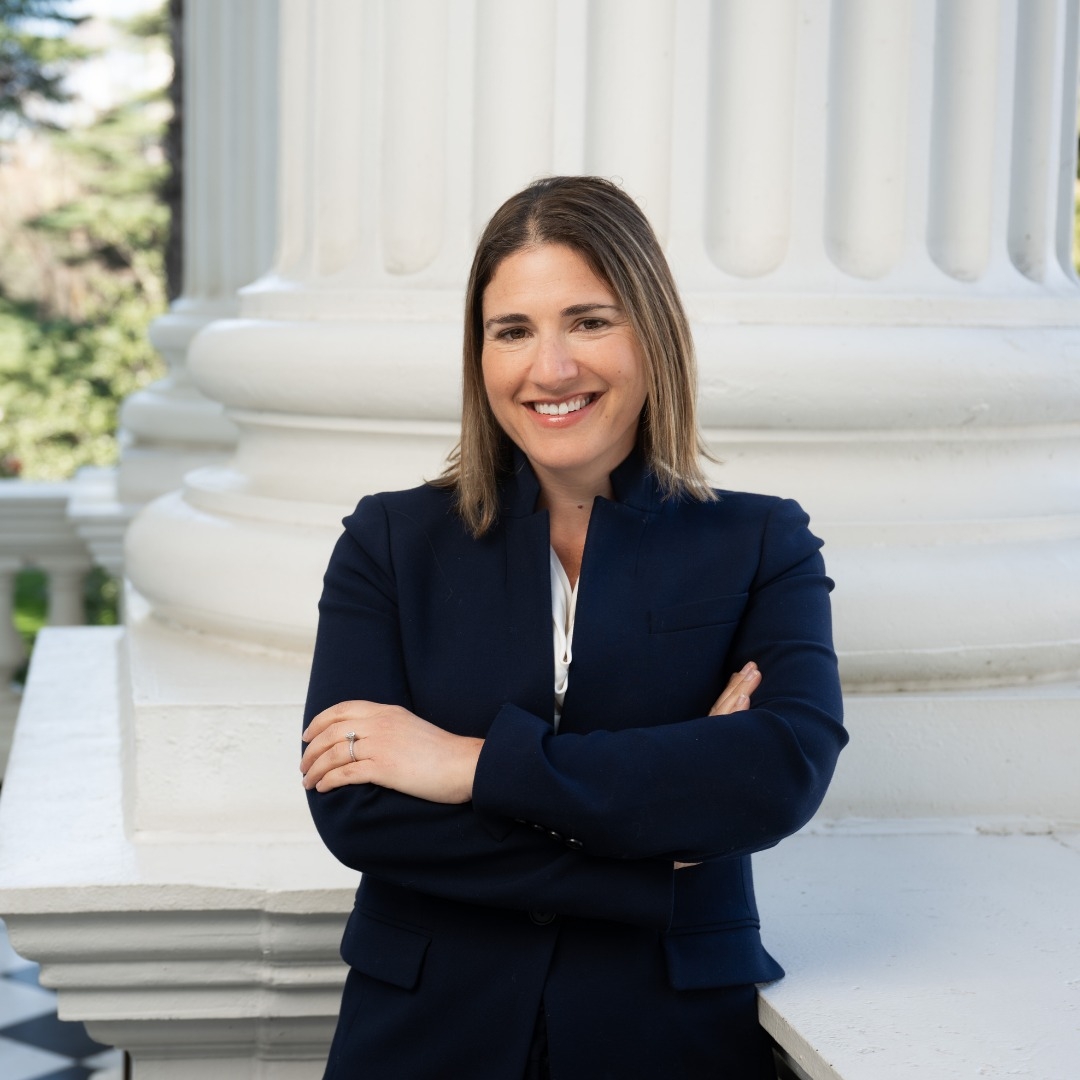
Photo of Rebecca Bauer-Kahan
D California Assembly · District 16 On the 2026 ballot

Asm. Rebecca Bauer-Kahan

Compare
Total votes
17,853
all sessions
Attendance
94%
974 missed
Near the chamber average
With party
99%
of cast votes
Near the chamber average
Bipartisan score
0%
crosses aisle rarely
Near the chamber average
Sponsored
1,561
bills & resolutions
Near the chamber average
Committees
8
assignments
1,561 bills and resolutions

Sponsored bills

Total
1,561
Primary
161
Co-sponsor
1,400
This page
1,561
matching current filters
Co-sponsor HR 79
Passed · California Assembly · Co-sponsor
Relative to Unclaimed Property Month.

Maddy summaryThis bill designates February 2026 as Unclaimed Property Month in California to raise awareness about state-held financial assets. It encourages residents to check the state Controller's website to claim unclaimed funds such as uncashed checks and insurance proceeds. The resolution does not change any laws or policies but serves as a public awareness campaign to help people locate and claim their abandoned property. It directs the Assembly Chief Clerk to distribute copies of the resolution for public distribution.

Passed Feb 5, 2026 1 co-sponsor
Co-sponsor HR 77
Passed · California Assembly · Co-sponsor
Relative to school governance.

Maddy summaryThis House Resolution declares January 2026 as School Board Recognition Month to honor the nearly 5,000 school board members across California's 1,000 school districts and county offices of education. The resolution recognizes these locally elected officials for their work in guiding public education and serving diverse communities, emphasizing their role in ensuring students' academic, social-emotional, and health needs are met. It calls on community members to join in acknowledging the dedication of school board members and collaborate to improve the education system. The bill has no operational effect beyond this symbolic recognition and does not change any laws or policies.

Passed Feb 5, 2026 1 co-sponsor
Co-sponsor HR 76
Passed · California Assembly · Co-sponsor
Relative to affordable homeownership.

Maddy summaryThis House Resolution formally recognizes the importance of affordable homeownership for California families, particularly those with lower incomes, and highlights how nonprofit-led programs help build generational wealth and reduce economic disparities. The document emphasizes that existing state programs like CalHome support the construction and preservation of affordable homes through competitive funding to cities, counties, indigenous communities, and nonprofit builders such as Habitat for Humanity. While the resolution does not create new laws or funding, it serves as an official acknowledgment of homeownership's role in improving educational outcomes, health, civic participation, and neighborhood stability. The text also notes California's significant housing deficit and racial wealth gaps as context for why expanding affordable ownership opportunities is a priority for state policy.

Passed Feb 5, 2026 1 co-sponsor
Primary AB 1345
Failed · California Assembly · Lead sponsor
Cartwright Act: restraint of trade.

Existing law establishes the Attorney General as the head of the Department of Justice, with charge of all legal matters in which the state is interested, except as specified. Existing law imposes various requirements on the Attorney General related to consumer protection, including, among others, the supervision of charitable trusts and the enforcement of antitrust laws. Existing law, known as the Cartwright Act, identifies certain acts that are unlawful restraints of trade and unlawful trusts. Under existing law, a violation of the Cartwright Act is punishable as a crime. This bill would provide that is unlawful for one or more persons to act, cause, take, or direct a measure, action, or event that is either in restraint of trade, as specified, or to monopolize or monopsonize, as specified. Because the bill would expand the scope of activities punishable as a crime under the Cartwight Act, the bill would impose a state-mandated local program. The bill would make related findings and declarations. The California Constitution requires the state to reimburse local agencies and school districts for certain costs mandated by the state. Statutory provisions establish procedures for making that reimbursement. This bill would provide that no reimbursement is required by this act for a specified reason.

Failed Feb 2, 2026 0 co-sponsors
Primary AB 1222
Failed · California Assembly · Lead sponsor
Public utilities: judicial review.

Existing law authorizes a party aggrieved by a decision or order of the Public Utilities Commission to file a petition for a writ of review in the court of appeal or the Supreme Court for purposes of reviewing the decision or order within 30 days after the commission issues its decision denying the application for a rehearing, or, if the application was granted, within 30 days after the commission issues its decision on the rehearing, or at least 120 days after the application is granted if no decision on rehearing has been issued. This bill would extend the 30-day time periods to 90 days. For a petition challenging a final decision of the commission on the grounds that the final decision substantially deviated from a proposed decision of a commission administrative law judge, the bill would require the court to presume the final decision to be arbitrary and unlawful unless the commission can demonstrate to the satisfaction of the court that the deviations were necessary to comply with state or federal law. Existing law authorizes the commission to fix the rates and charges for public utilities, including electrical and gas corporations, and requires those rates to be just and reasonable. This bill would prohibit the commission from authorizing electrical or gas corporations to recover from their ratepayers the costs associated with seeking judicial review of a commission decision by a state or federal court or requesting relief from a commission decision at a federal agency. The bill would require the electrical and gas corporation to track those costs. Under existing law, a violation of the Public Utilities Act or any order, decision, rule, direction, demand, or requirement of the commission is a crime. Because the above provisions would be part of the act and a violation of a commission action implementing this bill's requirements would be a crime, the bill would impose a state-mandated local program. The California Constitution requires the state to reimburse local agencies and school districts for certain costs mandated by the state. Statutory provisions establish procedures for making that reimbursement. This bill would provide that no reimbursement is required by this act for a specified reason.

Failed Feb 2, 2026 0 co-sponsors
Primary AB 67
Failed · California Assembly · Lead sponsor
Attorney General: Reproductive Privacy Act: enforcement.

Existing law, the Reproductive Privacy Act, prohibits a person from being subject to civil or criminal liability, or otherwise deprived of their rights, based on their actions or omissions with respect to their pregnancy or actual, potential, or alleged pregnancy outcome or based solely on their actions to aid or assist a woman or pregnant person who is exercising their reproductive rights as specified in the act. Existing law authorizes a party whose rights are protected by the Reproductive Privacy Act to bring a civil action against an offending state actor when those rights are interfered with by conduct or by statute, ordinance, or other state or local rule, regulation, or enactment in violation of the act, as specified, and require a court, upon a motion, to award reasonable attorneys' fees and costs to a prevailing plaintiff. This bill would authorize the Attorney General, if it appears to them that a person has engaged, or is about to engage, in any act or practice constituting a violation of the Reproductive Privacy Act, to bring an action in the name of the people of the State of California in the superior court to enjoin the acts or practices or to enforce compliance with the act, as specified. In this context, the bill would authorize the Attorney General to make public or private investigations, publish information concerning violation of the Reproductive Privacy Act, and subpoena witnesses, compel their attendance, take evidence, and require the production of documents or records that they deem relevant or material to the inquiry. This bill would impose a civil penalty not exceeding $25,000 upon any person or governmental entity that violates any provision of the act and a civil penalty for violation of the bill's provisions, to be determined as specified. The bill would require any costs, fees, and civil penalties collected pursuant to these provisions to be available to the office of the Attorney General upon appropriation of the Legislature for exclusive use by the Attorney General for enforcement of act. Existing law, the Government Claims Act, generally requires that all claims for money or damages against local public entities be presented in accordance with specified law, and excepts certain claims from this requirement. This bill would additionally except claims brought under the Reproductive Privacy Act from those requirements under the Government Claims Act.

Failed Feb 2, 2026 0 co-sponsors
Co-sponsor AB 1426
Failed · California Assembly · Co-sponsor
Diablo Range Conservation Program.

The Wildlife Conservation Law of 1947 establishes the Wildlife Conservation Board within the Department of Fish and Wildlife to investigate, study, and determine what areas within the state are most essential and suitable for wildlife production and preservation, among other things. Under existing law, the board administers various habitat conservation programs. This bill would require the board to establish and administer, through the Department of Fish and Wildlife, the Diablo Range Conservation Program and, pursuant to the program, to approve projects to acquire, preserve, restore, and enhance habitat within the Diablo Range, as defined, consistent with conservation strategies approved by the department. The bill would authorize the board to provide grants to local public agencies, nonprofit organizations, and California Native American tribes to be used for various purposes, including the acquisition, restoration, and enhancement of fish and wildlife habitat and other natural resources within and adjacent to the Diablo Range. The bill would establish the Diablo Range Conservation Fund in the State Treasury and would make moneys in the fund available, upon appropriation by the Legislature, for purposes of the program. The bill would authorize the board to accept moneys, grants, goods, or services contributed to it by public agencies or private entities or persons and would require those moneys to be deposited in the Donation Account, which the bill would establish in the fund. The bill would continuously appropriate the moneys in the account to the board for purposes of the program, thereby making an appropriation.

Failed Feb 2, 2026 1 co-sponsor
Co-sponsor SB 242
Failed · California Senate · Co-sponsor
Medicare supplement coverage: open enrollment periods.

Existing federal law provides for the Medicare Program, which is a public health insurance program for persons 65 years of age and older and specified persons with disabilities who are under 65 years of age. Existing federal law specifies parts of Medicare that cover specific services, such as Medicare Part B, which generally covers medically necessary services and supplies and preventive services. Existing law, the Knox-Keene Health Care Service Plan Act of 1975, provides for the licensure and regulation of health care service plans by the Department of Managed Health Care, and makes a willful violation of the act a crime. Existing law provides for the regulation of health insurers by the Department of Insurance. Existing federal law additionally provides for the issuance of Medicare supplement policies or certificates, also known as Medigap coverage, which are advertised, marketed, or designed primarily as a supplement to reimbursements under the Medicare Program for the hospital, medical, or surgical expenses of persons eligible for the Medicare Program, including coverage of Medicare deductible, copayment, or coinsurance amounts, as specified. Existing law, among other provisions, requires supplement benefit plans to be uniform in structure, language, designation, and format with the standard benefit plans, as prescribed. Existing law prohibits an issuer from denying or conditioning the offering or effectiveness of any Medicare supplement contract, policy, or certificate available for sale in this state, or discriminating in the pricing of a contract, policy, or certificate because of the health status, claims experience, receipt of health care, or medical condition of an applicant in the case of an application that is submitted prior to or during the 6-month period beginning with the first day of the first month in which an individual is both 65 years of age or older and is enrolled for benefits under Medicare Part B. Existing law requires an issuer to make available specified Medicare supplement benefit plans to a qualifying applicant under those circumstances who is 64 years of age or younger who does not have end stage renal disease. This bill would delete the exclusion of otherwise qualified applicants who have end stage renal disease, thereby making the specified Medicare supplement benefit plans available to those individuals. The bill, on and after January 1, 2027, would prohibit an issuer of Medicare supplement coverage in this state from denying or conditioning the issuance or effectiveness of any Medicare supplement coverage available for sale in the state, or discriminate in the pricing of that coverage because of the health status, claims experience, receipt of health care, medical condition, or age of an applicant, except as specified, if an application for coverage is submitted during an open enrollment period, as specified in the bill. The bill would entitle an individual enrolled in Medicare Part B to a 90-day annual open enrollment period beginning on January 1 of each year, as specified, during which period the bill would require applications to be accepted for any Medicare supplement coverage available from an issuer, as specified. The bill would require the open enrollment period to be a guaranteed issue period. The bill would authorize premium rates offered to applicants during the open enrollment period to vary based on the applicants' age at the time of issue, as specified, but would prohibit the premiums from varying based on age after the contract is issued. Because a violation of the bill's requirements by a health care service plan would be a crime, the bill would impose a state-mandated local program. The California Constitution requires the state to reimburse local agencies and school districts for certain costs mandated by the state. Statutory provisions establish procedures for making that reimbursement. This bill would provide that no reimbursement is required by this act for a specified reason.

Failed Feb 2, 2026 1 co-sponsor
Co-sponsor AB 1468
Failed · California Assembly · Co-sponsor
Ethnic studies: content standards, curriculum frameworks, instructional materials, and compliance monitoring.

Existing law requires the State Board of Education to adopt statewide academically rigorous content standards in the core curriculum areas of reading, writing, mathematics, history/social science, and science, as specified. Existing law requires the Instructional Quality Commission to, among other things, recommend curriculum frameworks to the state board and develop criteria for evaluating instructional materials. This bill would require the state board to, on or before January 1, 2028, develop and adopt academically rigorous content standards for ethnic studies instruction in high school. The bill would require the commission, on or before January 1, 2028, to review and recommend to the state board curriculum frameworks and instructional materials for ethnic studies instruction in high school, as specified. The bill would require the state board to provide the commission with evaluation criteria to use in providing its review and recommendations. The bill would state the intent of the Legislature to enact subsequent legislation to establish an advisory committee with a majority of the advisory committee's members being experts in African American studies, Asian American and Pacific Islander studies, Native American studies, and Latino and Chicanx studies, to provide input to the state board on proposed content standards and to the commission on proposed curriculum frameworks and instructional materials for ethnic studies instruction in high school. Existing law requires a pupil to complete designated coursework while in grades 9 to 12, inclusive, in order to receive a diploma of graduation from high school. These graduation requirements include, commencing for pupils graduating in the 2029–30 school year, the completion of a one-semester course in ethnic studies meeting specified requirements. Under existing law, the requirement to complete an ethnic studies course may be fulfilled by the completion of, among others, a course based on the model curriculum developed by the Instructional Quality Commission, an ethnic studies course taught as part of a course that has been approved as meeting the A–G requirements of the University of California and the California State University, or a locally developed ethnic studies course approved by the governing board of a school district or the governing body of a charter school. Existing law requires the curriculum, instruction, and instructional materials for these ethnic studies courses to meet specified requirements, including that they not reflect or promote any bias, bigotry, or discrimination against any person or group of persons on the basis of certain characteristics. Existing law makes these provisions relating to ethnic studies courses operative only upon an appropriation of funds by the Legislature for purposes of these provisions. This bill would require the curriculum, instruction, and instructional materials for any high school ethnic studies course, including ethnic studies courses meeting high school graduation requirements, to meet the above-described requirements, and would require the curriculum, instruction, and instructional materials for all high school ethnic studies courses to additionally, among other things, foster multicultural respect and understanding and focus on the domestic experience and stories of historically marginalized peoples in American society. To the extent that the bill would impose new duties on local educational agencies, the bill would impose a state-mandated local program. The bill would require a school district, county office of education, or charter school to provide, on or before June 30, 2026, the State Department of Education with a copy of all curricula, instruction, and instructional materials in ethnic studies that schools offer or plan to offer to pupils in any of grades 9 to 12, inclusive, and the adoption calendar for curricula, instruction, and instructional materials in ethnic studies proposed for adoption by the governing board or body of the local educational agency for instruction to these pupils. The bill would require a local educational agency that does not have an ethnic studies course in place for its pupils in any of grades 9 to 12, inclusive, on or before June 30, 2026, to provide the department with a copy of all curricula, instruction, and instructional materials in ethnic studies that its schools seek to adopt at least 60 days before being first presented at a public meeting of the governing board or body of the local educational agency for instruction to these pupils. The bill would require the department to post the information received pursuant to these requirements on its internet website. To the extent that the bill would impose new duties on local educational agencies, it would impose a state-mandated local program. The bill would require the department to monitor compliance with the requirements of this bill as part of its annual compliance monitoring of state and federal programs and to provide a report to the relevant policy and fiscal committees of the Legislature summarizing the data collected through compliance monitoring, as specified. The California Constitution requires the state to reimburse local agencies and school districts for certain costs mandated by the state. Statutory provisions establish procedures for making that reimbursement. This bill would provide that, if the Commission on State Mandates determines that the bill contains costs mandated by the state, reimbursement for those costs shall be made pursuant to the statutory provisions noted above.


Failed Feb 2, 2026 1 co-sponsor
Primary AB 432
Vetoed · California Assembly · Lead sponsor
Menopause.

(1) Existing law, the Medical Practice Act, provides for the licensure and regulation of physicians and surgeons by the Medical Board of California and requires the board to adopt and administer standards for the continuing education of those licensees. Existing law requires the board, in determining its continuing education requirements, to consider including a course in menopausal mental or physical health. This bill would delete that requirement of the board. The bill would require, beginning July 1, 2026, and until July 1, 2032, a qualifying physician and surgeon, as defined, who completes continuing medical education courses in perimenopause, menopause, and postmenopausal care to receive 2 hours of credit for each hour completed of that coursework, as specified. Existing law, the Osteopathic Act, provides for the licensure and regulation of osteopathic physicians and surgeons by the Osteopathic Medical Board of California and requires the board to adopt and administer standards for the continuing education of those licensees. This bill would require osteopathic physicians and surgeons to receive the same credit as described above for completed coursework relating to perimenopause, menopause, and postmenopausal care. (2) Existing law, the Knox-Keene Health Care Service Plan Act of 1975, provides for the licensure and regulation of health care service plans by the Department of Managed Health Care and makes a willful violation of the act a crime. Existing law also provides for the regulation of health insurers by the Department of Insurance. Existing law sets forth specified coverage requirements for health care service plan contracts and health insurance policies. This bill would require a health care service plan contract or health insurance policy that covers outpatient prescription drugs, except as specified, that is issued, amended, or renewed on or after January 1, 2026, to include coverage for evaluation and treatment options for symptoms of perimenopause and menopause. The bill would require a health care service plan or health insurer to annually provide clinical care recommendations, as specified, for hormone therapy to all contracted primary care providers who treat individuals with perimenopause and menopause. Because a willful violation of these provisions by a health care service plan would be a crime, the bill would impose a state-mandated local program. (3) The California Constitution requires the state to reimburse local agencies and school districts for certain costs mandated by the state. Statutory provisions establish procedures for making that reimbursement. This bill would provide that no reimbursement is required by this act for a specified reason.

Vetoed Jan 22, 2026 0 co-sponsors
Showing 211 to 220 of 1,561 bills
Previous 1 … 21 22 23 … 157 Next