

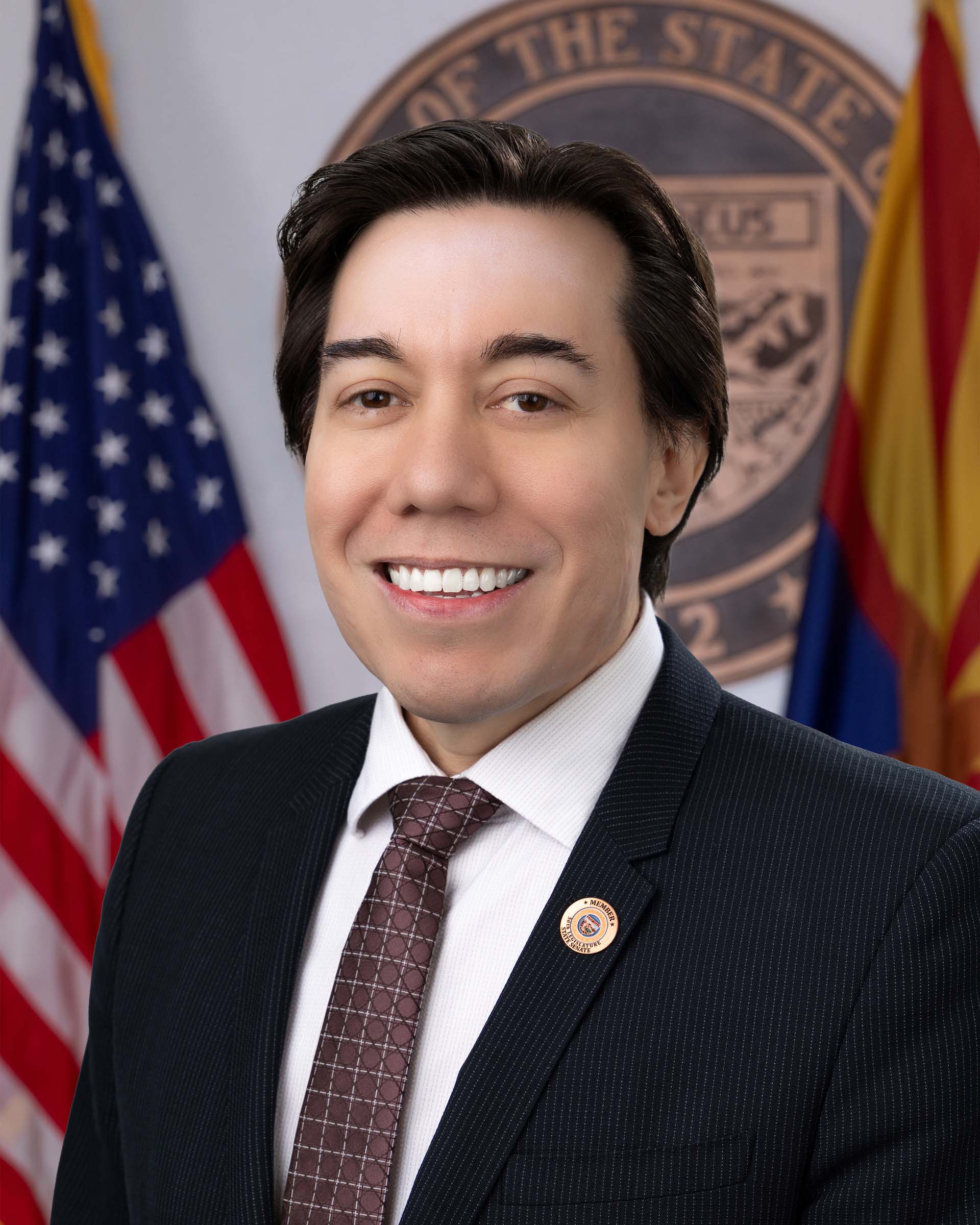
Photo of Brian Fernandez
D Arizona Senate · District 23 On the 2026 ballot

Sen. Brian Fernandez

Compare
Total votes
3,526
all sessions
Attendance
87%
454 missed
Lower than 87% of chamber peers
With party
93%
of cast votes
Lower than 87% of chamber peers
Bipartisan score
5%
crosses aisle rarely
Higher than 83% of chamber peers
Sponsored
401
bills & resolutions
Near the chamber average
Committees
5
assignments
401 bills and resolutions

Sponsored bills

Total
401
Primary
48
Co-sponsor
353
This page
401
matching current filters
Co-sponsor SB 1282
Passed · Arizona Senate · Co-sponsor
aggravated unlawful flight; law enforcement

Maddy summarySB 1282 creates a new offense called "aggravated unlawful flight" for drivers who recklessly endanger others while fleeing police. It classifies this as a class 4 felony generally, but elevates it to a class 2 felony if the driver causes serious injury, transports a minor under 15, or was already violating specific traffic laws (like driving under suspension). Convicted individuals in the class 2 felony scenario must serve at least four months in prison before becoming eligible for probation or early release. The bill directly affects drivers who flee law enforcement in a reckless manner, with stricter penalties for certain aggravating circumstances.

Passed Apr 22, 2025 1 co-sponsor
Co-sponsor HB 2733
Signed into law · Arizona House · Co-sponsor
unmanned aircraft; qualified immunity

Maddy summaryHB 2733 grants legal immunity to Arizona government agencies and employees (like law enforcement) who intercept, disable, or destroy unmanned aircraft (drones) within 30 miles of the state's international border. It protects them from liability for injuries caused during these actions unless they intentionally harmed someone or were grossly negligent. The law specifically applies to drone operators (defined as anyone controlling a drone, including owners or groups acting together) and covers contractors working for government entities. This bill directly affects border enforcement practices and drone operators operating near Arizona's international border.

Signed into law Apr 18, 2025 1 co-sponsor
Co-sponsor SB 1226
Passed · Arizona Senate · Co-sponsor
school policies; wireless communications devices

Maddy summaryThe provided bill text does not include the specific language addressing wireless communications devices, despite the bill's title. The amendment to Section 15-341 details existing school district powers (e.g., managing property, disciplinary procedures, athletic safety) but omits any new provisions about wireless devices. Without the actual text of the proposed changes to address wireless communications, a factual summary cannot be generated. The context lacks sufficient detail to describe the bill's mechanisms or affected parties.

Passed Apr 14, 2025 1 co-sponsor
Co-sponsor HB 2677
Passed · Arizona House · Co-sponsor
middle school students; CTE courses

Maddy summaryHB 2677 allows Arizona middle school students (grades 6-8) to earn career and technical education (CTE) course credits that count toward both 8th-grade promotion and high school graduation. Schools offering these courses must partner with approved CTE providers, such as career districts, state-approved schools, or community colleges. They must report annually to the state on course offerings and student completions, with a final summary due by December 2028. The law applies only through the 2027-2028 school year and expires December 31, 2036.

Passed Apr 1, 2025 1 co-sponsor
Co-sponsor SB 1312
Passed · Arizona Senate · Co-sponsor
coordinated reentry; grants; appropriation

Maddy summarySB 1312 creates a state-funded program to help people transitioning from county jails back into communities. It provides $20 million in grants to Arizona counties (excluding Maricopa and Pima) to establish coordinated reentry planning services in jails, connecting individuals with treatment, housing, and other support services early in the justice process. Key requirements include creating a cross-system database to track recidivism and service engagement, forming collaborative planning committees with law enforcement, courts, and service providers, and submitting annual reports on participant risks (like homelessness or lack of healthcare) and repeat offenses. Counties must demonstrate program implementation within two years of receiving funds, including dedicated staff and data-sharing agreements.

Passed Mar 26, 2025 1 co-sponsor
Co-sponsor SB 1227
Passed · Arizona Senate · Co-sponsor
school safety; cell phone bans

Maddy summarySB 1227 establishes a state-funded school safety program in Arizona to support safe learning environments. It specifically allows school districts and charter schools to apply for funding to implement policies limiting cell phone use in classrooms, alongside funding for school resource officers, counselors, and social workers. Schools must submit detailed proposals describing safety needs, implementation plans, and cost breakdowns for cell phone policies. Approved programs receive state funds for up to three years, with annual reporting on effectiveness and impact. The program is administered by the Arizona Department of Education, which reviews proposals using safety data and verifies school applications.

Passed Mar 26, 2025 1 co-sponsor
Co-sponsor SB 1311
Signed into law · Arizona Senate · Co-sponsor
west valley charity specialty plates

Maddy summarySB 1311 creates a new "West Valley Charity Special Plate" for Arizona vehicle owners. To implement this, a person must pay $32,000 to the state department upfront, then vehicle owners pay a $25 annual fee ($17 of which is donated to the West Valley Charity Special Plate Fund). The department issues the plates after design approval, and the fund receives all $17 annual donations from plate fees. This program affects Arizona drivers who choose this specialty plate, with the charity fund supporting West Valley community initiatives.

Signed into law Mar 25, 2025 1 co-sponsor
Co-sponsor HB 2736
Passed · Arizona House · Co-sponsor
cybersecurity; data encryption; pilot program

Maddy summaryHB 2736 establishes a five-year pilot program requiring Arizona state agencies to implement and upgrade data encryption systems meeting strict security criteria. It directly affects the Secretary of State, Department of Revenue, Department of Administration, and the Legislature, each implementing the system in sequential fiscal years starting in 2026. The bill mandates that encryption systems must be U.S.-owned, quantum-proof, use U.S. patents, allow key resets without third-party access, and include detailed audit trails. The Department of Administration must report annually on progress and security, with a final evaluation due in 2031, and the program expires June 30, 2032.

Passed Mar 24, 2025 1 co-sponsor
Co-sponsor SB 1442
Passed · Arizona Senate · Co-sponsor
appropriation; secure behavioral health facilities

Maddy summarySB 1442 allocates $25 million from Arizona's state general fund for fiscal year 2025-2026 to fund new or retrofitted secure behavioral health residential facilities. It directly affects licensed facilities serving two specific populations: individuals with serious mental illness who are chronically treatment-resistant (court-ordered under A.R.S. § 36-550.09) or those committed via court order (A.R.S. § 13-4521). Funds must be used solely for facility construction or retrofitting, with recipients required to measure clinical outcomes, independent living skills, program participation, and physical health metrics. Facilities must report these results annually to state leadership, and the appropriation is exempt from standard funding lapsing rules. The bill requires a request for proposals by January 2026, prioritizing facilities that can open within 12 months and meet geographic needs.

Passed Mar 19, 2025 1 co-sponsor
Co-sponsor SB 1532
Passed · Arizona Senate · Co-sponsor
appropriation; behavioral health fee schedule

Maddy summarySB 1532 allocates $15 million from Arizona's state general fund for fiscal year 2025-2026 to increase outpatient behavioral health payment rates by 5% for providers like clinics and therapists. It requires the Arizona health care cost containment system to report by November 2025 on how these rate increases are distributed to health plans. The bill also directs the system to seek input from providers on which specific mental health service codes (e.g., therapy sessions) should receive the 5% rate adjustment. This directly affects behavioral health providers by raising their reimbursement rates for outpatient services.

Passed Mar 19, 2025 1 co-sponsor
Showing 81 to 90 of 401 bills
Previous 1 … 8 9 10 … 41 Next