

Maddy summaryArizona's HB 2442 requires able-bodied adults under 60 receiving SNAP benefits to join a state-mandated employment and training program, unless they qualify for specific exemptions. The bill directly affects SNAP recipients who are not exempt, such as those not working 30+ hours weekly, not caring for young children, or not enrolled full-time in school. Key exemptions include being a full-time student, caring for a child under six, participating in addiction treatment, or already working 30+ hours per week. This aligns with federal SNAP work requirements but sets Arizona-specific implementation rules for the program.
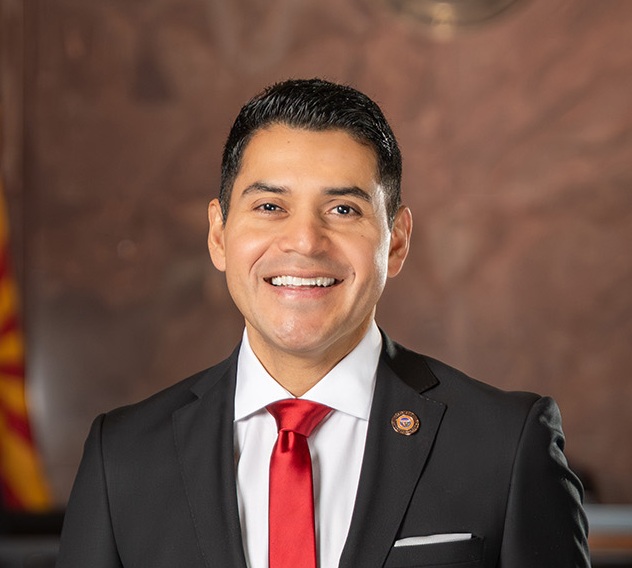
Rep. Steve Montenegro
Sponsored bills
Maddy summaryHB 2901 requires all voting machines used for federal, state, and county elections in Arizona to be 100% U.S.-sourced by January 1, 2029. This means every part and component must originate in the United States, and all manufacturing and assembly must occur within U.S. borders. The law directly affects voting machine manufacturers and election officials who certify or deploy equipment. It excludes machines acquired before January 1, 2028, from this requirement. The bill updates Arizona's voting equipment certification standards to include this domestic sourcing mandate.
Maddy summaryHB 2905 prohibits the conveyance (transfer) of any land in Arizona to a "federally banned corporation" beginning on the bill's effective date. A "federally banned corporation" is defined as a company banned by specific federal agencies (like the FCC, Commerce Department, CISA, or Federal Acquisition Security Council) or any affiliated entity under its significant control. This law directly affects property transactions involving such entities, preventing Arizona land sales or transfers to them. It does not apply to the U.S. government or its states/territories. The bill focuses solely on restricting land conveyances to these specific entities, with no impact on existing state land sale rules.
Maddy summaryHB 2153 updates Arizona's tax code to align with specific versions of the federal Internal Revenue Code (IRC) for different tax years. It defines "internal revenue code" for Arizona income tax calculations as the federal IRC as it existed on fixed dates (e.g., January 1, 2024 for 2023-2024 tax years), including retroactive federal provisions enacted during those years but excluding changes after the reference date. This affects Arizona taxpayers and businesses filing state returns by determining which federal tax rules Arizona applies. The bill does not change tax rates or create new deductions but standardizes the reference point for state tax computations. It is a technical conformity measure, not a policy change.
Maddy summaryHCR 2055 is a voter referendum (not enacted law) proposing that Arizona declare drug cartels "terrorist organizations" under state law and direct the Arizona Department of Homeland Security to address this threat. It defines "drug cartel" as groups engaging in human smuggling, drug trafficking, or terrorism, and states that this declaration does not affect asylum claims under federal law. The resolution cites voter-approved Proposition 314 and findings about border security concerns, including fentanyl trafficking and border crossings by individuals on terrorist watchlists. This measure failed to pass in the June 27, 2025, vote and did not become law.
Maddy summaryHB 2650 prohibits Arizona state agencies from requiring banks or financial institutions to use social credit scores when evaluating loan applications. It directly affects Arizona banks and customers seeking loans, ensuring lenders cannot be mandated to consider these scores. The bill’s key provision states the state may not compel financial institutions to factor social credit scores into lending decisions. This is a straightforward policy change preventing state-mandated use of social credit systems in financial approvals. The bill is currently at its first reading in the House (June 27, 2025).
Maddy summaryHCR 2013 is a proposed law requiring Arizona counties to verify voters' addresses before mailing early ballots and restricting foreign funding in election administration. It mandates that large counties (500,000+ population) require voters to confirm their address each election cycle via mail, phone, or online portal before receiving an early ballot, while smaller counties must do so every four years. The measure also prohibits government election administration from using funds from foreign governments or non-U.S. individuals, requiring vendors to certify annually they receive no such funds and imposing misdemeanor penalties for violations. This referendum failed to pass in June 2025 and would require voter approval to become law.
Maddy summaryHB 2374 enhances sentencing for individuals convicted of stalking, harassment, or assault when acting as agents of foreign governments or terrorist organizations to coerce people into actions like leaving the U.S. or restricting protected activities (e.g., free speech, religious practice). It also criminalizes foreign agents conducting unauthorized law enforcement activities (like surveillance) within Arizona, classifying violations as a class 2 felony. The bill mandates an annual training program for Arizona law enforcement on identifying transnational repression tactics, including digital surveillance and community-targeted threats. These provisions directly affect foreign government/terrorist agents operating in Arizona, local law enforcement, and residents potentially targeted by such repression. The law, signed by the governor on June 25, 2025, focuses on strengthening legal responses to cross-border intimidation campaigns.
Maddy summaryHCR 2021 would require Arizona cities and towns to exempt most food for home or on-premises consumption from municipal sales taxes, prohibiting differential tax rates on specific food items. It sets a deadline of June 30, 2027, for cities to comply, limits tax increases to 2% without voter approval, and bans new food taxes or rate hikes in the 24 months before that date. This affects local governments (cities/towns), food retailers, restaurants, and residents purchasing food, as it standardizes food tax treatment and restricts local tax authority over food sales. The bill also exempts SNAP/food stamp purchases and food packaging from taxation. It requires voter approval for any new food tax or rate increase beyond 2% and applies retroactively to December 31, 2024.
Maddy summaryArizona's SB 1109 prohibits foreign principals (including governments, businesses, or individuals from countries identified by U.S. intelligence as posing national security risks) from owning or acquiring most real property in Arizona. Exceptions allow small residential parcels (≤2 acres) for natural persons with valid U.S. visas, provided the property is not near military sites or critical infrastructure. The Attorney General enforces the law, and courts can order the sale of illegally held property, with proceeds distributed to lienholders, the state, and the original owner. The bill directly affects foreign entities from designated countries but exempts existing owners and specific residential purchases meeting strict conditions.