

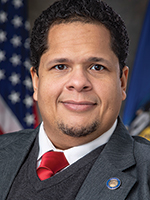
Photo of Julian Bradley
R Wisconsin Senate · District 28

Sen. Julian Bradley

Compare
Total votes
595
all sessions
Attendance
100%
of floor votes
Near the chamber average
With party
97%
of cast votes
Near the chamber average
Bipartisan score
3%
crosses aisle rarely
Near the chamber average
Sponsored
224
bills & resolutions
Near the chamber average
Committees
7
assignments
224 bills and resolutions

Sponsored bills

Total
224
Primary
224
Co-sponsor
0
This page
224
matching current filters
Primary SB 35
Failed · Wisconsin Senate · Lead sponsor
Relating to: law enforcement and firefighter annuitants in the Wisconsin Retirement System who are rehired by a participating employer. (FE)

Maddy summarySenate Bill 35 creates an exception for retired law enforcement officers and firefighters who are receiving an annuity from the Wisconsin Retirement System (WRS). It allows these individuals to be rehired by a WRS participating employer without re-entering the retirement system as a participating employee. To qualify, there must be at least a 75-day break in service between their initial termination and re-employment, no prior agreement to return to work, and the individual must elect not to become a participating employee again. This bill directly affects these specific annuitants and their employment options with WRS employers.

Failed Mar 23, 2026 0 co-sponsors
Primary SJR 36
Passed · Wisconsin Senate · Lead sponsor
Relating to: congratulating the University of Wisconsin–La Crosse women’s gymnastics team on winning the 2025 National Collegiate Gymnastics Association Championship.

Maddy summaryThis is a ceremonial resolution (SJR 36) expressing legislative congratulations to the University of Wisconsin-La Crosse women’s gymnastics team for winning the 2025 National Collegiate Gymnastics Association (NCGA) championship. It formally recognizes their achievement of an 18th national title (first since 2016) and highest-scoring championship in program history. The resolution has no policy impact or binding requirements - it simply serves as a symbolic gesture of recognition.

Passed Mar 23, 2026 0 co-sponsors
Primary SB 295
Failed · Wisconsin Senate · Lead sponsor
Relating to: the use of artificial intelligence or other machine assisted translation in court proceedings and of telephone or live audiovisual interpretation in criminal trials. (FE)

Maddy summaryThis bill permits courts to use artificial intelligence translation tools instead of or alongside human interpreters in both civil and criminal court proceedings. It applies to all court settings requiring language assistance, including municipal courts and criminal trials. The key change is that courts no longer need to obtain waivers from parties to use AI translation, which differs from current rules for human interpreters. It directly affects non-English speakers accessing court services and court staff managing interpretation needs.

Failed Mar 23, 2026 0 co-sponsors
Primary SB 280
Failed · Wisconsin Senate · Lead sponsor
Relating to: interest earned on coronavirus state and local fiscal recovery funds. (FE)

Maddy summarySB 280 redirects $172 million in interest earned from coronavirus state and local fiscal recovery funds to the general fund. It directly affects the state's budget by moving existing interest funds that would otherwise remain in the department of administration's appropriation. The bill's key mechanism is a fiscal adjustment under section 20.906(1), lapsing these funds to the general fund upon the bill's effective date. This is a procedural budget reallocation, not a new policy or program.

Failed Mar 23, 2026 0 co-sponsors
Primary SB 231
Failed · Wisconsin Senate · Lead sponsor
Relating to: creating a tax credit for expenses related to film production services and for capital investments made by a film production company, granting rule-making authority, and making an appropriation. (FE)

Maddy summarySB 231 creates a tax credit program for film production companies in Wisconsin, providing credits for eligible expenses like wages and capital investments incurred within the state. It establishes a State Film Office within the Department of Tourism to administer the program, set accreditation standards for productions (requiring minimum spending thresholds of $50,000 for short productions or $100,000 for longer ones), and issue tax credits. The bill caps annual program spending at $10 million total and $1 million per company, mandates that accredited productions include a state acknowledgment in the final product, and requires annual reports on program usage and efficiency. This directly affects film production companies operating in Wisconsin that meet the accreditation criteria and seek to reduce costs through state tax incentives.

Failed Mar 23, 2026 0 co-sponsors
Primary SB 57
Failed · Wisconsin Senate · Lead sponsor
Relating to: county sheriff assistance with certain federal immigration functions. (FE)

Maddy summarySB 57 reclassifies certain actions by county sheriffs who assist federal immigration authorities as a felony instead of a misdemeanor. It directly affects county sheriffs who provide support for federal immigration enforcement activities. The key provision changes the legal penalty for sheriffs participating in specific immigration-related functions, increasing the potential punishment. This bill modifies existing law to impose stricter criminal penalties for sheriffs engaging in these activities.

Failed Mar 23, 2026 0 co-sponsors
Primary SB 82
Failed · Wisconsin Senate · Lead sponsor
Relating to: governmental restrictions based on the energy source of a motor vehicle or other device.

Maddy summarySB 82 prohibits state and local governments from restricting the use or sale of motor vehicles based on their energy source (like gasoline, electric, or hydrogen power). It also bans similar restrictions on other devices that rely on specific energy sources for key functions. The law applies broadly to all government agencies and units, preventing them from enacting policies that target vehicles or devices solely by their power source. The only exception allows governments to maintain their own vehicle purchase policies for their own fleets.

Failed Mar 23, 2026 0 co-sponsors
Primary SB 256
Failed · Wisconsin Senate · Lead sponsor
Relating to: delivery network couriers and transportation network drivers, Department of Financial Institutions’ approval to offer portable benefit accounts, providing for insurance coverage, modifying administrative rules related to accident and sickness insurance, and granting rule-making authority. (FE)

Maddy summarySB 256 creates state-approved "portable benefit accounts" for app-based delivery and rideshare drivers (defined as "application-based drivers" earning at least $750 quarterly from one company). It allows drivers to deduct contributions to these accounts from state taxable income while imposing a 10% penalty on distributions used for non-permissible purposes (like non-health expenses). The bill modifies tax code sections to treat these accounts similarly to tax-advantaged savings vehicles and requires Department of Financial Institutions approval for their structure. This directly affects gig workers in delivery and rideshare services who meet the earnings threshold.

Failed Mar 23, 2026 0 co-sponsors
Primary SB 93
Failed · Wisconsin Senate · Lead sponsor
Relating to: recommendation to revoke extended supervision, parole, or probation if a person is charged with a crime. (FE)

Maddy summarySB 93 requires state departments to recommend revoking extended supervision, parole, or probation when a person under those programs is charged with a crime. It directly affects individuals supervised by the department after release from incarceration. The bill mandates this recommendation as a standard step in the process, without altering the existing revocation procedures or hearing requirements. The change applies to criminal charges filed on or after the bill's effective date.

Failed Mar 23, 2026 0 co-sponsors
Primary SB 338
Failed · Wisconsin Senate · Lead sponsor
Relating to: enforcement of the federal Help America Vote Act.

Maddy summarySB 338 modifies Wisconsin election law to strengthen enforcement of the federal Help America Vote Act. It requires election commissions to process complaints about voting system violations within strict timelines (5 business days to acknowledge, 89 days for final decisions) and hold open hearings with recorded proceedings. The bill mandates uniform, non-discriminatory investigation of all complaints and prohibits dismissing cases simply because a complaint alleges a violation by the commission itself. If a complaint is valid, the commission must take corrective action, and complainants can appeal dismissals to court. This directly affects voters, election officials, and organizations filing voting-related complaints.

Failed Mar 23, 2026 0 co-sponsors
Showing 31 to 40 of 224 bills
Previous 1 … 3 4 5 … 23 Next