

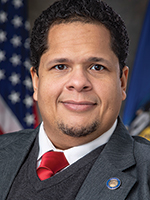
Photo of Julian Bradley
R Wisconsin Senate · District 28

Sen. Julian Bradley

Compare
Total votes
595
all sessions
Attendance
100%
of floor votes
Near the chamber average
With party
96%
of cast votes
Near the chamber average
Bipartisan score
3%
crosses aisle rarely
Near the chamber average
Sponsored
224
bills & resolutions
Near the chamber average
Committees
7
assignments
224 bills and resolutions

Sponsored bills

Total
224
Primary
224
Co-sponsor
0
This page
224
matching current filters
Primary SJR 116
Signed into law · Wisconsin Senate · Lead sponsor
Relating to: prohibiting the governor from using the partial veto to create or increase any tax or fee (second consideration).

Maddy summarySJR 116 is a proposed constitutional amendment that would prohibit governors from using their partial veto power to create or increase taxes or fees. If approved by voters, it would amend Article V, Section 10(1)(c) of the state constitution to block governors from altering tax or fee provisions during the veto process. This measure directly affects the governor's executive authority and state budget negotiations, requiring legislative action for any tax or fee changes. The amendment is now pending voter approval in the November 2026 election after passing the legislature with 18 "yes" votes.

Signed into law Jun 23, 2026 0 co-sponsors
Primary SJR 6
Signed into law · Wisconsin Senate · Lead sponsor
Relating to: honoring the life and enduring legacy of Robert George Uecker.

Maddy summaryThis Senate Joint Resolution (SJR 6) is a ceremonial honor recognizing the life and legacy of Bob Uecker, the longtime Milwaukee Brewers radio broadcaster and entertainer. It formally acknowledges his 54-year broadcasting career with the Brewers, his acting roles (including *Mr. Belvedere* and *Major League*), philanthropy, and contributions to baseball and Wisconsin culture. The resolution has no policy impact - it simply expresses the Wisconsin Legislature’s tribute to Uecker’s "extraordinary contributions" through a symbolic resolution passed on March 20, 2025.

Signed into law May 26, 2026 0 co-sponsors
Primary SB 184
Vetoed · Wisconsin Senate · Lead sponsor
Relating to: governmental restrictions based on the energy source of a motor vehicle or other device.

Maddy summarySB 184 would prevent Wisconsin state agencies and local governments from restricting the use or sale of motor vehicles or other devices based on their energy source (such as gasoline, electricity, or hydrogen). It specifically prohibits rules that ban or limit vehicles/devices due to their power source, though government fleets may still select energy types for their own purchases. The law would apply to all state and local regulations, including those governing vehicle access, sales, or device usage. This bill aimed to remove barriers for alternative-energy vehicles in public policy contexts.

Vetoed May 13, 2026 0 co-sponsors
Primary SB 25
Vetoed · Wisconsin Senate · Lead sponsor
Relating to: court-issued criminal complaints in officer-involved deaths.

Maddy summarySB 25 would require courts to defer to a district attorney's determination that there is no basis to prosecute a law enforcement officer involved in a death. Specifically, it prohibits judges from issuing criminal complaints against such officers unless new or unused evidence is presented, after the district attorney has already concluded there is no case to pursue. The bill directly affects officers in officer-involved death cases defined under Wisconsin law (s. 175.47 (1) (c)). This change shifts authority from courts to district attorneys in determining whether charges proceed, streamlining the process for cases where prosecutors have already declined to file.

Vetoed May 13, 2026 0 co-sponsors
Primary SB 405
Vetoed · Wisconsin Senate · Lead sponsor
Relating to: a civil cause of action for a minor injured by a gender transition procedure.

Maddy summarySB 405 creates a legal right for minors injured by gender transition procedures to sue healthcare providers for physical, psychological, emotional, or physiological harm. The bill defines "gender transition procedure" broadly (including puberty blockers and cross-sex hormones) but excludes treatments for certain medical conditions like disorders of sexual development. It requires providers to document a minor's gender identity for two years, obtain certification from multiple healthcare professionals confirming the procedure is the only treatment for a mental health concern, and provide specific risk warnings to minors and parents before consent. The law allows lawsuits to be filed before the minor turns 33, with defenses available if providers follow the required documentation and consent protocols.

Vetoed May 13, 2026 0 co-sponsors
Primary SB 276
Vetoed · Wisconsin Senate · Lead sponsor
Relating to: challenges to the validity of administrative rules and making an appropriation. (FE)

Maddy summarySB 276 changes how legal fees are handled when courts invalidate agency rules. It requires courts to award reasonable attorney fees and costs to parties successfully challenging administrative rules or guidance documents, provided the challenge is based on constitutional violations, exceeding statutory authority, or improper rule-making procedures. These fees and costs must be paid from specific state appropriations outlined in statutes (20.865 (1) (a), (g), or (q)), not from general funds. The bill directly affects individuals or organizations challenging agency rules and state agencies responsible for paying these costs.

Vetoed May 13, 2026 0 co-sponsors
Primary SB 275
Vetoed · Wisconsin Senate · Lead sponsor
Relating to: statements of scope for administrative rules. (FE)

Maddy summarySB 275 establishes time limits for statements of scope used by state agencies when creating administrative rules. It requires permanent rule scope statements to expire after 30 months and emergency rule statements after 6 months, after which agencies cannot base new rules on expired statements. The bill also mandates separate scope statements for concurrent emergency and permanent rule proposals and prohibits agencies from using a single scope statement for multiple rules. These changes apply to all Wisconsin administrative agencies creating new rules under the state's rulemaking process.

Vetoed May 13, 2026 0 co-sponsors
Primary SB 289
Vetoed · Wisconsin Senate · Lead sponsor
Relating to: requirements for proposed administrative rules that impose any costs.

Maddy summarySB 289 requires state agencies to provide detailed economic impact analyses for proposed rules that impose costs on businesses, local governments, or individuals. Agencies must quantify expected implementation and compliance costs (and potential savings) for each affected group, attribute all costs directly to the rule (not other laws or federal requirements), and include this in their analysis. If an independent analysis shows costs exceed $10 million over two years, the rule must be paused until costs are addressed or offset. This bill directly affects state agencies creating new rules and the businesses, local governments, and individuals who would bear the financial impact.

Vetoed May 13, 2026 0 co-sponsors
Primary SB 36
Vetoed · Wisconsin Senate · Lead sponsor
Relating to: an income tax exemption for cash tips paid to an employee. (FE)

Maddy summarySB 36 creates a state income tax exemption for cash tips received by employees, directly benefiting service industry workers (like servers or bartenders) who report cash tips to their employers. The bill allows taxpayers to subtract up to $25,000 in qualified tips from their taxable income each year, provided the tips are reported via federal tax forms (like those used for IRS Form 1099-NEC). This exemption phases out for higher earners: single filers see reductions when their modified adjusted gross income exceeds $150,000, while joint filers face reductions above $300,000. To claim the exemption, filers must include their Social Security number and, for married couples, file a joint return.

Vetoed May 13, 2026 0 co-sponsors
Primary SB 176
Vetoed · Wisconsin Senate · Lead sponsor
Relating to: an income and franchise tax exemption for broadband expansion grants and for federal high-cost program funding for broadband expansion. (FE)

Maddy summarySB 176 creates tax exemptions for income received from broadband expansion grants and federal high-cost program funding. It exempts from state income and franchise taxes funds provided by the state, local governments, tribal governments, or the federal government for broadband expansion projects. This directly affects businesses, internet service providers, and organizations receiving these specific grants or federal funding. The exemption applies to both state broadband grants and federal high-cost program funds (under 47 USC 254) used for expanding broadband access in the state, effective for tax years beginning after December 31, 2024.

Vetoed May 13, 2026 0 co-sponsors
Showing 1 to 10 of 224 bills
1 2 3 23 Next