

Maddy summarySB 1015 increases the state's earned income tax credit for low-income working families with fewer than three children. It raises the state credit to 34% of the federal basic earned income credit for families with children (effective 2026), and sets it at 15% for individuals without qualifying children. This directly affects eligible taxpayers who qualify for the federal earned income credit but have limited income. The bill amends tax statutes to replace the previous credit rate (applicable through 2025) with these new percentages for future tax years.
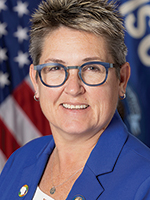
Sen. Kristin Dassler-Alfheim
Sponsored bills
Maddy summarySB 968 increases funding by $500,000 for the Family Foundations home visitation program in fiscal year 2026-27. This specifically expands parental education on social media's effects on children and healthy social media practices within the existing home visitation program. The bill directly affects parents participating in the program and their children, through enhanced educational resources provided during home visits. It makes a concrete policy change by appropriating additional state funds to support this targeted educational component.
Maddy summarySB 983 clarifies the definition of "veteran" for Wisconsin state veterans benefits. It creates a new statutory definition (45.01(12)(jm)) specifically including National Guard members who completed their initial service obligation and received an honorable or general discharge under honorable conditions. This change ensures these individuals qualify for state benefits under the new category, while removing them from the general "veteran" definition in 45.51(2)(a)1. The bill directly affects eligible National Guard members seeking state-level veterans' benefits.
Maddy summarySB 985 amends a statute to define "veteran at risk" for the veterans at risk alert system. The bill specifies that a "veteran at risk" includes veterans, active-duty service members, National Guard, or military reservists known to have a physical or mental health condition related to their military service, based on reports. This definition change directly affects how the alert system identifies individuals eligible for support. The bill is purely definitional and does not create new programs or alter system operations.
Maddy summarySJR 125 is a commemorative resolution honoring George Meyer, a former Wisconsin Department of Natural Resources (DNR) secretary and conservation leader, for his decades of service protecting waterways, advancing tribal treaty rights, and expanding state land conservation. It was adopted by the Wisconsin Legislature to recognize his legacy following his death in 2025, citing his work on wetland regulations, mercury emissions rules, and land acquisitions during his DNR tenure (1993-2001). The resolution does not create new laws or policies but formally expresses legislative gratitude for his contributions to Wisconsin's environmental stewardship.
Maddy summarySB 944 adjusts how property tax limits are calculated for cities and towns (political subdivisions) that redevelop parking lots into new commercial, residential, or mixed-use buildings. Specifically, it adds 1.5 times the value increase from qualifying parking lot redevelopment to the annual development percentage used in tax levy calculations. Qualifying redevelopment requires at least 40% of the parcel area to have been paved parking in the prior year. This change applies to all political subdivisions with qualifying projects but specifically includes tax increment districts in Evansville and Stevens Point, plus new districts after 2024. The bill aims to account for redevelopment value in tax levy limits without increasing the overall tax burden.
Maddy summaryThis Senate Joint Resolution (SJR 134) is a symbolic proclamation designating February 2026 as Black History Month in Wisconsin. It honors the contributions of eight notable African American Wisconsinites - such as civil rights leader Lloyd Barbee, first Black state legislator Marcia Coggs, and community leaders Clinton and Bernice Rose - while recognizing the historical significance of Black history in the state and nation. The resolution has no binding legal effect but serves to formally acknowledge these figures and the broader observance of Black History Month.
Maddy summarySJR 135 is a symbolic resolution commemorating the 250th anniversary of the 1776 Boston siege withdrawal (a key Revolutionary War victory) and recognizing Irish American contributions to American independence. It highlights historical connections, including Irish immigrant soldiers like General John Sullivan, eight Irish American Declaration of Independence signers, and Irish emigrant roles in the military and printing the Declaration. The resolution has no binding effect; it formally acknowledges these historical events and directs the Senate clerk to share copies with Irish officials. As a commemorative measure, it does not create new laws or affect any individuals or policies.
Maddy summarySB 924 creates a state grant program to help municipalities purchase election supplies and equipment, such as electronic poll books and accessibility tools. It provides tiered funding based on population: up to $2.5 million for cities over 250,000 residents, $1 million for 100,000-250,000, $500,000 for 50,000-100,000, and $250,000 for smaller communities. Municipalities must agree to random inspections of purchased equipment and apply before general elections, with a minimum grant of $250. The bill appropriates $5 million biennially for this program, administered by the Elections Commission.
Maddy summarySJR 130 is a ceremonial joint resolution celebrating Wisconsin athletes competing in the 2026 Winter Olympics and Paralympics in Italy. It formally recognizes the state's athletes, including those in cross-country skiing, biathlon, wheelchair curling, sled hockey, and other sports, by urging the Wisconsin Legislature to honor their participation. The resolution has no binding effect or policy changes; it serves solely as a symbolic gesture of support. It directly affects Wisconsin athletes by acknowledging their representation of the state on an international stage.