

Maddy summaryAB 535 requires all polling places to be accessible to voters with disabilities by mandating election workers to use a standardized accessibility checklist on election day to identify and immediately report barriers. It also requires the election commission to submit annual reports (by June 30 in odd years) on voting impediments faced by elderly and disabled voters, consulting with relevant advocacy groups. Additionally, the bill creates uniform signage guidelines to notify disabled voters about ballot assistance options at polling place entrances. These changes apply to all polling places and take effect before the 2027 spring election.
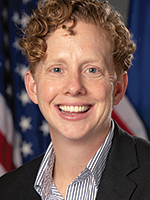
Rep. Angela Stroud
Sponsored bills
Maddy summaryAJR 111 is a symbolic resolution recognizing September 23, 2025, and September 23, 2026, as "Celebrate Bisexuality Day" in Wisconsin. It formally acknowledges the bisexual community's resilience and contributions without creating new laws, funding, or requirements. The resolution aims to increase visibility and respect for bisexual individuals within Wisconsin, aligning with an internationally observed day. It directly affects Wisconsin's bisexual community by affirming their inclusion through legislative recognition. The bill is procedural, focusing solely on symbolic support rather than policy changes.
Maddy summaryAB 434 creates a new $60 million annual state grant program to fund local traffic calming projects. It directly affects counties, cities, villages, towns, and federally recognized tribes by providing funding for infrastructure projects designed to reduce vehicle speeds. The program, administered by the Department of Transportation, will award grants for projects eligible under federal transportation alternatives programs. Grants require applications with specified details, and the department will set evaluation criteria for funding decisions. This is a concrete policy change establishing ongoing state funding for community safety improvements.
Maddy summaryAB 579 creates a new University of Wisconsin System tuition grant program to help cover the gap between other scholarships and full tuition and fees for eligible students. It directly affects Wisconsin residents enrolled in their first bachelor's degree program at a non-Madison UW campus with household income under $71,000 annually. The bill appropriates $11.86 million for 2025-26 and $28.11 million for 2026-27 to fund grants covering up to 8 consecutive semesters for freshmen or 4 for transfers (excluding summer terms). The program requires students to meet academic standards and excludes those with unmet selective service or child support obligations.
Maddy summaryAB 516 would allow local governments (counties, cities, towns, school districts) to adopt ranked-choice voting for nonpartisan local elections. Under this system, voters would rank candidates in order of preference instead of selecting just one. The bill provides funding for local governments to update election equipment and software to implement this system. It also modifies tie-breaking procedures for elections where candidates receive equal votes, requiring selection by lot if ranked-choice voting isn't used.
Maddy summaryAB 135 requires vehicle manufacturers to provide owners and repair shops with free, unrestricted access to vehicle data (like diagnostics) and critical repair information (tools, manuals, parts specs) needed to fix cars. It prohibits manufacturers from using technological barriers (like encrypted data) or legal barriers (such as forcing owners to use dealer-approved parts) to limit repair choices. The bill directly affects car owners, independent repair shops, and aftermarket parts companies by ensuring they can access necessary information without fees or manufacturer-imposed restrictions. Manufacturers must also stop mandating specific brands of parts or tools in repair guides, though they can still recommend options with clear disclaimers. This law aims to make vehicle repairs more accessible and affordable by removing artificial barriers.
Maddy summaryAssembly Bill 464 revises state laws concerning prevailing wages for public works projects. It establishes new definitions for terms related to wage determination areas, types of projects, and specific work classifications, directly affecting local governmental units and contractors. The bill aims to create uniform prevailing wage requirements across the state, explicitly stating that local ordinances requiring prevailing wages are inconsistent with state law. It also outlines the applicability of these wage rules to various public works projects, including infrastructure and facilities acquired by local units, and adds a provision to protect employees' personally identifiable information on these projects.
Maddy summaryAB 389 would require California's Department of Motor Vehicles to add a visible symbol or notation on driver's licenses and identification cards to indicate veteran status for certain service members. It directly affects veterans who have received an honorable discharge or have a service-connected disability, allowing them to visibly identify their military service. The key provision mandates that the DMV create and implement this indicator on state-issued IDs, with the specific symbol to be determined by the agency. The bill is currently pending in the Assembly, having recently received a fiscal estimate and added co-authors.
Maddy summaryAB 466 repeals specific statutes that previously required municipalities to include project labor agreements (PLAs) in public construction contracts for buildings and structures (excluding highways). The bill removes legal provisions allowing cities to mandate PLAs - agreements between contractors and unions covering wages, hours, and working conditions - and eliminates related requirements for contractor classification. This directly affects public contractors and municipalities when awarding bids for non-highway construction projects, as they can no longer legally require PLAs. The amendment to Section 66.0901(6) clarifies that municipalities may set reasonable labor conditions but no longer must include PLAs in contracts. The bill is currently pending in the Workforce Development Committee with fiscal estimates received.
Maddy summaryAB 643 establishes November 11 (Veterans Day) as a state holiday when all state government offices must close. It directly affects state government employees (excluding limited-term staff) by adding Veterans Day as a recognized paid personal holiday, in addition to their existing 9-10 annual paid holidays. The bill amends statutes to include November 11 in the list of holidays requiring office closures and creates a new provision specifying that employees earn one additional paid personal holiday each year specifically for Veterans Day. This change clarifies the holiday schedule and ensures Veterans Day is treated as a standard paid holiday for state employees.