

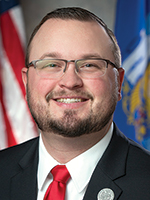
Photo of Alex Dallman
R Wisconsin House · District 39 On the 2026 ballot

Rep. Alex Dallman

Compare
Total votes
583
all sessions
Attendance
100%
of floor votes
Near the chamber average
With party
100%
of cast votes
Near the chamber average
Bipartisan score
0%
crosses aisle rarely
Near the chamber average
Sponsored
188
bills & resolutions
Near the chamber average
Committees
2
assignments
188 bills and resolutions

Sponsored bills

Total
188
Primary
188
Co-sponsor
0
This page
188
matching current filters
Primary AB 501
Failed · Wisconsin House · Lead sponsor
Relating to: free speech and academic freedom at University of Wisconsin System institutions and technical colleges, due process in disciplinary proceedings at University of Wisconsin System institutions and technical colleges, and causes of action against the Board of Regents of the University of Wisconsin System and technical college district boards. (FE)

Maddy summaryAB 501 establishes new standards for free speech and academic freedom at University of Wisconsin System institutions and technical colleges. It protects students, faculty, staff, and graduate assistants from campus restrictions on First Amendment-protected speech, including in virtual spaces (except during virtual classroom instruction). Institutions may only limit speech that violates laws, constitutes threats/harassment, or materially disrupts operations, and must use content-neutral time/place/manner rules for public forums. The bill also creates legal grounds for individuals to sue the Board of Regents or technical college boards if these protections are violated.

Failed Mar 23, 2026 0 co-sponsors
Primary AB 367
Failed · Wisconsin House · Lead sponsor
Relating to: exemptions from minimum wage, overtime pay, and recordkeeping requirements for minor league baseball players.

Maddy summaryAB 367 exempts minor league baseball players covered by a collective bargaining agreement (CBA) from standard labor laws requiring minimum wage, overtime pay, and detailed recordkeeping. Specifically, it creates new exemptions in state labor statutes for players whose CBAs explicitly define their wages and working conditions. Employers are no longer required to track these players' hours or maintain standard payroll records. The bill applies only to players under such CBAs, not to all minor league athletes. This is a procedural change to labor law exemptions, not a new pay standard.

Failed Mar 23, 2026 0 co-sponsors
Primary AB 509
Failed · Wisconsin House · Lead sponsor
Relating to: alternative delivery of projects contracted by the Department of Transportation. (FE)

Maddy summaryAB 509 updates Wisconsin's rules for highway project delivery by creating new definitions for alternative methods like "design-build" and excluding others. It establishes a $300 million annual funding limit for alternative delivery projects (adjusted yearly using the DOT's construction cost index), with a cap of six contracts per year. The bill specifically prohibits using "construction manager-general contractor" or "progressive design-build" methods in the pilot program. This directly affects the Wisconsin Department of Transportation, contractors bidding on highway projects, and state transportation budget allocations.

Failed Mar 23, 2026 0 co-sponsors
Primary AB 606
Failed · Wisconsin House · Lead sponsor
Relating to: regulation of hemp-derived cannabinoid products, renaming the Division of Alcohol Beverages as the Division of Intoxicating Products, creating an occupational tax on hemp-derived cannabinoid products, alcohol beverage warehouses and production arrangements, granting rule-making authority, and providing a penalty. (FE)

Maddy summaryAB 606 regulates hemp-derived cannabinoid products by creating an occupational tax on businesses selling these products, alcohol warehouses, and production facilities. It renames the state's "Division of Alcohol Beverages" to the "Division of Intoxicating Products" and grants this new division rule-making authority to enforce regulations. The bill also establishes penalties for violations of the new rules. This directly affects hemp product businesses, alcohol warehouse operators, and the state agency responsible for oversight.

Failed Mar 23, 2026 0 co-sponsors
Primary AB 276
Failed · Wisconsin House · Lead sponsor
Relating to: statements of scope for administrative rules. (FE)

Maddy summaryAB 276 sets time limits for state agencies' "statements of scope" when creating administrative rules. It requires permanent rule statements to expire after 30 months and emergency rule statements after 6 months, preventing agencies from using expired statements to propose new rules. The bill also mandates separate statements for concurrent emergency and permanent rules and limits agencies to one rule per statement. These changes directly affect state agencies developing regulations and ensure legislative review occurs within defined timeframes. The bill does not alter rule content but streamlines the process for agency rulemaking and legislative oversight.

Failed Mar 23, 2026 0 co-sponsors
Primary AB 274
Failed · Wisconsin House · Lead sponsor
Relating to: the expiration of administrative rules. (FE)

Maddy summaryAB 274 establishes a 7-year expiration cycle for Wisconsin administrative rules, requiring state agencies to formally request "readoption" before rules expire. It directly affects state agencies that create and maintain administrative rules, mandating they submit detailed notices to the legislature with specific information about each rule's purpose, legal basis, and compliance status. Key provisions include new requirements for readoption notices (including statements on rule compliance), a process for legislative committees to review these notices, and a schedule for expiring rules that were in effect before 2025. The bill also creates a rules procedures manual to guide agencies on drafting and legislative review. These changes streamline rule expiration and renewal while increasing transparency for lawmakers.

Failed Mar 23, 2026 0 co-sponsors
Primary AB 277
Failed · Wisconsin House · Lead sponsor
Relating to: requirements for proposed administrative rules that impose any costs.

Maddy summaryAB 277 requires state agencies to provide detailed cost analyses for new rules that may affect businesses, local governments, or individuals. Agencies must quantify all expected implementation and compliance costs (and potential savings) over a two-year period, broken down by affected groups, and report this as a single net dollar figure. If projected costs exceed $10 million, the rulemaking process must pause until costs are reduced or offset. The bill also establishes rules for funding independent cost analyses when agency estimates vary significantly and mandates revised analyses after rule modifications. This bill aims to increase transparency around financial impacts of new regulations before they are finalized.

Failed Mar 23, 2026 0 co-sponsors
Primary AB 683
Passed · Wisconsin House · Lead sponsor
Relating to: prohibiting critical telecommunications infrastructure from including equipment manufactured by a foreign adversary. (FE)

Maddy summaryAB 683 prohibits telecommunications providers from using equipment manufactured by entities designated as "foreign adversaries" in key network infrastructure (like cell towers or fiber lines). It directly affects telecom companies operating in Wisconsin, requiring them to stop purchasing or leasing such equipment and remove existing installations by following federal removal programs. Providers must annually certify compliance and publicly report locations of affected equipment, including replacement plans, while the state commission will publish a public map and annual report. The bill aligns with federal rules banning equipment from specific foreign entities, focusing on network security without specifying political outcomes.

Passed Mar 23, 2026 0 co-sponsors
Primary AB 572
Signed into law · Wisconsin House · Lead sponsor
Relating to: the definition of bingo.

Maddy summaryAB 572 clarifies the legal definition of "bingo" in Wisconsin law to distinguish it from certain free games. The bill specifies that bingo requires participants to pay to play, uses standard 5x5 cards with numbers 1-75 (including a "FREE" center space), and determines winners based on random number draws matching predefined patterns. Crucially, it explicitly excludes games using free cards and donated prizes where participants pay no consideration, regardless of whether the host pays for prizes or supplies. This change directly affects gambling regulators, local governments, and organizations running bingo events, ensuring only paid participation games fall under gambling licensing rules. The bill does not alter existing bingo rules but provides clear legal boundaries for enforcement.

Signed into law Mar 20, 2026 0 co-sponsors
Primary AJR 99
Passed · Wisconsin House · Lead sponsor
Relating to: recognizing October 14, 2025, as First Responders Appreciation Day in Wisconsin.

Maddy summaryAJR 99 is a symbolic resolution recognizing October 14, 2025, as "First Responders Appreciation Day" in Wisconsin. It does not create new laws or policies but formally honors all professional and volunteer first responders, including police, firefighters, and emergency medical personnel. The resolution acknowledges their daily risks and service to the public, specifically noting Wisconsin's over 4,800 career firefighters, 20,600 volunteer firefighters, 14,700 law enforcement officers, and 17,426 EMS personnel. This is a non-binding gesture of appreciation with no direct impact on legislation or funding.

Passed Oct 16, 2025 0 co-sponsors
Showing 31 to 40 of 188 bills
Previous 1 3 4 5 19 Next