

Maddy summaryAB 663 prohibits University of Wisconsin System institutions from accepting foreign grants, entering academic partnerships, or engaging in research collaborations with entities from countries designated as security threats (like China or Russia) without board approval. Exceptions require security reviews, approval that benefits students, and confirmation the partnership won’t compromise U.S. security or academic freedom. The bill also bans accepting gifts or cultural exchange payments from such entities. Institutions must submit annual reports detailing all foreign partnerships to state officials.
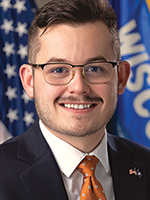
Rep. Calvin Callahan
Sponsored bills
Maddy summaryAB 662 prohibits Wisconsin state agencies from contracting with business entities primarily based in designated "foreign countries of concern" (like China), controlled by Chinese government entities, or subsidiaries of such entities. Contractors must certify they are not prohibited entities and ensure goods/services aren’t sourced from them. Violations trigger significant penalties, including fines up to twice the contract value or $250,000, plus a 5-year contracting ban. An exemption exists if the goods/services are unavailable elsewhere and approved by the Department of Administration.
Maddy summaryAB 211 creates a new exemption in Wisconsin law allowing "tobacco bars" to operate without adhering to the state's public smoking ban. To qualify, these establishments must have opened after June 4, 2009, allow only cigar and pipe smoking (not cigarettes), not be classified as food establishments, display clear signage about smoking, prohibit minors under 21 from entering, require employee acknowledgment of secondhand smoke exposure, and demonstrate adequate air filtration in licensing applications. The bill directly affects tobacco bars meeting these specific criteria, enabling them to operate with smoking permitted while imposing strict operational requirements. It does not change the general public smoking ban but establishes a defined exception for this narrow category of businesses.
Maddy summaryAB 673 bans medical and research facilities receiving state or federal funds from using genetic software or sequencers developed by foreign adversaries (as defined by federal regulations). It also prohibits storing human genome data of state residents in foreign adversary countries, with exceptions for certain clinical trials. The law applies to facilities, companies, and nonprofits handling genetic data, requiring them to keep such data inaccessible to foreign adversaries. Violations carry a $10,000 penalty per offense, enforced by the state Attorney General.
Maddy summaryAB 308 prohibits Wisconsin state and local government funds from being used to pay for health services for individuals without legal immigration status. The bill directly affects undocumented residents by blocking state/local funding for their healthcare. Key provisions ban state/local funds for such services (except where federal law requires payment or where applying the ban would cause loss of federal funds). The law does not restrict federal healthcare programs or funding. This is a policy change affecting state budget allocations, not a procedural measure.
Maddy summaryAB 674 prohibits health insurance plans and the Medical Assistance program from covering organ transplants or related care if the organ was transplanted in or originated from a country designated by the department as participating in forced organ harvesting. The bill applies to disability insurance, self-insured health plans, and Medical Assistance. It defines "forced organ harvesting" as removal via coercion, deception, or abuse of power, and requires the department to designate affected countries. Life-saving post-transplant care remains covered even if the transplant itself is prohibited under the bill.
Maddy summaryThis bill proposes changing the fee for the inland waters trout stamp from $9.75 to $15.75. It directly affects anglers who purchase this stamp to fish for trout in inland waters. The change is made by amending the relevant section of the state statutes. The bill was introduced in 2026 but failed to pass during the legislative session.
Maddy summaryAB 968 would require virtual currency kiosks (machines exchanging cash for digital currency or vice versa) to obtain state licenses, display mandatory fraud warnings, and verify customer identities using government ID and photos. It sets a $500 daily transaction limit, caps fees at 3% or $5 per transaction, and mandates detailed receipts showing all transaction details. The bill directly affects kiosk operators and customers, aiming to prevent fraud through identity checks and clear transaction records. Currently under review in the Financial Institutions committee.
Maddy summaryAB 192 establishes a formal framework for fatality review teams in Wisconsin to examine specific types of deaths, including homicides, overdoses, child abuse, maternal deaths, and other unexpected deaths. It creates definitions for local and state teams, requires the Department of Children and Families to coordinate these teams, and allows confidential sharing of health records with teams for review purposes. The bill specifies that healthcare providers and agencies sharing records must maintain strict confidentiality under new provisions, and clarifies which death types qualify for review (e.g., suicide, domestic violence-related deaths, stillbirths, or infant deaths). This directly affects healthcare providers, fatality review teams, and state/local agencies responsible for child welfare and public health. The legislation focuses on improving death review processes while protecting privacy through updated confidentiality rules.
Maddy summaryAB 619 creates a $150 million grant program to fund aviation biofuel manufacturing projects in Wisconsin, funded through state public debt issuance. The bill requires grantees to use facilities exclusively for aviation biofuel production (with limited exceptions for other biofuels if 80% of output is aviation fuel), source 80% of biomass locally, and invest at least $1.5 billion in aviation biofuel manufacturing within five years. It directly affects companies building such facilities and the Department of Natural Resources, which administers the grants. The program aims to support the state's forest products industry and create jobs, with strict repayment terms if grantees fail to meet requirements.