

Maddy summaryAB 742 regulates lease-purchase agreements for personal property (like furniture or appliances used at home), directly affecting consumers who rent items with an option to buy. It requires written agreements with clear disclosures, including total payments needed to own the goods, the cash-sale price, payment frequency, and terms for early purchase. The law mandates that lessors provide these details in plain language (at least 8-point type) and in the same language as any advertising. Violations allow consumers to sue for damages, but the law exempts business leases, vehicles, mobile homes, and real estate-related rentals.
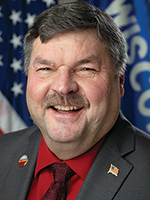
Rep. Rob Swearingen
Sponsored bills
Maddy summaryAB 704 increases fees for snowmobile registration and trail use stickers in Wisconsin. It raises the public-use registration fee from $30 to $45 (with a $5 fee for political subdivisions), keeps private-use registration fee-free, and increases trail sticker fees: from $49.25 to $69.25 for exempt snowmobiles, $9.25 to $19.25 for club members meeting specific criteria, and $29.25 to $49.25 for others. The bill directly affects snowmobile owners who register their vehicles or use public trails. Key provisions include standardized fee increases and a reduced rate for members of qualifying snowmobile clubs.
Maddy summaryAB 748 exempts home producers of shelf-stable food products (like pickled fruits/vegetables and baked goods) from state licensing requirements, directly affecting small-scale home cooks and cottage food businesses. The bill creates a registration system requiring producers to register with the department, maintain liability insurance, and label products with their registration number, preparation date, and a "made in a private home" statement. It limits annual sales to under $40,000 and mandates specific labeling for allergens, while requiring inspections for producers with sales between $10,000-$40,000. Producers must sell directly to consumers (e.g., farmers' markets or home delivery) and comply with new safety labeling and insurance rules. The bill replaces prior licensing rules with this structured framework for home food sales.
Maddy summaryAJR 1 is a constitutional amendment requiring voters to present valid photo identification to cast a ballot in any election. It directly affects all voters in state elections, specifying that acceptable ID must be issued by the state, federal government, a federally recognized tribal entity, or a college/university in the state. The bill mandates the legislature to define acceptable ID types and establish exceptions, while allowing voters without ID on election day to cast a provisional ballot and submit ID later. This proposal, on second consideration after a 2023 rejection, would be submitted to voters in April 2025 if approved.
Maddy summaryAJR 9 is a Wisconsin Assembly Joint Resolution honoring Bob Uecker, the longtime Milwaukee Brewers radio broadcaster and entertainer, for his 69-year career in baseball. The resolution recognizes his contributions as a broadcaster, actor (including "Mr. Belvedere" and "Major League"), philanthropist, and community figure, citing his 54-year tenure with the Brewers and his cultural impact. It does not create new laws or affect any policies - it is a symbolic tribute passed by the Wisconsin Legislature to memorialize his legacy. The resolution extends condolences to his family and acknowledges his widespread influence on baseball fans and Wisconsin.
Maddy summaryAssembly Joint Resolution 24 expresses the Wisconsin Legislature's support for strengthening its relationship with Taiwan. The resolution reaffirms the existing sister-state ties between Wisconsin and Taiwan and reiterates support for the federal Taiwan Relations Act. It also endorses Taiwan's pursuit of a Bilateral Trade Agreement with the United States to foster closer economic partnerships. Furthermore, the resolution advocates for Taiwan's increased participation in international organizations that impact its people's well-being.
Maddy summaryAB 231 creates a 25% tax credit for film production companies in Wisconsin covering eligible expenses (like wages, equipment, and location costs) and capital investments for accredited productions. It directly affects film production companies operating in Wisconsin that meet minimum spending thresholds ($50,000 or $100,000 depending on production length) and excludes news, sports, or corporate content. The bill establishes a State Film Office to administer the program, requiring accredited productions to include a state acknowledgment in the final film and mandating annual reports on credit allocations. It caps annual tax credits at $10 million statewide and $1 million per company, with strict eligibility rules and third-party audit requirements to ensure compliance.
Maddy summaryAB 279 creates a state grant program to help municipalities and eligible nonprofits recruit new residents from outside the state. The program provides grants (capped at $500,000 per municipality annually) to cover costs of talent recruitment initiatives, with half the funds paid upfront and the second half released only if half the target number of relocating households is met. Households must earn at least $55,000 annually, live outside the state when applying, and commit to relocating to qualify for incentives. Recipients must submit detailed semiannual reports tracking applications, approved households, costs, incomes, and economic impacts like tax revenue.
Maddy summaryAB 190 modifies state public records law to allow requesters who win partial victories to recover attorney fees. Specifically, it enables fee recovery when a government agency voluntarily releases a contested record *after* a lawsuit is filed, and a court determines the lawsuit was a substantial factor in that release. This directly affects public record requesters who successfully pressure agencies to disclose documents through litigation without a full court judgment. The bill creates a clear mechanism for fee awards in these specific scenarios, avoiding the need for a formal court order on the record's disclosure.
Maddy summaryAB 284 streamlines the management of state construction projects by raising the cost threshold for mandatory project enumeration from $1 million to $2 million. It requires quarterly budget reports for projects needing increases, sets a 6-month deadline for the Claims Board to resolve certain construction claims, and mandates state agencies to collaborate with energy conservation contractors on pilot projects. The bill also clarifies responsibilities for utility costs in contracts, modifies bidding procedures, and transfers $32 million from the general fund to the state building trust fund for infrastructure. These changes primarily affect state agencies, the building commission, and contractors managing public construction projects.