

Maddy summaryAB 181 modifies grant eligibility for county forest programs by allowing counties to receive funding for one professional forester in a county forest administrator or assistant role. The bill specifies that grants cover up to 50% of the forester’s salary and up to 40% of fringe benefits (capped at 40% of salary), using funds from a designated appropriation. It defines a qualifying "county forest administrator" as someone with a forestry degree (or equivalent), natural resources degree with 3+ years’ experience, or an associate degree in forestry with 3+ years’ experience managing county forests - excluding department employees. The changes apply retroactively to grant applications submitted on or after the bill’s effective date (January 1, 2025). This bill directly affects counties managing forest programs seeking state funding for their designated forest administration staff.
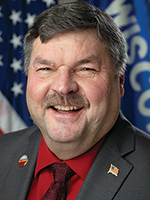
Rep. Rob Swearingen
Sponsored bills
Maddy summaryAB 214 modifies Wisconsin town government procedures for appointing clerks and treasurers. It allows towns with 2,500+ residents to combine these roles under new rules, including immediate implementation when both positions become vacant or upon vacancy in one role. The bill updates deputy appointment rules (removing residency requirements) and adjusts highway discontinuance timelines. These changes primarily affect municipal officials in Wisconsin towns operating under the specified statutes.
Maddy summaryThis Wisconsin joint resolution (AJR 101) honors Charlie Kirk, founder of Turning Point USA and a prominent advocate for liberty, following his assassination. It recognizes his work promoting "faith, liberty, and truth," his role as a devoted family man, and his impact on inspiring young Americans. The resolution includes three key parts: honoring his life and legacy, commending his memory to future generations, and joining in prayer for his family and the nation. As a symbolic tribute with no policy changes or funding, it does not affect laws or individuals.
Maddy summaryAB 34 prevents courts from allowing criminal complaints against law enforcement officers in officer-involved deaths when a district attorney has already determined there is no basis for prosecution. The bill requires that courts and judges cannot issue complaints unless "new or unused evidence" is presented, effectively barring judicial override of a district attorney's initial decision. This directly affects law enforcement officers involved in such deaths and the legal process for pursuing criminal charges against them. The law applies to cases defined under statute 175.47 (1) (c), limiting judicial action based on a district attorney's prior assessment.
Maddy summaryAB 204 creates a 30% tax credit for video game developers in the state, directly affecting companies producing qualifying video games within the state. The credit applies to 30% of eligible wages paid to workers directly developing games or eligible expenditures (like software licenses), excluding wages, marketing costs, capital expenses, or content violating specific laws. Developers must certify claims with an independent CPA audit and comply with strict definitions, such as excluding political, educational, or social media-focused games. The credit is funded through a new appropriation account and cannot exceed the state’s tax liability for the year.
Maddy summaryAB 609 modifies firearm regulations in the state by reducing the restricted distance near schools and hospitals from 1,700 to 1,200 feet for hunting. It removes restrictions on loading firearms in vehicles and discharging weapons within 50 feet of roadways for certain individuals. The bill clarifies that law enforcement officers, qualified out-of-state officers, and former officers are exempt from specific firearm restrictions while acting in their official duties. These changes primarily affect law enforcement personnel and their operational procedures, not general public carry rights. The bill does not create new carry permits or alter concealed weapon licensing requirements.
Maddy summaryAJR 112 proposes a constitutional amendment to Article I, Section 25, explicitly defining the right to keep and bear arms as applying to security, defense, hunting, recreation, and any other lawful purpose. It states this right is "fundamental" and requires any government restriction to undergo "strict scrutiny." The amendment would directly affect all residents by altering the state constitution's firearm rights protections. If approved by voters, it would become part of the constitution, requiring future laws restricting firearms to meet the strict scrutiny standard. The bill is currently in committee after its October 2025 introduction.
Maddy summaryAB 511 classifies tobacco products into two categories for tax purposes: traditional cigarettes (burning tobacco) and "heating tobacco" products (tobacco heated without combustion, excluding vapor products). It imposes a $0.63 per cigarette tax on lighter heating tobacco products (≤3 pounds per thousand) and $1.26 on heavier ones, while traditional cigarettes face lower base rates ($0.126/$0.252) with federal tax adjustments. The bill also requires distributors to pay an inventory tax on existing stock when rates increase, due within 30 days of the rate change. This directly affects tobacco manufacturers, distributors, and retailers selling these products in the state. The legislation modifies existing tax structures without banning products or making health claims.
Maddy summaryAB 327 increases the empty weight limit for utility terrain vehicles (UTVs) from 3,000 pounds to 3,500 pounds under Wisconsin law. This change directly affects UTV operators and manufacturers by expanding the regulatory threshold for vehicles classified as UTVs (excluding golf carts, dune buggies, and tracked vehicles). The bill amends two sections of statutes to reflect this updated weight limit, which applies to vehicles originally manufactured with that weight capacity and designed primarily for off-highway use. The bill passed committee recommendations in November 2025 and is currently pending further legislative action.
Maddy summaryAB 200 creates a refund program for retail fuel sellers (like gas stations) who experience fuel loss from evaporation or shrinkage. It allows retailers to claim a 0.5% refund on the motor vehicle fuel tax they paid when purchasing fuel, based on their tax-paid amount. Retailers must submit detailed invoices showing the tax amount separately, and file claims within 12 months of purchase. The refund applies to all motor vehicle fuels, including diesel, and requires suppliers to provide specific purchase documentation.