

Maddy summaryThis bill authorizes cities, villages, towns, and counties to establish fair housing departments to educate residents about housing discrimination rights and enforce local fair housing ordinances. It creates a grant program that provides up to $10 million in state funding to help local governments set up these departments, with grants distributed across state regions to ensure equitable access. The legislation includes specific rules for grant applications, limits each region to receiving no more than 12.5 percent of available funds, and restricts grant usage to supporting fair housing department operations. The bill also establishes a sunset provision that prevents new grants from being awarded after June 30, 2029.
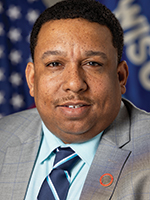
Rep. Russell Goodwin
Sponsored bills
Maddy summaryAB 1008 clarifies eligibility for Wisconsin's child care subsidy program (Wisconsin Shares) by expanding "relative" definitions to include "like-kin" caregivers. It allows non-relatives who provide care as family (e.g., close family friends) to qualify for subsidies if they meet specific criteria, such as having a court order and receiving payments under certain statutes. The bill also adjusts income calculations for eligibility, including court-ordered support payments exceeding $1,250 monthly. This directly affects caregivers of children under 13 (or 19 if disabled) who seek child care assistance through Wisconsin Shares.
Maddy summaryAB 1023 creates a dedicated $500,000 annual appropriation (for 2025-26 and 2026-27) specifically for training and technical assistance for tribal child care providers. The bill directs the Department of Children and Families to use this funding to contract with agencies or award grants aimed at improving the quality of child care services provided by tribal organizations. This funding is separate from other child care funding streams and must be used exclusively for these tribal provider support activities. The bill directly affects tribal child care programs in Wisconsin by providing a new, dedicated resource for their professional development and operational support.
Maddy summaryAB 999 clarifies that employees of the University of Wisconsin Hospitals and Clinics Authority (UWHCA) are covered under collective bargaining agreements. The bill amends specific statutes (including 40.02, 40.05, and 111.02) to explicitly include UWHCA employees in provisions governing union dues, sick leave conversion, and bargaining unit structures. This ensures UWHCA staff have the same collective bargaining rights as other state employees covered under Chapter 111. The changes directly affect UWHCA employees by integrating them into existing labor frameworks without creating new rights. The bill focuses on administrative alignment within current state labor laws.
Maddy summaryThis bill expands eligibility for Wisconsin's child care subsidy program (Wisconsin Shares) by allowing families with incomes above 200% of the federal poverty line but below 100% of the state median income to continue receiving subsidies. It creates a new eligibility pathway (20.437 (2) (ct)) to cover families previously disqualified due to income thresholds and adjusts copayment rules for those exceeding income limits. The policy directly affects low-income working families who lost subsidies due to modest income increases but remain below the new 100% state median income cutoff. A $1.25 million appropriation for fiscal year 2026-27 funds this expansion.
Maddy summaryAB 1017 creates a new child care subsidy program specifically for custodial parents who work as employees in child care facilities. It allows these parents to qualify for subsidies under revised eligibility rules, bypassing standard income and asset requirements that typically apply to other subsidy recipients. The bill appropriates $1.2 million in fiscal year 2025-26 for administrative costs related to this new program. This directly affects parents employed by child care providers who have primary custody of children under 13 (or 19 if disabled) and meet the new eligibility criteria.
Maddy summaryAB 1009 creates a framework for local governments to establish "tourism promotion improvement districts" to fund tourism marketing and infrastructure. It directly affects hotels and motels within designated districts, requiring at least 50% of room owners to petition for creation and approve an operating plan detailing improvements, activities, and financing. Key provisions include setting a 5-year maximum assessment period (10 years for renewals), capping fees for payment processing at 5%, and mandating public hearings before district approval. The bill enables districts to fund tourism promotions and infrastructure (like visitor centers) through business assessments, with all details of costs and benefits outlined in the approved operating plan.
Maddy summaryAB 1020 designates specific highway segments in Wisconsin as "Memorial Highways" honoring eight fallen state troopers, naming each route after a trooper (e.g., STH 23 near Green Lake for Trooper Donald C. Pederson). The bill requires the state transportation department to install commemorative signs on these routes only if sufficient private contributions cover all costs - no state funds may be used. This is a purely commemorative measure with no policy changes to transportation or law enforcement, directly affecting the named highways and the troopers' families.
Maddy summaryAJR 136 is a proposed constitutional amendment that would add a new Section 1m to Article I of the state constitution, stating: "As a necessary part of a free society, the people have an individual and fundamental right to privacy." This resolution, introduced by multiple assembly members and senators, would establish this privacy right as a fundamental constitutional protection for all residents. The bill requires voter approval at the next general election, as it must be referred to voters following a three-month publication period. It does not create immediate legal requirements but proposes a foundational constitutional change.
Maddy summaryAB 1030 increases the state earned income tax credit for low-income working families with fewer than three children. Starting in 2026, eligible individuals will receive a credit equal to 34% of the federal earned income credit (if they have children) or 15% (if they have no children), up from previous rates. This policy directly benefits qualifying working adults and families who earn below certain income thresholds. The change applies to tax returns filed for years beginning after December 31, 2025.