

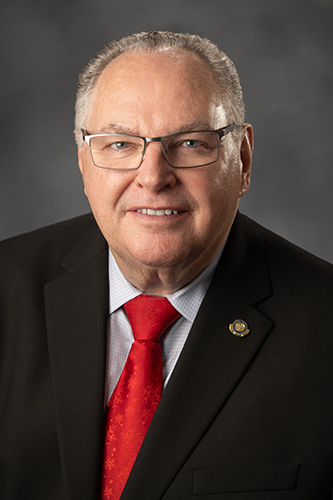
Photo of Rollan Roberts
R West Virginia Senate · District 9 On the 2026 ballot

Sen. Rollan Roberts

Compare
Total votes
2,270
all sessions
Attendance
99%
14 missed
Near the chamber average
With party
97%
of cast votes
Near the chamber average
Bipartisan score
1%
crosses aisle rarely
Near the chamber average
Sponsored
655
bills & resolutions
Near the chamber average
Committees
11
assignments
655 bills and resolutions

Sponsored bills

Total
655
Primary
64
Co-sponsor
591
This page
655
matching current filters
Co-sponsor SB 49
In committee · West Virginia Senate · Co-sponsor
Relating to permissible expenditures by Water Development Authority from Infrastructure Fund

Maddy summaryThis bill amends West Virginia law to increase the annual funding limit for the Water Development Authority's Critical Needs and Failing Systems Sub Account from $12 million to $14 million. It allows the Authority to provide grants for projects upgrading water or wastewater facilities to reduce maintenance, operations, or leak costs, with a $300,000 cost cap per project. The bill expands eligibility to include facilities failing due to age or needing extensions to serve new customers (under $2 million total cost), while exempting these grants from standard allocation rules. It directly affects public water systems, local governments, and utility providers managing aging infrastructure statewide.

In committee Jan 14, 2026 1 co-sponsor
Co-sponsor SB 82
Introduced · West Virginia Senate · Co-sponsor
Establishing tax on production of electricity from wind and solar sources

Maddy summarySB 82 imposes a $3 tax per megawatt-hour on electricity produced from wind and solar sources for sale or trade in West Virginia, starting January 1, 2027. It applies to commercial producers at the point of interconnection with transmission lines, with exemptions for government facilities, personal consumption under 500 kWh daily, and new installations for the first three years of operation. Producers must report annual output by February 1 and pay taxes by the same date, facing penalties of up to 25% for late payment plus 12-18% annual interest. Revenue collected will be distributed to West Virginia counties based on the number of compliant volunteer fire departments, with counties then allocating funds directly to those departments.

Introduced Jan 14, 2026 1 co-sponsor
Primary SJR 14
In committee · West Virginia Senate · Lead sponsor
Incorporation of Churches or Religious Denominations Amendment

Maddy summaryThis Senate Joint Resolution proposes a constitutional amendment to allow churches and religious denominations in West Virginia to incorporate, changing the current prohibition in Article VI, Section 47 of the state constitution. If approved, it would permit religious groups to form legal entities (incorporate) while maintaining existing provisions for securing church property and its use. The amendment specifically authorizes incorporation for religious organizations that choose to do so, without altering how church property is managed or transferred. It requires voter approval in the 2026 general election to take effect.

In committee Jan 14, 2026 0 co-sponsors
Co-sponsor SJR 2
In committee · West Virginia Senate · Co-sponsor
Protection of the Right to Bear Arms Amendment

Maddy summaryThis Senate Joint Resolution (SJR 2) proposes a constitutional amendment to protect gun rights in West Virginia. It would add a new section to the state constitution stating that "a person has the right to keep and bear arms for defense of self, family, home and state, and for lawful hunting and recreational use." The amendment specifically prohibits state, county, municipal, or local government restrictions on this right based on factors like ammunition capacity, caliber, carry method, or accessories. If approved by voters in the 2026 election, it would become "Amendment 1" to the West Virginia Constitution.

In committee Jan 14, 2026 1 co-sponsor
Co-sponsor SB 50
Introduced · West Virginia Senate · Co-sponsor
Providing all coal severance tax be provided to county that produced coal

Maddy summaryThis bill redirects a portion of West Virginia's coal severance tax to the specific counties where coal is mined. Starting in 2012, it gradually increases the share sent to coal-producing counties (from 1% to 5% of the tax), with an annual cap of $20 million. Counties must use these funds exclusively for economic development or infrastructure projects like roads, broadband, mine reclamation, or water systems - barring personal services or bond costs. It ensures local communities directly benefit from coal extracted within their borders.

Introduced Jan 14, 2026 1 co-sponsor
Co-sponsor SB 24
In committee · West Virginia Senate · Co-sponsor
Creating WV Intrastate Energy Use Act

Maddy summarySB 24 creates the West Virginia Intrastate Energy Use Act, clarifying that environmental regulations for coal, oil, and natural gas produced and consumed entirely within West Virginia fall under the West Virginia Department of Environmental Protection (WVDEP), not the federal EPA. It requires coal mines, oil wells, and gas wells operating for in-state use to obtain operational permits from the WVDEP before commencing activities, asserting that EPA lacks authority to deny such permits for resources not entering interstate commerce. The bill applies to all in-state energy production and power generation facilities using these resources, while explicitly stating it does not override other state or federal environmental laws. This legislation aims to define state regulatory authority for intrastate energy activities based on constitutional principles of state sovereignty.

In committee Jan 14, 2026 1 co-sponsor
Co-sponsor SB 154
Signed into law · West Virginia Senate · Co-sponsor
Prohibiting sexual orientation instruction in public schools

Maddy summarySB 154 prohibits public schools from teaching about sexual orientation as part of their curriculum. The law directly affects public school students and educators in the state where it passed, banning instruction on sexual orientation in classrooms. Key provisions require schools to remove any content related to sexual orientation from required lessons. This law became effective on April 30, 2025, after being approved by the governor.

Signed into law Aug 8, 2025 1 co-sponsor
Primary SB 914
Signed into law · West Virginia Senate · Lead sponsor
Relating to testing and attendance requirements for private, parochial, and church schools

Maddy summarySB 914 requires private, parochial, and church schools in the state to implement standardized testing and maintain specific attendance records for students. It directly affects these schools by establishing uniform testing requirements and attendance tracking standards previously not mandated for them. The bill amends existing education codes to ensure these institutions comply with the same testing and attendance reporting rules as public schools, effective August 8, 2025.

Signed into law Aug 8, 2025 0 co-sponsors
Co-sponsor SB 565
Signed into law · West Virginia Senate · Co-sponsor
Relating generally to practice of optometry

Maddy summarySB 565, titled "Relating generally to practice of optometry," became law on May 1, 2025, without the Governor's signature. The bill's title indicates it addresses regulations governing optometry practice, but the provided context does not include specific provisions, mechanisms, or affected parties. No details about scope of practice changes, licensing requirements, or other concrete policy elements are available in the given information. As a procedural bill focused on professional practice standards, a more detailed summary cannot be provided without additional legislative text.

Signed into law Aug 8, 2025 1 co-sponsor
Co-sponsor SB 810
Signed into law · West Virginia Senate · Co-sponsor
Clarifying requirements for administration of anesthesia and chronic pain practice by certain licensed nurses

Maddy summarySB 810 clarifies the requirements for licensed nurses who administer anesthesia or manage chronic pain practices. The bill updates existing rules to provide clearer standards for these specific nursing roles, directly affecting qualified nurses in those specialties. It does not create new requirements but makes current regulations more explicit and actionable. The law became effective on August 8, 2025, following gubernatorial approval on April 30, 2025.

Signed into law Aug 8, 2025 1 co-sponsor
Showing 71 to 80 of 655 bills
Previous 1 7 8 9 66 Next