

Maddy summaryHB 4584 establishes a market-based pay enhancement for West Virginia teachers in counties where the regional median home price exceeds the state average. It calculates an annual lump-sum payment for teachers in those counties by comparing regional home prices (including contiguous border counties/states) to West Virginia's statewide median home price, then applying a multiplier to the county's average teacher salary. The State Board of Education determines this adjustment every five years starting in 2027, certifies the amount to the State Auditor, and payments are distributed annually as taxable income. This directly affects certified teachers in specific counties with higher regional cost-of-living compared to West Virginia's average, aiming to make salaries competitive with neighboring areas.
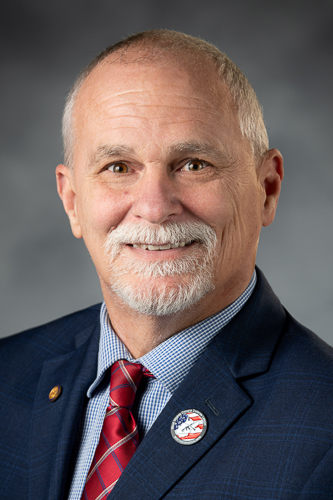
Del. Chuck Horst
Sponsored bills
Maddy summaryHCR 12 is a West Virginia House Concurrent Resolution requesting Congress to call a constitutional convention to propose an amendment. It specifically seeks to amend the U.S. Constitution to establish a fixed number of nine justices on the Supreme Court, as Article III currently does not specify the number. The resolution cites Article V of the Constitution, which allows states to request such a convention, and urges Congress to fulfill this duty. This resolution does not change the Court's size itself but formally requests action from Congress and other states to pursue the proposed amendment.
Maddy summaryHB 4551, the West Virginia Safe Trucking Act 2026, requires non-domiciled commercial drivers (those not residents of West Virginia) operating commercial vehicles in the state to present a valid work visa and proof of citizenship (such as a birth certificate, naturalization certificate, or passport) starting July 1, 2026. This applies specifically to drivers holding non-domiciled commercial driver licenses or learner permits, as defined by federal regulations. Violations carry fines up to $2,500 for drivers per offense and up to $3,000 per violation for commercial carriers employing non-compliant drivers. The bill amends existing licensing standards to add these requirements and penalties, focusing on verifying legal work authorization for commercial truck drivers.
Maddy summaryHB 4613 establishes the State Resiliency Office and requires the State Resiliency Officer to update West Virginia's Flood Resiliency Plan every two years (by June 30 in even-numbered years). The plan must include recommendations for high-impact flood prevention measures and prioritize the five most critical flood prevention projects in each regional planning zone, with estimated costs for each project. The State Resiliency Officer must also provide quarterly reports to the Joint Legislative Committee on Flooding, coordinate flood mitigation efforts with federal and state agencies, and maintain a centralized website for flood-related information. This bill directly affects the State Resiliency Office, the Governor's office, and the legislative committee, aiming to improve statewide flood preparedness and resource allocation.
Maddy summaryHJR 20 proposes adding a new constitutional section recognizing the Holy Bible (66 books of Old and New Testaments) as "the divinely inspired, inerrant foundational document for our society and government" and requiring its "precepts" to be given "prominence and reverence" in West Virginia's public buildings, laws, policies, and schools. If approved by voters in 2026, this amendment would formally enshrine the Bible's role in state governance and public life. The bill is currently in the House Judiciary Committee, awaiting further legislative action before a voter referendum. It does not mandate Bible instruction in schools but seeks to establish the Bible as a foundational reference for state policy.
Maddy summaryHB 4521 requires the West Virginia state government to reimburse counties for the daily costs of housing inmates when a conviction results in credit for time already served in jail. This directly affects counties operating local jails and inmates whose sentences are reduced due to prior incarceration time. The bill amends existing law to mandate state reimbursement for the days an inmate is credited toward their sentence, rather than having counties absorb those costs. It clarifies that counties should be paid back for these specific days through the state's correctional funds, ensuring counties aren't financially burdened by reduced sentences.
Maddy summaryHB 4447 prohibits election officials and others from sending absentee ballot applications to voters who haven’t specifically requested one. It limits anyone from delivering more than 10 unsolicited applications to a single voter. The bill requires absentee ballot applications to be available at county clerk offices and online, but ensures they are only sent upon direct request. Violations could result in misdemeanor penalties. This directly affects election officials, political groups, and individuals distributing ballot materials.
Maddy summaryHB 4454 increases West Virginia's homestead property tax exemption from $20,000 to $40,000 for qualifying homeowners. It directly affects residents aged 65 or older or those certified as permanently and totally disabled who have lived in West Virginia for two consecutive years. The bill allows the exemption to apply to the first $40,000 of a home's assessed value, reducing property taxes for eligible primary residences. The change requires applicants to confirm they aren't receiving a similar exemption in another state.
Maddy summaryHB 4448 removes exemptions that currently protect bona fide schools, public libraries, and museums from criminal charges when distributing or displaying obscene material to minors. The bill amends West Virginia law to eliminate these specific protections, meaning these institutions would no longer be shielded from prosecution under the existing obscenity statute (§61-8A-3). Previously, schools were exempt when showing material as part of approved curriculum, and libraries/museums were exempt if minors were accompanied by parents. This change directly affects how these public institutions handle materials accessible to minors. The bill does not alter other existing exemptions, such as those for medical professionals or internet service providers.
Maddy summaryHB 4455 gradually increases West Virginia's homestead property tax exemption for eligible homeowners, starting at $20,000 in 2028 and rising to $40,000 by 2031. It directly affects homeowners aged 65 or older, or those certified as permanently and totally disabled, who have resided in West Virginia for two consecutive years. The bill requires a constitutional amendment to take effect and removes a cap on property tax books while repealing a prior limitation on levy rates. This change aims to reduce property tax burdens for qualifying senior and disabled residents over time.