

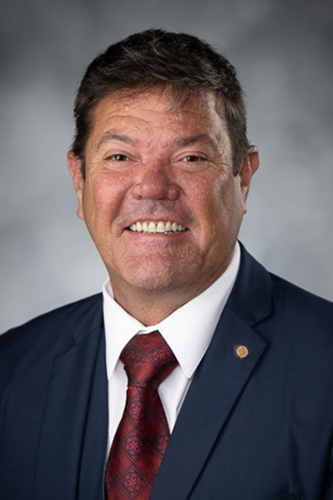
Photo of Mike Hornby
R West Virginia House of Delegates · District 93 On the 2026 ballot

Del. Mike Hornby

Compare
Total votes
3,175
all sessions
Attendance
98%
78 missed
Near the chamber average
With party
97%
of cast votes
Higher than 95% of chamber peers
Bipartisan score
2%
crosses aisle rarely
Lower than 93% of chamber peers
Sponsored
485
bills & resolutions
Higher than 76% of chamber peers
Committees
6
assignments
485 bills and resolutions

Sponsored bills

Total
485
Primary
69
Co-sponsor
416
This page
485
matching current filters
Primary HB 4606
Signed into law · West Virginia House of Delegates · Lead sponsor
Relating to the meaning of residence for the purpose of bail

Maddy summaryHB 4606 requires West Virginia judges to specifically consider a defendant's residency status - whether they live in West Virginia or the U.S. - when deciding bail or pretrial release conditions for criminal cases. This applies to both misdemeanor and felony offenses, clarifying that judicial officers must weigh residency alongside factors like community ties, flight risk, and prior criminal history. The bill also explicitly states that magistrates cannot release felony defendants on their own recognizance without bail. It adds residency as a formal consideration in the existing framework for determining appropriate bail or release conditions.

Signed into law Jun 29, 2026 0 co-sponsors
Primary HB 5510
Passed · West Virginia House of Delegates · Lead sponsor
Eliminate the requirement for private wedding venues to own or lease 2 acres in rural location.

Maddy summaryHB 5510 removes a requirement that private wedding venues in West Virginia must own or lease at least two acres of land in a rural area to operate. This change directly affects private wedding venues, particularly those in rural locations that previously faced this land-use barrier. The bill amends West Virginia Code §60-7-2 (relating to private club licenses) to eliminate the two-acre minimum, simplifying licensing for these venues. The policy change takes effect July 1, 2026, after passing through legislative committees.

Passed Mar 14, 2026 0 co-sponsors
Co-sponsor HB 5537
Passed · West Virginia House of Delegates · Co-sponsor
Repealing obsolete and outdated sections of the Education code.

Maddy summaryHB 5537 repeals four outdated sections of West Virginia's Education Code: §18-2E-5 and §18-2E-12 (related to education performance audits and digital literacy projects), §18-2I-1 (professional development for educators), and §18-8-6 (High School Graduation Improvement Act). The bill directly affects the state's education code by removing obsolete provisions that no longer apply. This is a procedural update to streamline the code, with no new policies or funding changes. The bill passed the House on March 3, 2026, and is now in the Senate for review.

Passed Mar 14, 2026 1 co-sponsor
Co-sponsor HB 5453
Passed · West Virginia House of Delegates · Co-sponsor
To modify the school aid funding formula.

Maddy summaryHB 5453 modifies West Virginia's school funding formula, shifting to a block grant of $6,100 per student for county school districts starting in 2029-2030 (with a minimum 1,200-student threshold per county), while public charter schools receive $8,600 per student. It creates a "Supplemental School Aid Fund" to provide additional per-pupil funding for Tier II ($3,050) and Tier III special needs students beginning in 2029-2030. School districts may also request supplemental funding for specific needs like transportation, vocational centers, or pilot programs through this fund. The bill requires annual oversight reports by the Legislative Oversight Commission on Education Accountability and defines "maladministration" as financial mismanagement that could trigger funding restrictions.

Passed Mar 14, 2026 1 co-sponsor
Co-sponsor HB 4198
Passed · West Virginia House of Delegates · Co-sponsor
E-Verify Safe Harbor Act

Maddy summaryHB 4198, the E-Verify Requirement Act, requires all employers in West Virginia - including businesses, government entities, and public agencies - to use the federal E-Verify system to confirm employees' work authorization. It replaces criminal penalties with fines for knowingly employing unauthorized workers ($100-$10,000 per violation depending on offense count) and allows license suspension or revocation for repeat violations. The bill also creates a "safe harbor" for employers who use E-Verify, shielding them from penalties for failure to verify status. It repeals a provision denying business expense deductions for non-compliance but maintains financial penalties and licensing consequences for violations.

Passed Mar 14, 2026 1 co-sponsor
Primary HB 4006
Passed · West Virginia House of Delegates · Lead sponsor
Creating the West Virginia Aerospace and Advanced Manufacturing Growth Act

Maddy summaryThe West Virginia Aerospace and Advanced Manufacturing Growth Act creates a new program within the West Virginia Department of Commerce to support aerospace and advanced manufacturing businesses. The program will identify qualifying projects (including manufacturing, maintenance, and research of aircraft components), assign a dedicated liaison to assist with development and access to existing state tax incentives, and maintain confidential records of these projects. It also establishes a workforce training program to develop skilled workers for the aerospace industry. This bill directly affects aerospace companies and projects operating in West Virginia, such as those involved in aircraft assembly, engine production, and component manufacturing.

Passed Mar 14, 2026 0 co-sponsors
Co-sponsor HB 4012
Failed · West Virginia House of Delegates · Co-sponsor
Relating to reducing the regulatory burden on utility companies when constructing and maintaining electric power generation and transmission facilities within this state

Maddy summaryHB 4012 reduces regulatory requirements for utility companies building or maintaining electric power generation and transmission facilities in West Virginia. The bill waives the need for a certificate of public convenience and necessity for projects approved by the Infrastructure and Jobs Development Council, streamlining approvals for these projects. It also shortens the Public Service Commission’s decision timeline, reducing the maximum processing time for large projects (over $50 million) from 400 days to 270 days. This directly affects utility companies seeking to develop or upgrade electric infrastructure within the state.

Failed Mar 14, 2026 1 co-sponsor
Co-sponsor HB 4010
Failed · West Virginia House of Delegates · Co-sponsor
Providing a statutory program for loaning financial assistance to local airports for airplane hangar construction in this state

Maddy summaryHB 4010 establishes a state loan program to provide financial assistance for constructing airplane hangars at local airports in West Virginia. It directly affects counties, municipalities, and regional airport authorities that own or operate airports, allowing them to access state loans for hangar planning, construction, or improvements. The bill creates a pilot project with specific eligibility standards (considering site readiness, economic impact, and market demand) and requires the transportation division to set loan terms, limit participating airports based on funding, and report annually to the Joint Committee on Government and Finance. This program aims to support airport infrastructure development to enhance economic opportunities in local communities.

Failed Mar 14, 2026 1 co-sponsor
Co-sponsor HB 5162
Passed · West Virginia House of Delegates · Co-sponsor
Relating to the sales of tax liens

Maddy summaryThis bill (HB 5162) amends West Virginia law governing tax lien sales. It requires sheriffs to suspend sales when property is already sold, liens are unredeemed, tax amounts are incorrect, or property is tax-exempt. County commissions gain authority to decide whether a suspended lien should be sold (removing it if not) or included in the next sale. The bill also clarifies that tax deeds acquired by government entities (like states, counties, or municipalities) for tax-exempt properties extinguish all prior tax liens and prevent future ad valorem taxation on that property. This directly affects sheriffs, county governments, and owners of tax-exempt properties.

Passed Mar 12, 2026 1 co-sponsor
Co-sponsor HB 4656
Passed · West Virginia House of Delegates · Co-sponsor
Relating to chronic absenteeism

Maddy summaryHB 4656 modifies West Virginia's school attendance laws by ending the compulsory attendance requirement at age 18 (previously 17), meaning 18-year-olds no longer face penalties for chronic absenteeism. It replaces "truancy" with "chronic absenteeism," removes criminal penalties for 18-year-olds, and requires schools to notify them directly about unexcused absences - same as parents. The bill establishes new referral pathways to human services for wrap-around support, shifts handling of chronic absenteeism to juvenile welfare (not criminal) proceedings, and defines key terms like "student support specialist." It directly affects students aged 17-18, school staff, and county human services departments.

Passed Mar 11, 2026 1 co-sponsor
Showing 21 to 30 of 485 bills
Previous 1 … 2 3 4 … 49 Next