

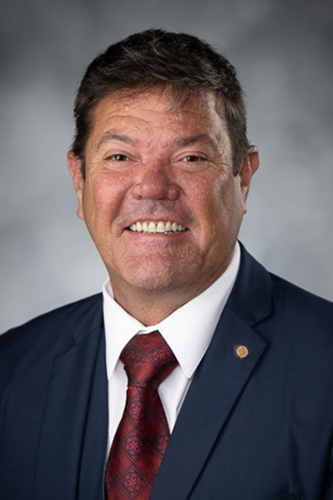
Maddy summaryHCR 52 is a ceremonial resolution requesting the West Virginia Division of Highways name I-64 Nitro Interchange Bridge (Bridge Number 40-064/00-044.47) in Putnam County as the "Ronnie W. Matthews Memorial Bridge." It commemorates Ronnie W. Matthews, a local businessman, Putnam County Circuit Clerk (2008), U.S. Army veteran, and community leader who passed away in 2018. The resolution directs the agency to install signage identifying the bridge with this name. This is a non-binding memorial gesture with no policy or funding changes, solely honoring an individual's contributions to the Nitro community.
Del. Mike Hornby
Sponsored bills
Maddy summaryHB 2736 creates an Underground Facilities Damage Prevention Board to enforce rules preventing damage to underground utility lines during excavation. It directly affects excavators (e.g., construction crews) and operators of underground facilities (e.g., gas, water, or telecom companies). The bill establishes the board’s authority to investigate damage incidents, assess civil penalties, require training, and collect fines - which must be retained by the board (not the state general fund) for its operations. Key provisions clarify definitions of "damage," "excavation," and "underground facility" to standardize reporting and safety protocols. The law aims to reduce accidental utility line strikes during digging projects.
Maddy summaryHB 3150 amends West Virginia's medical student loan program to replace scholarship language with loan repayment terms for health science and mental health providers. It clarifies that medical student loans - maxing at $10,000-$20,000 annually for up to four years - will prioritize West Virginia residents, require service in designated shortage areas, and mandate direct payments from the state commission to federal loan servicers. The bill removes licensure requirements for repayment eligibility and updates definitions to align with current health workforce needs, such as specifying "approved service commitment areas" as locations meeting both geographic and specialty shortages. These changes aim to streamline loan administration and better target support for health professionals in underserved communities.
Maddy summaryHB 2514 is a procedural bill that removes outdated references in West Virginia law to two specific one-time reports already submitted to the Legislative Oversight Commission on Education. The bill amends sections of the education code (§18-2-7f and §18-2E-10) that previously required reporting on extended learning programs and early literacy support systems. It does not change any program requirements or student eligibility - it only eliminates redundant reporting language for reports that have already been provided. This is a technical cleanup measure with no direct impact on schools, students, or program operations.
Maddy summaryHB 3452 transfers administration of Advanced Career Education (ACE) programs - from high school courses preparing students for specific careers - from county school boards to community and technical colleges. The bill amends education code to end current county board oversight (repealing §18-5-19b) and establishes community colleges as the new administrators for ACE programs, including approval of curricula and credentials. This directly affects high school students enrolled in ACE pathways, county schools currently managing these programs, and community colleges taking on this responsibility. The change aims to align career education with college-level technical training structures, though it does not alter program content or funding mechanisms.
Maddy summaryHB 2543 requires state agencies to prepare and submit detailed economic impact statements for certain proposed legislative rules before they are finalized. These statements must analyze potential costs to the public, including regulatory expenses, effects on business competitiveness, job creation, private investment, and economic growth. The bill applies specifically to "legislative rules" (rules that have legal force, impose liability, or grant/deny specific benefits), excluding interpretive or exempt rules. This change aims to provide transparency about the economic consequences of new regulations before they take effect.
Maddy summaryHB 2688 would exempt overtime pay from West Virginia's personal income tax. The bill directly affects workers who earn overtime wages by removing the tax on that specific income. It adds a new provision (§11-21-12o) to the tax code stating "Overtime pay shall be exempt from the tax imposed by this article." This changes the tax treatment of overtime earnings without altering other tax rules or affecting non-overtime income.
Maddy summaryHB 2876 increases the Natural Resources Commission from seven to eleven members by adding four new positions. These additional members must be Division of Natural Resources staff wildlife biologists, each specializing in a specific wildlife area: deer, bears, turkeys, or fisheries. The bill directly affects the commission's structure and operations, requiring specialized expertise in key species management. This change takes effect with appointments in 2025, expanding the commission's capacity to address species-specific conservation needs.
Maddy summaryHB 2646 allows eighth and ninth-grade students in West Virginia to attend summer school specifically to improve their grades and meet academic eligibility requirements for fall sports. The bill amends existing law to explicitly permit this use of summer school programs, which previously focused on general remedial or accelerated instruction. Key provisions ensure counties can operate these programs with tuition limited to actual costs, offer reduced fees for financially needy students, and maintain existing teacher pay structures. This change directly affects middle and high school athletes seeking to qualify for sports participation under current academic standards.
Maddy summaryHB 3508 modifies West Virginia's school funding formula to provide increased support for public schools in rural counties with low population density. It adjusts how "net enrollment" is calculated for counties where student population density is low (specifically, counties with fewer than 1,400 students), using a formula that accounts for the ratio of students to square miles. This adjustment increases funding for these counties by effectively raising their calculated enrollment, with a specific provision also giving special education enrollment a 1.5 weighting for funding special education aides. The bill directly affects school districts in rural areas, particularly those with sparse populations, by changing the calculation method used to distribute state education funds.