

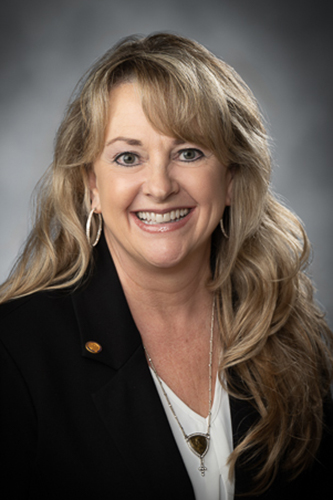
Maddy summaryHB 3383 creates the Great Expectations Pilot Program to support West Virginia youth aging out of foster care in transitioning to community college. The program pairs eligible foster youth (those who were in foster care when earning their high school diploma or GED) with full-time coaches at a single community college, who provide personalized guidance on college applications, financial aid, transportation, career planning, and accessing support services. It allocates $95,000 annually from state general revenue to cover the coach's salary, benefits, and program resources. The three-year pilot, starting September 2025 at one college, will be evaluated in 2029 to determine potential statewide expansion.
Del. Laura Kimble
Sponsored bills
Maddy summaryHB 3328 requires hospitals and healthcare facilities to provide effective communication tools for deaf or hard-of-hearing patients and their families when ASL interpreters aren't available on staff. Specifically, facilities must offer technology like hearing loops, captioning services, or video relay systems to enable communication. The bill also mandates that any ASL interpreters used must be approved by the West Virginia Commission for the Deaf and Hard of Hearing. This applies to all hospitals, ambulatory care facilities, and extended care centers under West Virginia law, aligning with the Americans with Disabilities Act.
Maddy summaryHB 3329 amends West Virginia law to strengthen penalties for sex offenses against children under 12 and for filming minors in sexually explicit conduct. It mandates prison sentences without probation for sex offenses involving force, weapons, or moving the victim, with a minimum 20-year sentence for first offenses. Repeat offenders face life imprisonment without parole. The bill also increases penalties for filming minors in sexually explicit conduct, imposing fines up to $10,000 or up to 10 years in prison for violations.
Maddy summaryHB 3220 creates a statewide moratorium on public school closures and consolidations in West Virginia, except for cases of catastrophic structural failure or unresolved safety hazards. It requires the West Virginia Department of Education to review closures considered over the past five years and propose changes to the school funding formula that would prevent at least 80% of those closures based on financial or operational factors. The moratorium remains in effect until the legislature receives the proposed formula and takes action on it. This directly affects all West Virginia public school districts and students by delaying closure decisions pending the new funding approach.
Maddy summaryHB 3301 would amend West Virginia law to prohibit any requirement that a person receive or use a medical product, such as vaccines or treatments. It also bans penalties or denial of benefits for refusing a medical product or for declining to disclose whether one has been used. The bill would override existing health regulations to ensure individuals cannot be forced to use medical products or face legal consequences for refusing them. This applies broadly to all medical products and all state laws, effectively blocking mandatory use in public health contexts.
Maddy summaryHB 3299 prohibits West Virginia state and local government agencies from purchasing or operating drones (small unmanned aircraft systems) manufactured or assembled by foreign entities linked to China or Russia, as defined by U.S. sanctions lists. It requires agencies to replace non-compliant drones by May 1, 2028, and creates a grant program within the Department of Homeland Security to fund the transition to U.S.-made drones. The grant provides reimbursement based on a drone’s current value for agencies turning in non-compliant equipment, with priority for agencies submitting complete applications. Agencies must use funds only for drones meeting U.S. certification standards, such as Defense Innovation Unit’s Blue sUAS or AUVSI Green UAS. The bill directly affects all public safety and government drone users across the state.
Maddy summaryHJR 37 proposes a constitutional amendment to formally establish West Virginia citizens' powers of initiative, referendum, and recall. It would add Article XV to the state constitution, reserving these direct democracy tools for voters to propose laws, reject legislation, and remove officials at all government levels. The amendment requires voter approval at the 2028 general election and would amend existing sections on legislative power (Article VI) and constitutional amendment procedures (Article XIV). This change would codify existing practices into the state constitution, ensuring these powers are explicitly reserved to registered voters.
Maddy summaryHB 2689 requires websites that primarily offer pornography to verify the age of users before allowing access, aiming to prevent minors from viewing such content. It targets commercial entities where pornography constitutes a "substantial portion" of their content, mandating "reasonable" age verification methods. The bill creates civil liability for non-compliance, allowing lawsuits against violators, while exempting internet service providers from liability for hosting content they didn’t create. It defines "minor" as under 18 and "sexual material harmful to minors" using community standards and explicit content criteria. The law provides a five-year statute of limitations for civil actions and excludes certain news organizations from coverage.
Maddy summaryHB 3308 terminates West Virginia's Health Care Authority's certificate of need program, which previously required health care facilities to seek state approval before expanding services. This directly affects hospitals, clinics, and behavioral health providers that previously needed certificate approvals for new services or expansions. The bill repeals all related statutes, transfers the Authority's remaining powers, assets, records, and employees to the Secretary of the Department of Health, and moves funds to the general revenue fund. It also establishes a new summary review process for certain behavioral health services to meet federal Medicaid waiver requirements, but eliminates the broader certificate of need requirement.
Maddy summaryHB 3300 requires medical professionals to ask patients in advance before appointments or procedures whether they consent to being treated by a medical resident (trainee) or having a resident observe. If a patient declines, a licensed physician must provide care instead, but this does not apply in emergencies. The bill directly affects patients receiving routine care in non-emergency settings and aims to ensure patient comfort and trust in their care team. It mandates that facilities obtain this consent prior to treatment, with no impact on emergency care. The law creates a concrete policy change by making advance consent for resident treatment mandatory.