

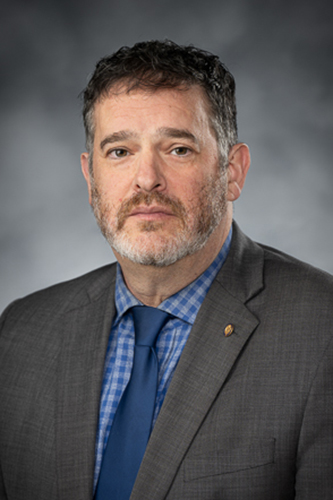
Photo of Mike Pushkin
D West Virginia House of Delegates · District 54 On the 2026 ballot

Del. Mike Pushkin

Compare
Total votes
6,862
all sessions
Attendance
99%
66 missed
Higher than 94% of chamber peers
With party
94%
of cast votes
Higher than 76% of chamber peers
Bipartisan score
3%
crosses aisle rarely
Lower than 83% of chamber peers
Sponsored
720
bills & resolutions
Near the chamber average
Committees
7
assignments
720 bills and resolutions

Sponsored bills

Total
720
Primary
275
Co-sponsor
445
This page
720
matching current filters
Primary HB 3243
In committee · West Virginia House of Delegates · Lead sponsor
Relating to calculating max number of students at alternative and year-round schools

Maddy summaryHB 3243 updates how student enrollment is counted for school funding in West Virginia, specifically for alternative and year-round schools. The bill adds adults in vocational programs (capped at 2,500 per county) and early childhood students (counted as full-time equivalents) to the enrollment calculation. It also includes a population density adjustment to increase enrollment counts for counties with fewer than 1,400 students. This change affects how state funding is distributed to school districts operating these school types.

In committee Mar 7, 2025 0 co-sponsors
Primary HB 3229
In committee · West Virginia House of Delegates · Lead sponsor
Authorizing possession and smoking of medical cannabis by approved persons

Maddy summaryHB 3229 would allow certified medical cannabis patients and their designated caregivers to legally possess and smoke medical cannabis in West Virginia, provided they hold valid identification cards issued by the state bureau. The bill specifies that cannabis must be dispensed in approved forms (like pills, oils, topicals, or vaporized products) and prohibits dry leaf or plant forms until future bureau rules permit them. Patients may have up to two caregivers, and caregivers cannot serve more than five patients. All products must display specific labeling including THC content, and smoking is explicitly permitted - unlike many medical cannabis programs that restrict it. This applies only to individuals certified under the state's medical cannabis program, not to recreational users.

In committee Mar 7, 2025 0 co-sponsors
Primary HB 3245
In committee · West Virginia House of Delegates · Lead sponsor
Directing the Supreme Court of Appeals to create a pilot domestic violence court in Kanawha County

Maddy summaryHB 3245 directs the West Virginia Supreme Court of Appeals to establish a pilot domestic violence court in Kanawha County. This court would handle misdemeanor domestic violence cases and related civil protective orders for family or household members, with judicial officers (such as circuit judges, family court judges, or magistrates) assigned to oversee these proceedings. The Supreme Court must collect data on the court's operation and report its effectiveness to the Legislature by 2026 and 2027. The pilot court would not handle felony cases unless a circuit judge is assigned to preside.

In committee Mar 7, 2025 0 co-sponsors
Primary HB 3246
In committee · West Virginia House of Delegates · Lead sponsor
Prohibiting expanding drug and alcohol treatment facilities and services in certain counties

Maddy summaryHB 3246 removes a current restriction that prevents adding licensed substance abuse treatment beds in West Virginia counties with more than 250 existing such beds. This bill directly affects counties exceeding that bed threshold and substance abuse treatment facilities seeking to expand services there. It amends the certificate of need law (§16-2D-9) to allow new beds in these high-capacity counties, removing a prior prohibition. The policy change specifically targets regulatory barriers for treatment providers in areas already meeting or exceeding current bed capacity. The bill does not alter bed limits in counties with fewer than 250 beds.

In committee Mar 7, 2025 0 co-sponsors
Primary HB 3250
In committee · West Virginia House of Delegates · Lead sponsor
Relating to removing the Certificate of Need moratorium on opioid treatment facilities

Maddy summaryHB 3250 repeals a law (§16B-13-12) that had paused the Certificate of Need requirement for opioid treatment facilities in West Virginia. This bill directly affects opioid treatment providers by removing a temporary moratorium that previously exempted them from needing state approval for new facilities or expansions. The key mechanism is the formal repeal of the moratorium provision, meaning these facilities will now be subject to the standard Certificate of Need review process. The change aims to align opioid treatment facility regulations with other healthcare facilities under state law.

In committee Mar 7, 2025 0 co-sponsors
Primary HB 3252
In committee · West Virginia House of Delegates · Lead sponsor
Prohibiting the private ownership or operation of a prison

Maddy summaryHB 3252 prohibits private ownership or operation of prisons in West Virginia, effective July 1, 2025. It requires private entities to obtain written approval from the secretary to operate or modify facilities before that date, but eliminates this option entirely after the deadline. The bill directly affects private prison contractors and operators, banning their ability to run facilities for general incarceration. It explicitly preserves state and local government authority to operate prisons, and does not apply to foreign court sentences.

In committee Mar 7, 2025 0 co-sponsors
Primary HB 3244
In committee · West Virginia House of Delegates · Lead sponsor
Removing the one-time limit on the expungement of certain criminal convictions

Maddy summaryHB 3244 removes a restriction that previously allowed only one expungement of eligible criminal convictions per person in West Virginia. It enables individuals with certain misdemeanor or nonviolent felony convictions (after meeting waiting periods of 1 year for misdemeanors or 5 years for nonviolent felonies) to seek multiple expungements of their records. The bill does not change eligibility criteria or waiting periods but eliminates the "one-time limit" on expungement petitions. This directly affects people with qualifying convictions who have completed required waiting periods and met other standard expungement requirements.

In committee Mar 7, 2025 0 co-sponsors
Primary HB 3249
In committee · West Virginia House of Delegates · Lead sponsor
Permitting certain felons to work in licensed behavioral health facilities

Maddy summaryHB 3249 allows individuals who have completed their sentence for a nonviolent felony to work in licensed behavioral health facilities, provided they meet conditions set by new state rules. The bill requires the state health department to develop eligibility criteria and safety measures for these workers, which must be approved by the legislature. These rules will address patient and staff safety without changing existing licensing requirements for regulated professions like therapists or counselors. The policy applies directly to formerly incarcerated individuals with nonviolent felony convictions and behavioral health facilities seeking to hire them.

In committee Mar 7, 2025 0 co-sponsors
Co-sponsor HB 3259
In committee · West Virginia House of Delegates · Co-sponsor
To increase the minimum starting salary for a teacher to $50,000

Maddy summaryThis bill raises West Virginia's minimum starting salary for public school teachers from $36,597 to $50,000, directly affecting all new teachers entering the state's public school system. It amends the state salary schedule (§18A-4-2) to set $50,000 as the base rate for teachers with zero years of experience, replacing the current minimum. The change applies to all public school districts beginning with the 2025-2026 school year, as specified in the bill's effective date.

In committee Mar 7, 2025 1 co-sponsor
Co-sponsor HB 3257
In committee · West Virginia House of Delegates · Co-sponsor
Creating the Police Partnering with Communities Act

Maddy summaryHB 3257, the "Police Partnering With Communities Act," establishes a fund within the West Virginia State Treasurer's office to reimburse police officers for full housing costs if they live in designated distressed areas. Distressed areas are defined as low-income West Virginia neighborhoods with poverty rates of at least 20% or median family income below 80% of the area median, particularly those with higher crime rates. Officers must provide proof of residence in a distressed area and employment with a local police department to qualify for reimbursement. The fund, to be funded through a separate appropriations bill, becomes effective July 1, 2025. This policy directly affects police officers in participating municipalities who choose to reside in targeted communities.

In committee Mar 7, 2025 1 co-sponsor
Showing 91 to 100 of 720 bills
Previous 1 … 9 10 11 … 72 Next