

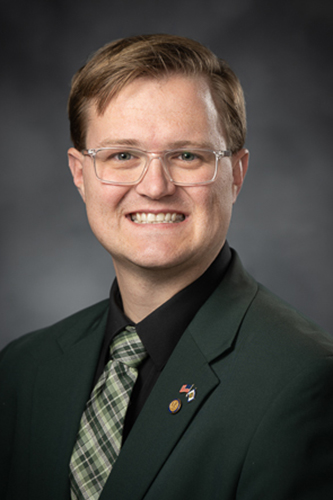
Photo of Michael Amos
R West Virginia House · District 27

Rep. Michael Amos

Compare
Total votes
1,396
all sessions
Attendance
90%
143 missed
Lower than 91% of chamber peers
With party
96%
of cast votes
Near the chamber average
Bipartisan score
2%
crosses aisle rarely
Near the chamber average
Sponsored
84
bills & resolutions
Near the chamber average
Committees
3
assignments
84 bills and resolutions

Sponsored bills

Total
84
Primary
9
Co-sponsor
75
This page
84
matching current filters
Co-sponsor HB 5631
In committee · West Virginia House · Co-sponsor
Relating to the Tobacco Products Excise Tax Act

Maddy summaryHB 5631 increases taxes on tobacco products in West Virginia and removes existing tax discounts on stamps. It adds a clear definition for "electronic smoking devices" (including e-cigarettes and vapes) and expands the tax to cover these products, while excluding FDA-approved nicotine products. The bill directs 10% of the collected tax revenue to fund the state's tobacco prevention program. This affects tobacco manufacturers, retailers, and consumers through higher product costs and updated tax rules for vaping products.

In committee Feb 16, 2026 1 co-sponsor
Co-sponsor HR 14
Passed · West Virginia House · Co-sponsor
Honoring the life and public service of the Honorable Timothy P. Armstead.

Maddy summaryThis is a commemorative House resolution honoring former West Virginia House Speaker and Chief Justice Timothy P. Armstead following his passing. It memorializes his service, names a conference room in the House as the "Speaker Tim Armstead Memorial Conference Room," and extends condolences to his family. The resolution does not create new laws or affect policy - it formally recognizes his legacy and contributions to West Virginia.

Passed Feb 16, 2026 1 co-sponsor
Primary HB 5598
In committee · West Virginia House · Lead sponsor
To increase state sales tax to 8% and abolish personal income tax.

Maddy summaryHB 5598 would increase West Virginia's general sales tax rate from 6% to 8% for most goods and services while repealing all state personal income tax provisions. The bill would change the sales tax calculation method for fractional dollar amounts as detailed in the current law. This would directly affect businesses that collect sales tax and consumers who purchase taxable goods and services, shifting the state's primary revenue source from income tax to sales tax.

In committee Feb 16, 2026 0 co-sponsors
Co-sponsor HB 4462
Passed · West Virginia House · Co-sponsor
Prohibition on cell-cultured products

Maddy summaryHB 4462 bans the sale of cell-cultured food products (like lab-grown meat, eggs, fish, or poultry) for human consumption in West Virginia. It defines these products as those made by growing animal cells in a lab to mimic traditional food items, and removes any requirement for labeling them as "lab-grown" or similar. The bill specifically targets cell-cultured products, not plant-based alternatives (defined as "analogue products"). This is a direct sales prohibition with no new labeling rules for the banned products.

Passed Feb 16, 2026 1 co-sponsor
Primary HB 5481
In committee · West Virginia House · Lead sponsor
To ban ultraprocessed foods (exempt drinks) from schools in WV

Maddy summaryHB 5481 bans ultraprocessed foods from West Virginia public school meals while exempting certain non-alcoholic beverages (like diet drinks). It defines ultraprocessed foods as industrially manufactured items containing additives like artificial sweeteners, industrial flavorings, or preservatives beyond basic cooking methods. The bill requires schools participating in state meal programs to avoid these foods in reimbursable breakfasts and lunches, directing the West Virginia Department of Education to create compliant food lists, provide training, and allow phased implementation. It explicitly excludes foods brought from home, classroom celebrations, and medical accommodations, ensuring no impact on federal meal funding eligibility.

In committee Feb 12, 2026 0 co-sponsors
Co-sponsor HB 5345
In committee · West Virginia House · Co-sponsor
To require child care subsidy payments in West Virginia to be based on enrollment rather than daily attendance

Maddy summaryHB 5345 would change how West Virginia pays child care subsidies by requiring payments to be based on a child’s monthly enrollment (how many children are registered for the month) instead of daily attendance (paying for each day a child attends). This directly affects licensed child care centers and family day-care homes that receive state subsidies, providing more stable monthly funding regardless of daily attendance fluctuations. The bill amends state code to replace the current daily-attendance payment system with a monthly enrollment model for these providers. It does not apply to exempt programs like public schools, short-term care, or certain summer camps. The change aims to simplify billing and ensure consistent funding for child care providers.

In committee Feb 12, 2026 1 co-sponsor
Co-sponsor HB 5433
In committee · West Virginia House · Co-sponsor
Require all state‑regulated health insurance plans to provide meaningful coverage for hearing aids and to cover at least one annual audiological evaluation.

Maddy summaryHB 5433 requires all state-regulated health insurance plans to cover hearing aids and annual audiological evaluations for insured individuals with hearing impairment. The bill mandates coverage for initial and replacement hearing aids (every 36 months), necessary adjustments, and at least one yearly hearing evaluation. It limits coverage to $1,400 per hearing-impaired ear every 36 months for standard hearing aids, while allowing individuals to pay extra for more expensive options without penalties. The law applies to policies issued or renewed after January 1, 2026, and excludes batteries and cords from coverage.

In committee Feb 11, 2026 1 co-sponsor
Co-sponsor HB 5103
In committee · West Virginia House · Co-sponsor
Relating to requiring the Office of Health Facility Licensure and Certification to inspect office-based medication-assisted treatment programs at least every 24 months

Maddy summaryHB 5103 requires the West Virginia Office of Health Facility Licensure and Certification to inspect office-based medication-assisted treatment programs (which provide opioid addiction treatment using medication) at least once every 24 months. These inspections must include reviewing patient records to ensure compliance with licensing rules and may involve a pharmacist and law enforcement officer. The bill mandates formal inspections every two years, in addition to unannounced complaint inspections already allowed. It directly affects opioid treatment programs operating in medical offices across West Virginia.

In committee Feb 10, 2026 1 co-sponsor
Co-sponsor HB 5058
In committee · West Virginia House · Co-sponsor
Require that notice be provided for any lab-grown food served in restaurants.

Maddy summaryHB 5058 requires restaurants in West Virginia to clearly label any menu item containing or made from "analogue products," "cell-cultured products," or "food products" (as defined in state law) with specific terms. This directly affects restaurants serving lab-grown or lab-made food alternatives, such as cultivated meat or plant-based substitutes. The key provision mandates that these labels appear prominently on all menus to inform consumers about the product type before purchase. The bill aims to ensure transparency for dining choices without specifying how restaurants must implement the labeling. It does not change food safety standards or restrict the sale of these products.

In committee Feb 10, 2026 1 co-sponsor
Co-sponsor HB 5344
In committee · West Virginia House · Co-sponsor
Relating to the definition of firearm

Maddy summaryHB 5344 clarifies West Virginia's definition of "antique firearm" in state law. It specifies that antique firearms include pre-1898 weapons (like flintlocks), replicas of those weapons (if not designed for modern ammunition), and muzzle-loading guns using black powder. The bill explicitly excludes weapons with modern frames/receivers, converted muzzle-loaders, or those easily adaptable to fire standard ammunition. This definition affects how antique firearms are regulated under West Virginia law, particularly regarding possession and sale restrictions that typically apply to modern firearms.

In committee Feb 9, 2026 1 co-sponsor
Showing 21 to 30 of 84 bills
Previous 1 2 3 4 9 Next