

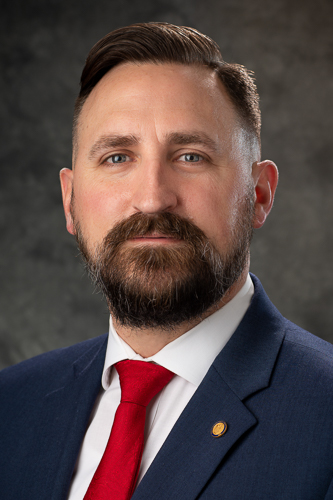
Photo of Evan Worrell
R West Virginia House · District 23 On the 2026 ballot

Rep. Evan Worrell

Compare
Total votes
4,054
all sessions
Attendance
95%
186 missed
Near the chamber average
With party
94%
of cast votes
Near the chamber average
Bipartisan score
3%
crosses aisle rarely
Near the chamber average
Sponsored
540
bills & resolutions
Near the chamber average
Committees
7
assignments
540 bills and resolutions

Sponsored bills

Total
540
Primary
105
Co-sponsor
435
This page
540
matching current filters
Co-sponsor HCR 29
In committee · West Virginia House · Co-sponsor
Requesting Joint Committee study the feasibility of establishing a flexible, short-duration, on-demand respite care program for seniors and caregivers

Maddy summaryThis bill asks a state committee to study whether West Virginia should create a flexible respite care program for seniors and their caregivers. The proposed program would allow families to schedule short-term, on-demand assistance for specific needs like medical appointments or personal obligations, rather than being limited to fixed weekly service blocks. The study will examine costs, potential savings from delaying nursing home placement, and how to fund and manage the program, especially in rural areas with fewer resources. If the committee finds the idea feasible, it will recommend new legislation to establish the program.

In committee Mar 5, 2026 1 co-sponsor
Co-sponsor HB 5260
Passed · West Virginia House · Co-sponsor
Relating generally to medical cannabis

Maddy summaryHB 5260 adds "edible" as an allowable form of medical cannabis in West Virginia, with strict requirements for safety and regulation. It requires processors to obtain bureau approval for each edible product, mandates specific shapes (like squares or circles), limits edibles to lozenges or gelatins, and caps THC content at 10mg per serving with a 15% potency variance. The bill prohibits color additives in edibles and requires all medical cannabis dispensing to be reported to the state's controlled substance monitoring database. This directly affects patients using medical cannabis, caregivers, and licensed processors who must comply with these new edible-specific rules.

Passed Mar 5, 2026 1 co-sponsor
Primary HB 5625
In committee · West Virginia House · Lead sponsor
Relating to the licensure of radon mitigators, testers, contractors, and laboratories

Maddy summaryThis bill establishes licensing requirements for radon testers, radon mitigation specialists, radon mitigation contractors, and radon laboratories in West Virginia. It mandates that individuals must hold a license to perform radon testing, provide radon-related advice, or supervise mitigation work, and businesses must have a license to offer mitigation services or operate a radon lab, with limited exemptions for self-testing on owned properties or research. The bill adds a definition for "Radon Resistant New Construction" (RRNC) and requires licensed professionals to be used when building RRNC homes. Additionally, it directs the Commissioner of the Bureau for Health to conduct inspections of radon mitigation systems.

In committee Mar 5, 2026 0 co-sponsors
Co-sponsor HB 4772
Passed · West Virginia House · Co-sponsor
Medicaid eligibility verification

Maddy summaryHB 4772 requires West Virginia's Medicaid agency to verify enrollee status monthly by matching Medicaid records against state death records (from the Office of Vital Statistics) and the federal Social Security Death Master File. If a person has died, their Medicaid coverage must be terminated immediately, effective the date of death, stopping all future payments. The bill mandates data-sharing agreements with federal agencies, annual audits by the state Inspector General, and yearly reports to the legislature on the number of deceased enrollees removed and estimated cost savings. This directly affects deceased Medicaid recipients (whose records are automatically removed) and aims to prevent unnecessary payments, saving state funds.

Passed Mar 5, 2026 1 co-sponsor
Co-sponsor HB 4981
Passed · West Virginia House · Co-sponsor
Relating to state psychiatric hospital designations

Maddy summaryHB 4981 designates psychiatric hospitals treating exclusively civil and forensic patients (over 95% court-ordered civil/forensic cases from state custody) as "state-designated facilities" for Medicaid funding purposes. This change allows these specific hospitals to qualify for Medicaid reimbursement under federal rules, rather than being excluded as "state-designated" under current tax code. The bill amends tax provisions to ensure revenue collected from eligible hospitals (via a 0.75% tax on gross receipts) flows directly into a Medicaid funding account. It directly affects licensed psychiatric hospitals meeting the strict patient-mix criteria, enabling them to access Medicaid program funds they previously could not.

Passed Mar 4, 2026 1 co-sponsor
Co-sponsor HB 4148
Passed · West Virginia House · Co-sponsor
Requiring all salesperson licensees to submit proof of authorization to work.

Maddy summaryHB 4148 requires real estate salesperson license applicants in West Virginia to submit proof of U.S. citizenship or legal authorization to work in the United States. This directly affects individuals seeking to become real estate salespersons in the state. The bill amends §30-40-13 of the West Virginia Code to add this documentation requirement alongside existing education and exam standards. It does not change the education or exam requirements but adds a new verification step for applicants' immigration status. The law applies only to salesperson licenses, not other real estate professional licenses.

Passed Mar 4, 2026 1 co-sponsor
Co-sponsor HR 20
Passed · West Virginia House · Co-sponsor
Memoralizing the life of the Honorable Larry D. Kump; dedicated public servant, principled legislator, and devoted family man.

Maddy summaryThis House Resolution honors the life and legacy of the late West Virginia legislator Larry D. Kump, who passed away on February 28, 2026. The resolution formally expresses the House of Delegates' condolences to Kump's family and acknowledges his service as a representative for Berkeley County across three different terms. It recognizes his career in criminal justice and mediation, his commitment to limited government, and his role as a devoted family member and church leader. The document is a ceremonial tribute rather than a law that changes policy or affects public programs.

Passed Mar 2, 2026 1 co-sponsor
Co-sponsor HR 19
In committee · West Virginia House · Co-sponsor
Urging Department of Administration to maintain trees on grounds to prevent damage to persons or property

Maddy summaryThis House Resolution urges the Capitol Building Commission and Department of Administration to assess and address hazardous trees along California Avenue and Kanawha Boulevard on the State Capitol Complex grounds. The resolution requests an immediate evaluation of trees that have caused property damage through falling limbs and broken trunks over the past two years. It specifically asks officials to trim trees back to the grass side of sidewalks or remove and replace hazardous trees to protect public safety and state property. This non-binding resolution directs state agencies to take preventative maintenance actions without mandating specific enforcement measures.

In committee Feb 26, 2026 1 co-sponsor
Co-sponsor HB 5198
Passed · West Virginia House · Co-sponsor
Relating to crimes against the intellectually disabled

Maddy summaryHB 5198 amends West Virginia's hate crime law to explicitly include "disability" as a protected class alongside race, sex, and other characteristics. It increases penalties for crimes motivated by disability bias - such as violence or intimidation - by classifying such acts as felonies punishable by fines up to $5,000 or 10 years in prison. The bill applies to all individuals with disabilities as defined under state law (§16B-17-3), directly affecting victims of disability-targeted crimes and holding perpetrators accountable under existing hate crime provisions.

Passed Feb 24, 2026 1 co-sponsor
Co-sponsor HB 4587
In committee · West Virginia House · Co-sponsor
Prohibiting public funds from supporting low-earning outcome postsecondary degree programs

Maddy summaryHB 4587 prohibits West Virginia state and local public funds from supporting postsecondary degree programs classified as "low-earning outcome" under federal standards. It requires the Higher Education Policy Council to adopt rules blocking state funding - including student aid, operational costs, and capital grants - for these programs, and to annually report on prohibited programs and fiscal impacts. The bill directly affects public colleges, universities, and students enrolled in degrees deemed low-earning by federal criteria (per Public Law 119-21, Section 84001). It takes effect immediately upon passage, restricting state and local government funding for specific degree programs without specifying exact income thresholds.

In committee Feb 23, 2026 1 co-sponsor
Showing 21 to 30 of 540 bills
Previous 1 2 3 4 54 Next