

Maddy summaryHB 4424 allows landowners or lessees whose property is damaged by deer or other wildlife to hire a third-party hunter to kill the animals using a bow and arrow. Landowners must report the damage to wildlife authorities, who will investigate and issue a permit enabling the hiring of a hunter. The hunter must follow the same bow and arrow restrictions as during regular hunting seasons, such as minimum bow poundage requirements. This bill does not change hunting seasons but provides a specific method for landowners to address property damage.
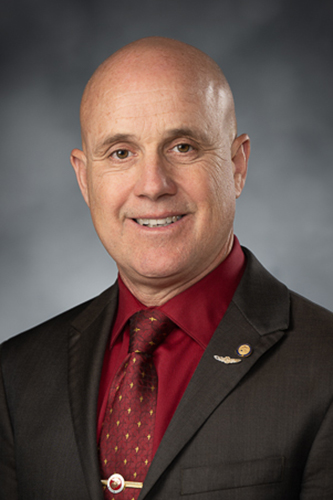
Del. Jim Butler
Sponsored bills
Maddy summaryHB 4338 clarifies definitions and procedures for eminent domain in West Virginia's slum clearance and blight removal programs. It defines key terms like "blighted area" (properties with deteriorated conditions endangering health/safety) and "area of operation" (geographic limits for redevelopment authorities), requiring municipal resolutions before authorities can take property in other municipalities. The bill specifies that eminent domain can only be used for acquiring slum or blighted properties, not general development, and mandates that regional authorities obtain local consent before operating in municipal areas. This amendment to West Virginia Code §16-18-3, §16-18-8, and §54-1-2 updates existing law without creating new powers.
Maddy summaryHB 4337 prohibits public schools from using school resources - including facilities, staff time, or equipment - for election advocacy, such as promoting or opposing candidates. It also bans school employees from engaging in political activities during work hours or while representing the school administration. The bill applies directly to all West Virginia public school employees and school entities, preventing the use of official capacity for political purposes. It does not restrict political activity outside school hours or personal political expression unrelated to school duties. The law aims to maintain nonpartisan environments in educational settings by limiting political involvement during work-related activities.
Maddy summaryHB 4339 moves West Virginia county school board elections from primary elections to general election dates, affecting all county school board members. The bill requires these elections to be nonpartisan, with candidates running on a nonpartisan ballot, and limits representation to no more than two members per magisterial district. It also establishes procedures for certifying winners for full terms and unexpired terms based on vote totals, with tiebreakers handled per existing election laws. This change directly impacts how school boards are elected and who can serve from specific geographic areas.
Maddy summaryHB 4380 clarifies West Virginia's business and occupation (B&O) tax rules by requiring businesses to pay taxes to each municipality where they maintain a permanent physical presence, based on revenue generated at each location. Businesses without a permanent address in a municipality or performing temporary work (e.g., one-time jobs) are exempt from paying taxes there. For revenue earned outside municipal boundaries (like in unincorporated areas), taxes are paid to the business’s primary municipality, and businesses with multiple locations must prorate revenue earned outside municipal boundaries using a consistent, auditable method. The bill also eliminates county-level B&O taxes for businesses operating solely in unincorporated areas.
Maddy summaryHB 2129, now law after Governor approval on April 12, 2025, establishes a "Parents Bill of Rights" for K-12 public schools. It directly affects parents and guardians by granting them specific rights regarding school curriculum, instructional materials, and communications about their child's education. Key provisions require schools to provide parents with clear notice about curriculum content and allow them to review instructional materials used in the classroom. The law creates a framework for parental involvement in educational decisions within public school settings.
Maddy summaryHB 2961 amends laws related to ownership and possession of real property, as indicated by its title. However, the provided context does not include the bill's specific provisions, affected parties, or mechanisms for change. The bill was approved by the Governor on April 28, 2025, and became Chapter 120 of the 2025 Regular Session Acts. Without details on the actual policy changes, a substantive summary cannot be provided from the available information. For a complete summary, the full text of the bill would be required.
Maddy summaryHB 2678, now Chapter 100 of the 2025 Regular Session Acts, establishes new regulations for school zones around public and private schools in the state. The bill directly affects school districts, local law enforcement, and drivers operating near school property during designated hours. While the specific provisions (such as speed limits or enforcement protocols) are not detailed in the provided context, the bill creates a statutory framework for defining and managing school zone boundaries. It became law after receiving gubernatorial approval on April 25, 2025.
Maddy summaryHB 2511 allows charitable organizations to sell and serve alcohol during bingo events they host for fundraising. It directly affects nonprofit groups, such as churches or community centers, that operate charitable bingo games. The bill removes previous restrictions by permitting alcohol sales and consumption while bingo is being played, aligning with updated regulations for these events. This change became law after the governor approved it on April 28, 2025.
Maddy summaryHCR 7 is a commemorative resolution naming a specific bridge in Mason County, West Virginia, as the "U.S. Army Private First Class John Wesley Meadows Memorial Bridge." It requests the Division of Highways to rename bridge ACNS-0035(166) on US Route 35 over Lower Nine Mile Road (coordinates provided) in honor of John Wesley Meadows, a WWII veteran who landed at Normandy, served in the 4th Infantry Division, and later worked in West Virginia's power industry. The resolution has been adopted by both legislative chambers and directs the Division of Highways to install signage.