

Maddy summaryHB 2540 requires the West Virginia state to reimburse counties for daily incarceration costs when an inmate’s conviction results in credit for time already served toward their sentence. This directly affects counties that house inmates who receive sentence reductions due to prior time served in custody. The bill amends §15A-3-16 of state code to establish a reimbursement process for these costs, replacing the current system where counties pay daily per diem fees. Previously, counties paid for all days incarcerated, but the state now covers costs for days not served due to time credit.
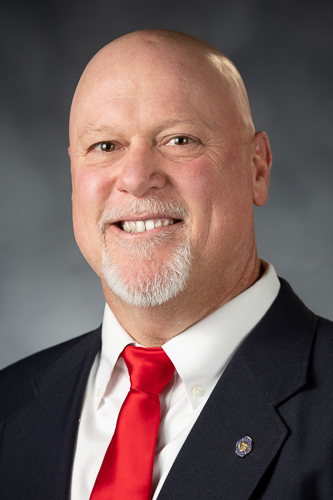
Del. Dave Foggin
Sponsored bills
Maddy summaryHB 2568 (West Virginia House Bill 2568) would repeal the existing net metering rules for public utilities by eliminating Section 24-2F-8 of the West Virginia Code. This bill directly affects residential solar customers who currently receive credit for excess electricity they send back to the grid. The key mechanism is the simple repeal of the current net metering provision, removing the requirement for utilities to compensate solar homeowners for surplus power. If passed, homeowners with solar panels would no longer earn credits for electricity generated beyond their own use. The bill is currently pending in the House Committee on Energy and Public Works.
Maddy summaryHB 2567 would allow the death penalty for anyone convicted of intentionally killing a law enforcement officer or first responder while they are performing their duties. This bill specifically targets murders of these public safety workers by adding their status as an "aggravating circumstance" that automatically triggers the death penalty if proven with physical evidence like DNA or an uncoerced confession. The law requires a separate sentencing hearing where a jury must unanimously agree on the death penalty after reviewing aggravating and mitigating factors, with automatic Supreme Court review of all death penalty cases. It also details execution procedures, including lethal injection or firing squad, and administrative steps for carrying out the sentence.
Maddy summaryHB 2530 creates a state program within West Virginia’s Department of Homeland Security to facilitate the transport of "inspected unauthorized aliens" (people processed by federal authorities but not formally admitted under immigration law) within the United States. The bill establishes the Unauthorized Alien Transport Program, authorizing the state to contract services and adopt rules for transporting these individuals, while requiring compliance with federal law. It does not address deportation or sanctuary cities, as the bill’s title misrepresents its purpose. The program is temporary, expiring June 30, 2028. This bill directly affects West Virginia’s administrative processes for handling individuals already processed by federal immigration systems.
Maddy summaryHB 2538 exempts retirement benefits received by retired West Virginia Division of Natural Resources (DNR) Police Officers from the state's personal income tax. The bill amends the state tax code to specifically exclude these pension payments from taxation, applying only to officers who served in the DNR Law Enforcement Division. This change directly affects retired DNR officers who currently pay state income tax on their pension benefits. The policy provides a tax exemption for this specific group under existing retirement laws, without altering other tax provisions or creating new state spending.
Maddy summaryHB 2531 increases West Virginia's homestead property tax exemption from $20,000 to $40,000 for qualifying homeowners. It directly affects residents aged 65 or older or certified as permanently and totally disabled who have lived in West Virginia for two consecutive years. The bill allows these homeowners to exclude the first $40,000 of their property's assessed value from local property taxes, provided they occupy the home exclusively as their primary residence. The exemption applies starting July 1st and requires proof of residency, such as a state voter registration or vehicle registration.
Maddy summaryHB 2534 creates a voluntary registry for people with specific disabilities (like autism, Alzheimer’s, or Down syndrome) to help law enforcement better interact with them during encounters. Adults can self-enroll with medical documentation, while parents or legal guardians can enroll minors or incapacitated adults using proof of disability or guardianship. Registry information - including names, contact details, and disability type - is kept confidential and exempt from public records, but may be shared with law enforcement, emergency management, or fire departments for official duties. Individuals can request removal from the registry within five business days.
Maddy summaryHB 2526 requires West Virginia public schools to designate shared restrooms and changing areas exclusively for students based on the sex assigned at birth, as listed on their original birth certificate. It mandates that schools provide single-occupancy restrooms as a "reasonable accommodation" for students unable to use designated facilities, but prohibits access to restrooms designated for the opposite sex. Violations could result in fines up to $500 for school officials like principals or superintendents, with parents able to sue if students encounter opposite-sex individuals in designated areas without permission. The bill excludes accommodations needed under the Americans with Disabilities Act or for young children requiring physical assistance.
Maddy summaryHB 2529 prohibits state-funded organizations from requiring COVID-19 vaccinations as a condition for employment or participation in their programs. Covered entities - including state agencies, schools, local governments, and businesses receiving state funds - must provide exemptions for medical reasons (verified by a physician) or religious beliefs (via notarized statement), and cannot discriminate against employees using these exemptions. The law explicitly excludes Medicare/Medicaid facilities due to conflicting federal regulations. It takes effect immediately upon passage.
Maddy summaryHJR 15 is a constitutional amendment proposal (not a law) that would allow West Virginia lawmakers to create a future tax exemption for owner-occupied homes without mortgages. If adopted, it would permit the legislature to exempt from property taxes the value of residential property (including mobile homes) occupied by the owner as their primary residence, provided the property has no mortgage and the owner is a West Virginia citizen. The exemption would apply only to homes without mortgages - taxes would resume if a mortgage is later obtained. This amendment requires voter approval at the 2025 general election and does not change current tax appraisal processes. It is currently in the early legislative stage, referred to the House Finance Committee.