

Maddy summaryHCONRES 30 is a symbolic resolution expressing congressional support for local law enforcement officers. It does not create new laws or policies but formally recognizes their work through four non-binding actions: thanking officers and families for service, honoring those who died in the line of duty, and encouraging community-law enforcement collaboration. The resolution directly addresses Congress's acknowledgment of law enforcement efforts, not any specific group affected by a policy change. It has no legal effect or funding implications, serving solely as a statement of appreciation. This is a procedural resolution, not a legislative bill with concrete policy changes.
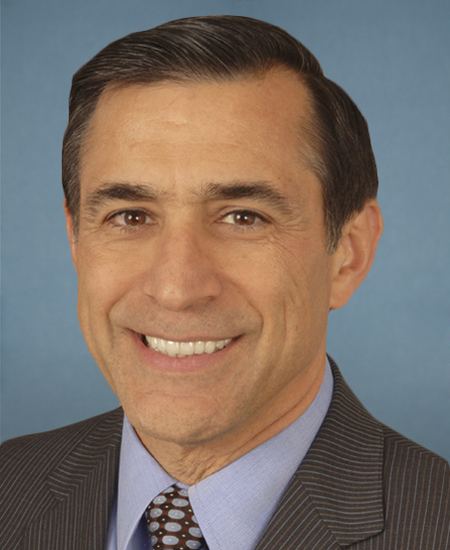
Rep. Darrell Issa
Sponsored bills
Maddy summaryHR 1286, the Simplifying Forms for Veterans Claims Act, requires the Department of Veterans Affairs (VA) to simplify forms sent to veterans filing claims. Within 30 days of enactment, the VA must hire an independent research center (FFRDC) to assess these forms, working with veterans' groups, legal experts, and the VA itself. The VA must then report the assessment to Congress within 90 days and implement approved changes - like clearer language or better organization - within two years. This directly affects veterans navigating VA claims by aiming to reduce confusion in the application process.
Maddy summaryThis bill would rename Gravelly Point Park in Arlington County, Virginia (located along the George Washington Memorial Parkway) to "Nancy Reagan Memorial Park." It directly affects the park's official name and all government references to it. The bill requires that any future law, map, regulation, or document citing "Gravelly Point Park" be updated to reflect the new name, "Nancy Reagan Memorial Park," for consistency. No other policy changes or effects are specified in the bill text.
Maddy summaryThe ETHIC Act (HR 3269) limits how many patents pharmaceutical companies can assert in lawsuits against generic drug and biosimilar manufacturers. Specifically, it prohibits a company from claiming more than one patent per "Patent Group" (commonly owned patents linked through disclaimers) in an infringement case involving a generic drug applicant or biosimilar product. This directly affects generic drug makers (under FDA's 505(b)(2) or 505(j) pathways) and biosimilar developers (under the Public Health Service Act), reducing the ability of brand-name companies to use stacked patents to delay competition. The law applies to applications submitted after its enactment date.
Maddy summaryHR 3304, the Providing Child Care for Police Officers Act of 2025, establishes a federal grant program to help law enforcement agencies provide child care for officers' minor children during nonstandard shifts. The program awards competitive 3-year grants to state or local "lead agencies" (like state child care offices) to fund child care services through eligible law enforcement agencies or consortia, with 20% of funds reserved for small agencies (under 200 officers). Grants cover startup costs, provider training, sick child care, facility construction, and other needs, requiring local matching funds (10% to 33% over three years). The program is authorized for $24 million annually from 2026-2030 and includes studies to evaluate its impact on child care access for officers and other first responders.
Maddy summaryHJRES 78 is a joint resolution seeking congressional disapproval of a U.S. Fish and Wildlife Service rule that granted endangered species status to the San Francisco Bay-Delta population of the longfin smelt, a fish native to California's Bay-Delta region. If passed, this resolution would block the rule from taking effect, preventing the smelt from receiving federal protections under the Endangered Species Act. The rule, published in the Federal Register in July 2024, aimed to protect this specific fish population from threats like habitat loss and water management practices. This resolution does not create new policy but directly reverses an existing regulatory action affecting the smelt and its ecosystem.
Maddy summaryHR 2930, the PROTECT the Second Amendment Act, prevents landlords and housing authorities from banning or imposing extra restrictions on lawfully possessed firearms in specific federally assisted housing. It directly affects tenants living in properties covered by HUD or USDA housing programs, including public housing, Section 8 voucher recipients, and other subsidized rental units. The bill explicitly allows residents to possess firearms within their own dwelling units or while moving through common areas to reach their unit, without additional prohibitions. This changes existing policies in these housing programs by mandating that firearm possession cannot be restricted solely based on housing type.
Maddy summaryHR 1526 (NORRA of 2025) limits U.S. district courts' power to issue injunctions. It prohibits courts from granting court orders that stop actions affecting parties outside the specific lawsuit, restricting injunctions to apply only to the immediate parties involved in the case. This change would directly affect federal district courts and the parties seeking injunctive relief in litigation. The bill adds Section 1370 to Title 28 of the U.S. Code, requiring that any injunction be limited to the specific case parties. It does not alter other court powers or affect existing legal procedures beyond this specific restriction.
Maddy summaryThis bill amends federal law (18 U.S.C. § 1362) to explicitly include broadband internet access service infrastructure under protections against destruction. It directly affects entities that operate or damage broadband facilities, such as internet service providers, infrastructure owners, and individuals who might intentionally destroy such infrastructure. Key changes expand the definition of protected "means of communication" to specifically cover broadband facilities and broaden liability to include "any other person or entity" beyond government-controlled systems. The amendment removes the prior exemption for infrastructure used in "military or civil defense functions," ensuring all broadband infrastructure receives equal legal protection. This strengthens existing penalties for damaging broadband networks but does not create new regulatory requirements for service providers.
Maddy summaryThis resolution formally appoints specific members to House standing committees. It elects Mr. Fine to the Committee on Education and Workforce and Mr. Patronis to both the Committee on Small Business and the Committee on Transportation and Infrastructure. As a procedural resolution, it does not change laws or policies but assigns membership for committee service. The bill directly affects the composition of these three committees for the 119th Congress.