

School breakfast; availability at no cost to students. Requires each school board to require each public elementary and secondary school in the local school division to participate in the federal National School Lunch Program and the federal School Breakfast Program administered by the U.S. Department of Agriculture and to make breakfast available to any student who requests such a meal at no cost to the student, unless the student's parent has provided written permission to the school board to withhold such a meal from the student. The bill clarifies that the provision of a breakfast by a school to a student at no cost to the student shall not be construed as creating a disincentive for the school or local school division to participate in the federal Community Eligibility Provision program. Additionally, the bill provides that schools shall maximize the number of students who participate in the school breakfast program by implementing one or more suggested service models to increase access to such program. The bill requires the Department of Education to reimburse each public elementary and secondary school for each eligible school breakfast served to a student, with a maximum of one reimbursable breakfast per student per school day, and provides the formula for determining the state reimbursement rate for such meals. Finally, the bill repeals a provision of law relating to the federal School Breakfast Program that is rendered obsolete by the provisions of the bill. This bill is a recommendation of the Virginia Commission to End Hunger.
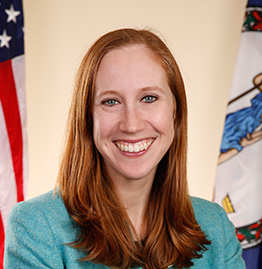
Sen. Elizabeth Bennett-Parker
Sponsored bills
Protected areas; certain federal immigration enforcement prohibited; penalty. Prohibits any employee or agent acting on behalf of a protected area from knowingly permitting any person to enter a nonpublic area of such protected area for the purpose of federal immigration enforcement. The bill defines protected area as any place or facility that is owned or operated by the Commonwealth or any political subdivision thereof and is (i) a hospital or other facility providing health care services; (ii) a school, including a preschool, primary school, or secondary school, vocational or trade school, or public institution of higher education; (iii) an office of an attorney for the Commonwealth; or (iv) any other place or facility designated by the Attorney General. The bill creates a Class 1 misdemeanor for any violation of such provision, subject to certain exceptions. The bill also makes the performance of certain acts for the purpose of identifying, arresting, or otherwise imposing a penalty upon a person for federal immigration enforcement punishable by a Class 1 misdemeanor.
Public elementary and secondary schools and public institutions of higher education; certain federal immigration investigation and enforcement activities; certain notifications and prohibitions. Requires, no later than July 1, 2027, and subject to certain enumerated conditions and requirements, (i) the written school crisis, emergency management, and medical emergency response plan for each public elementary or secondary school to include (a) a requirement that whenever the division superintendent confirms that an individual is present on the property of a public elementary or secondary school in the school division to investigate compliance with, enforce, or assist in the investigation for compliance with or enforcement of any federal civil immigration law or any federal criminal immigration law that penalizes an individual's presence in, entry or reentry into, or employment in the United States, each school board employee at such school and the parents of each student enrolled in such school shall be notified of such presence and (b) a prohibition against any individual present on the property of a public elementary or secondary school in the school division to investigate compliance with, enforce, or assist in the investigation for compliance with or enforcement of any federal civil immigration law or any federal criminal immigration law that penalizes an individual's presence in, entry or reentry into, or employment in the United States from accessing any nonpublic area of such school property without a warrant signed by a judge or magistrate and (ii) each public institution of higher education to (a) notify all students, faculty, and staff whenever the institution confirms that an individual is present on campus to investigate compliance with, enforce, or assist in the investigation for compliance with or enforcement of any federal civil immigration law or any federal criminal immigration law that penalizes an individual's presence in, entry or reentry into, or employment in the United States and (b) prohibit any individual present on campus to investigate compliance with, enforce, or assist in the investigation for compliance with or enforcement of any federal civil immigration law or any federal criminal immigration law that penalizes an individual's presence in, entry or reentry into, or employment in the United States from accessing any nonpublic area of campus without a warrant signed by a judge or magistrate.
Agencies of the Commonwealth; law-enforcement agencies; employees and officers; agreements with federal authority for immigration enforcement; prohibitions and limitations. Prohibits a state agency or a law-enforcement agency, defined in the bill, from entering into a written agreement authorizing any employee or law-enforcement officer to perform a function of a federal immigration officer. The bill provides that federal immigration laws shall be enforced by a state or local law-enforcement agency of the Commonwealth pursuant to a valid judicial warrant, federal or statutory regulations, or as otherwise required by state law. The bill also prohibits an employee of a state agency or a law-enforcement officer, defined in the bill, from conducting certain actions or inquiries regarding a person's citizenship or immigration status while engaged in the performance of his duties and creates a cause of action for appropriate equitable, injunctive, or declaratory relief against such employee or law-enforcement officer who willfully conducts such actions or inquiries in violation of the provisions of the bill. Finally, the bill requires any state agency or law-enforcement agency that has an existing written agreement with a federal authority to perform federal immigration functions to terminate such written agreement by September 1, 2026.
Local anti-rent gouging authority; civil penalty. Provides that any locality may by ordinance adopt anti-rent gouging provisions. The bill provides for notice and a public hearing prior to the adoption of such ordinance and specifies that all landlords who are under the ordinance may be required to give at least 90 days' written notice of a rent increase and cannot increase the rent by more than the locality's calculated allowance, not to exceed three percent, and states that such allowance is effective for a 12-month period beginning July 1 each year. The bill requires the locality to publish such allowance on its website by June 1 of each year. Certain facilities, as outlined in the bill, are exempt from such ordinance. The bill also requires a locality adopting an anti-rent gouging ordinance to establish an anti-rent gouging board to establish rules and procedures by which landlords may apply for and be granted exemptions from the rent increase limits set by the ordinance or delegate such duties and functions to an existing local board, department, or agency. The bill also requires the anti-rent gouging board to establish a fair return on investment rent increase exemption to the annual anti-rent gouging allowance where necessary to offset increased operating expenses. Finally, the bill provides that a locality shall establish a civil penalty for failure to comply with the requirements set out in its ordinance.
Electric utilities; electric vehicle charging stations; transportation electrification. Permits Dominion Energy and Appalachian Power Company to develop, own, maintain, and operate public-facing fast-charging stations, as defined in the bill, at or beyond a radial distance from privately owned fast-charging stations, which radial distance shall be determined by the Commission in a rulemaking proceeding initiated by June 1, 2027, with a final order entered no later than December 31, 2027. The bill repeals current law related to the recovery of costs associated with investment in transportation electrification on December 31, 2027, to coincide with such final order. The bill has an expiration date of July 1, 2030.
Admission to bail; pregnant persons or persons who have recently given birth. Requires the judicial officer to consider any evidence a person provides indicating that such person (i) is currently pregnant, (ii) has recently given birth, or (iii) is currently nursing a child when determining whether such person shall be admitted to bail.
Contraception; right to contraception; applicability; enforcement. Establishes a right to obtain contraceptives and engage in contraception, as such terms are defined in the bill. The bill clarifies that none of its provisions shall be construed to permit or sanction the performance of any sterilization procedure without a patient's voluntary and informed consent. The bill creates a cause of action that may be instituted against anyone who infringes on such right. This bill is identical to SB 1105.
Board of Medicine; continuing education; unconscious bias and cultural competency. Directs the Board of Medicine to require unconscious bias and cultural competency training as part of the continuing education requirements for renewal of licensure. The bill specifies requirements for the training and requires the Board of Medicine to report on the training to the Department of Health. This bill is a recommendation of the Joint Commission on Health Care.
Department of Medical Assistance Services; state plan for medical assistance services; postpartum doula care; report. Directs the Department of Medical Assistance Services to amend the state plan for medical assistance services to include a provision for payment for up to 10 doula visits, with up to four doula visits during pregnancy and up to six doula visits during the 12 months after the individual gives birth. The bill requires the Department to report to the Governor and General Assembly annually on the implementation and outcomes of the provision, and requires the first such report to be submitted by December 31, 2026. This bill is identical to SB 1418.