Alcoholic beverage control; advertising materials; purchase and display of barrels. Allows a retail licensee to elect to receive the physical barrel or lid in addition to purchasing the bottled contents of a distilled spirits barrel from a manufacturer through a barrel purchase agreement supplied to the Alcoholic Beverage Control Authority. The bill provides that such physical barrel or lid shall not be considered a gift and may be displayed on the retail licensee's premises.
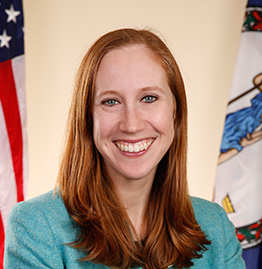
Sen. Elizabeth Bennett-Parker
Sponsored bills
Comprehensive children's health care coverage program. Directs the Department of Medical Assistance Services (the Department) to establish a program to provide state-funded comprehensive health care coverage for individuals in the Commonwealth who are (i) under 19 years of age and (ii) not covered under a group health plan or health insurance coverage, or otherwise eligible for medical assistance services through the Commonwealth's program of medical assistance services established pursuant to Title XIX or XXI of the Social Security Act. The bill also requires the Department to ensure that all program information is made available in a manner that is accessible to individuals with limited English proficiency and individuals with disabilities through the provision of language access services, including oral interpretation and written translation, free of charge and to ensure that information obtained by the program remains confidential and is not disclosed for any purpose not related to the administration of the program or any purpose related to civil immigration enforcement unless the subject of the information consents to such disclosure or the requesting agency presents a valid judicial order, subpoena, or warrant. The bill requires the Department to seek all federal waivers and other approvals necessary to maximize federal financial participation in the cost of carrying out the program established by the bill.
Maddy summarySJ 83 is a ceremonial resolution commending the Greater Washington Society for Clinical Social Work for its contributions to mental health services in the region. It has no policy provisions or direct impact on laws, regulations, or constituents - its purpose is solely to express legislative recognition. The bill passed unanimously in both the Senate and House via voice vote in February 2026 and was sent to the Governor. As a non-binding resolution, it does not alter any existing laws or create new obligations. This type of bill is common for honoring organizations but has no practical effect beyond symbolic acknowledgment.
Maddy summarySJ 97 is a ceremonial resolution commending the Fairfax Bar Association for its contributions to the legal community and public service. It does not create new laws or affect any individuals or policies, as it is purely a symbolic gesture of recognition. The resolution passed unanimously in both the Senate and House via voice vote in February 2026. This type of bill typically honors an organization without implementing concrete policy changes.
Unemployment benefits; maximum duration. Provides that, beginning July 1, 2026, for claims effective on or after July 1, 2026, an eligible individual's weekly unemployment compensation benefit amount shall be paid for a maximum duration of 26 weeks.
Earned income tax credit. Removes the sunset from and makes permanent the increase in Virginia's refundable earned income tax credit from 15 percent to 20 percent of the allowable federal earned income tax credit. Under current law, the Virginia refundable earned income tax credit expires in taxable year 2027, and Virginia's nonrefundable earned income tax credit, which has no expiration date, is equal to 20 percent of the federal credit.
Public schools; right to free public elementary and secondary education; discrimination based on immigration status prohibited; requirements; civil cause of action. Prohibits any child in the Commonwealth from being denied a free public education through secondary school on the basis of the actual or perceived immigration or citizenship status of the child or the child's parents, in accordance with the Constitution of Virginia and consistent with the requirements of the Fourteenth Amendment to the United States Constitution. The bill prohibits any school board or public elementary or secondary school from engaging in certain enumerated actions and practices that involve or result in the denial of a free public education, or denial of the benefits or exclusion from participation in any program or activity thereof, of a child on the basis of the actual or perceived immigration or citizenship status of the child or the child's parents. The bill also requires each public elementary and secondary school to develop and implement procedures for reviewing and authorizing requests from law enforcement agents to enter a public school or public school facility. The bill establishes a civil cause of action for any party aggrieved by conduct that violates the provisions of the bill, in accordance with the provisions of the bill. Finally, the bill directs (i) the Department of Education to develop and make available to each school board by August 1, 2026, guidance for school personnel on the requirements of the bill and training guidelines and materials for the training of all public school principals and administrators on compliance with the provisions of the bill, and (ii) each school board to (a) develop and implement by August 1, 2026, policies and procedures in accordance with the provisions of the bill and (b) require each public school principal and administrator to complete training on compliance with the provisions of the bill by the beginning of the 2026–2027 school year. This bill was incorporated into HB 836.

Constitutional amendment (voter referendum); fundamental right to reproductive freedom. Provides for a referendum at the November 3, 2026, election to approve or reject an amendment to the Constitution of Virginia relating to the right to make one's own decisions related to reproductive health care, including access to abortion. The amendment protects patients and their doctors and nurses from being punished for making such decisions. The amendment allows the state to place restrictions on access to abortion during the third trimester of pregnancy except when the patient's life or physical or mental health is at risk or the pregnancy cannot survive. This bill is identical to SB 449.
Constitutional amendment (voter referendum); qualifications of voters; right to vote; persons not entitled to vote. Provides for a referendum at the November 3, 2026, general election to approve or reject an amendment that would provide for the fundamental right to vote in the Commonwealth, revise the qualifications of voters so that a person convicted of a felony is not entitled to vote during his period of incarceration but is automatically invested with the right to vote upon release from incarceration, and update the existing prohibition on voting by persons found to be mentally incompetent to instead apply to persons who have been found to lack the capacity to understand the act of voting. This bill is identical to SB 6.
Uniform Statewide Building Code; amendments; energy efficiency and conservation. Requires the Board of Housing and Community Development to adopt amendments to the Uniform Statewide Building Code within 18 months of publication of a new version of the International Code Council's International Energy Conservation Code (IECC) to incorporate the latest IECC standards related to energy efficiency and conservation. The bill requires the Board to adopt Building Code standards that are at least as stringent as those contained in the new version of the IECC.