

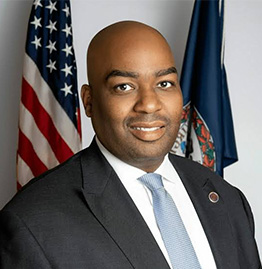
Department of Housing and Community Development; affordable housing; development by nonprofit organizations. Directs the Department of Housing and Community Development to develop a document describing considerations that a locality may consider when implementing an ordinance to stimulate affordable housing and strategies on property owned by a property tax-exempt nonprofit organization. Such document shall be published on the Department's website no later than December 31, 2025.
Sponsored bills
Authority of local governments; service employees. Permits any county, city, or town in the Commonwealth to provide for certain requirements concerning incumbent and successor service employers, defined in the bill, by local ordinance or resolution. For example, such local ordinance or resolution may require that successor service employers retain incumbent service employees during a transition period of 90 days. Under the bill, service employees are those who perform work in connection with the care or maintenance of property, services at an airport, or food preparation services at schools. The provisions of the bill do not include any building owned by the Commonwealth or any institution of higher education. The bill provides that an employer that violates the provisions of a local ordinance or resolution enacted pursuant to the bill may be subject to a civil action and monetary damages. This bill is identical to SB 1489.
Public elementary and secondary schools; student cell phone possession and use policies; development and implementation. Directs each school board to develop and each public elementary and secondary school to implement policies relating to the possession and use of cell phones and smart devices by students on school property from bell to bell, as defined in the law, and requires such policies, among other things, to (i) restrict student cell phone and smart device possession and use on school property from bell to bell and (ii) permit any student, pursuant to an Individualized Education Plan, Section 504 Plan, individualized health care plan, or Limited English Proficiency plan, to possess and use a cell phone or smart device on school property, including in the classroom, from bell to bell to monitor or address a health concern or as an accommodation or assistive technology support. This bill is identical to HB 1961.
Financial institutions; loans and legal rate of interest. Provides that for the purposes of provisions governing usury and the legal rate of interest, "make" or "making," when used in reference to a loan, means advancing, offering to advance, or making a commitment to advance funds to a borrower for a loan. The bill provides that the prohibition against a contract for the payment of interest on a loan at a rate that exceeds 12 percent per year applies to any person who seeks to evade its application by any device, subterfuge, or pretense whatsoever, including (i) making loans disguised as personal property sale and leaseback transactions; (ii) disguising loan proceeds as a cash rebate for the pretextual installment sale of goods or services; and (iii) making, offering, assisting, or arranging a debtor to obtain a loan with a greater rate of interest, consideration, or charge than permitted through any method, including mail, telephone, Internet, or any electronic means, regardless of whether the person has a physical location in the state.
Maddy summaryHJ 707 is a ceremonial resolution commending Melvin Carter for his service. It does not create new policies or affect any laws, programs, or individuals. The bill simply expresses formal recognition through a legislative resolution, with no substantive provisions or mechanisms. As a procedural measure, it has no practical impact beyond the symbolic gesture.
Maddy summaryHJ 706 is a ceremonial resolution honoring Louise Stuart Tabb Whipple. It formally celebrates her life and contributions without creating any new laws or affecting policies. The resolution was unanimously agreed to by both the House and Senate in early 2025. As a commemorative measure, it has no practical policy impact and does not directly affect any individuals or groups.
Maddy summaryHJ 748 is a ceremonial resolution commending the Center for Nonprofit Excellence for its work supporting nonprofit organizations. It does not create new laws, allocate funding, or directly affect any individuals or entities beyond expressing legislative recognition. The bill passed both chambers via voice vote in February 2025 and is purely symbolic, with no binding requirements or policy changes. It serves only to honor the organization's contributions to the nonprofit sector.
Maddy summaryHJ 702 is a ceremonial resolution honoring Morton G. Thalhimer, Jr., a former Virginia legislator and community leader. It formally recognizes his life and contributions through a joint resolution passed by both the House and Senate. This resolution has no policy impact or effect on laws or constituents - it serves solely as a symbolic tribute. The bill was approved by both chambers and is now officially recorded.
Maddy summaryHJ 679 is a ceremonial resolution commending United Methodist Family Services for its community work. It does not create new laws, allocate funds, or affect any specific policies or individuals. The resolution passed unanimously in both the House and Senate (by voice vote on Feb 18 and Feb 20, 2025) and was enrolled as passed on March 24, 2025. As a formal expression of appreciation, it has no legal effect or practical impact on services, funding, or regulations.
Maddy summaryThis is a commemorative resolution (HJ 681) expressing legislative recognition and honoring the life of Meghan Rose Hinger. It does not create new laws, alter policies, or directly affect any individuals or groups. The resolution passed both the House and Senate in February 2025 and serves solely as a ceremonial tribute.