

Income tax; credit for certain health care providers. Provides, for taxable years 2026 through 2030, a nonrefundable individual income tax credit for eligible health care providers, defined in the bill, who provide health care in an underserved community during the taxable year. The bill defines "underserved community" as an area within the Commonwealth identified by the Board of Health as medically underserved. The amount of the credit shall equal $5,000 if the eligible health care provider provided at least 1,600 hours of health care in an underserved community during the taxable year or $2,500 if the eligible health care provider provided at least 800 hours of health care in an underserved community during the taxable year. The bill provides that such providers shall only be allowed to claim such credit for two taxable years. The aggregate amount of credits allowable under the provisions of the bill shall not exceed $5 million per taxable year.
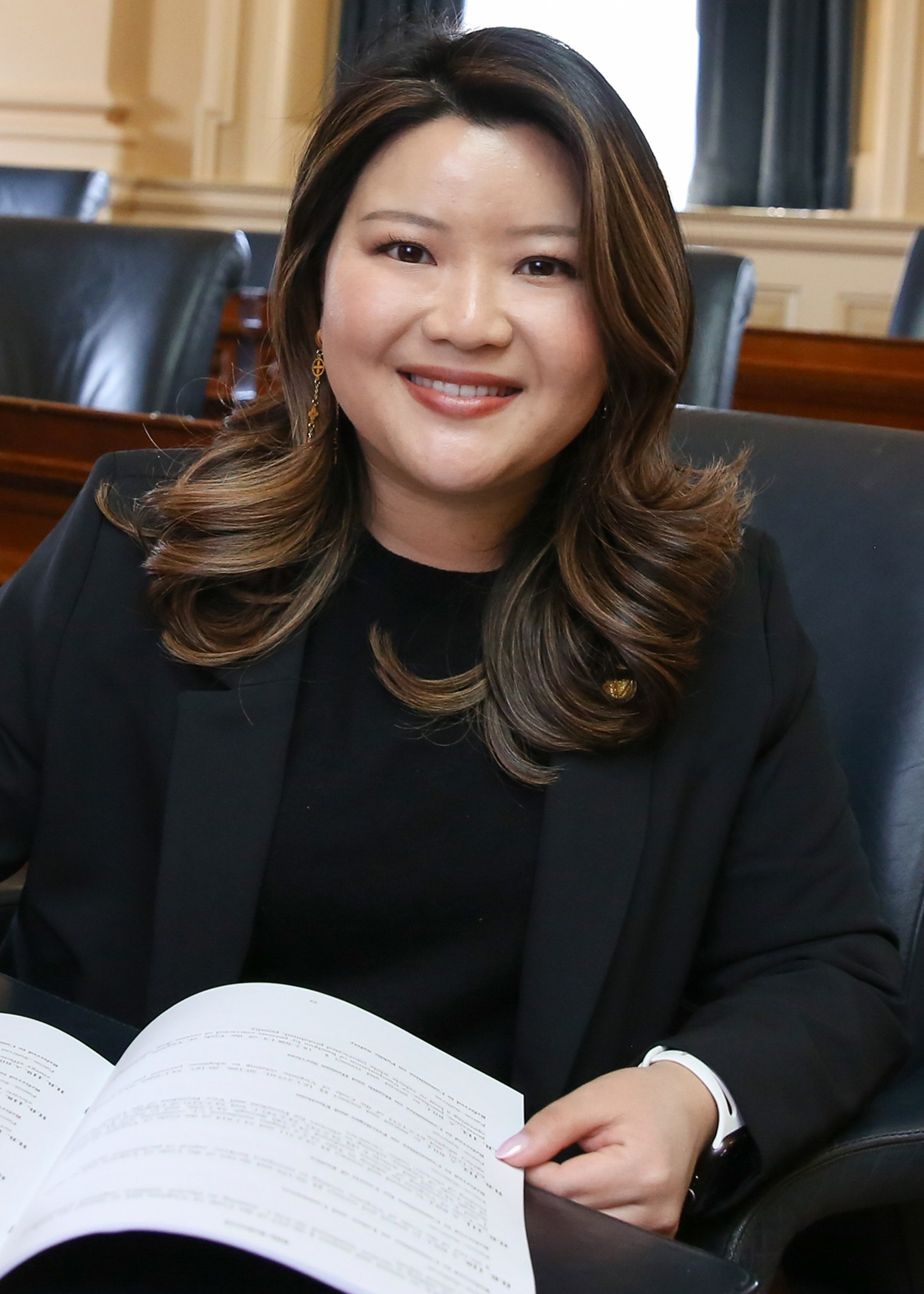
Del. Irene Shin
Sponsored bills
Use of artificial intelligence system by mental health service providers; civil penalty. Permits the use of an artificial intelligence system by mental health service providers for administrative support and supplementary support, as those terms are defined in the bill, and prohibits the use of an artificial intelligence system to provide therapy or counseling services without a mental health service provider. The bill specifies that records kept by mental health service providers must comply with health records privacy requirements; creates an exception for religious counseling, peer support, or self-help materials and educational resources; and establishes a civil penalty not to exceed $10,000 for violations of the statute.
Administration of government; language access equity; report. Requires each public-facing state agency, defined in the bill, to designate a language access coordinator who will be responsible for the agency's annual language access report, the requirements of which are set out in the bill. The Secretary of Health and Human Resources is directed to establish criteria for state agencies to procure language interpretation and translation services and to establish a policy for compensating multilingual state employees who are required as part of their job to provide interpretation, translation, or other bilingual skills at least once a month.
Commonwealth Savers Plan; State Council of Higher Education for Virginia; Virginia College Access and Affordability Scholarship Fund established; work group; report. Directs the transfer of actuarial surplus defined benefit prepaid tuition contract funds from the Commonwealth Savers Plan (the Plan) Fund into a DB529 Fund established by the bill to be deposited into the Virginia College Access and Affordability Scholarship Fund (the Access Fund) established by the bill. Under the bill, the DB529 Fund and the Access Fund operate as subfunds of the Commonwealth Savers Plan Fund. The bill further provides that the Plan shall initially deposit $500 million from the DB529 Fund into the Access Fund to be invested and managed by the Plan. The Joint Legislative Audit and Review Commission shall no less than biennially complete an independent evaluation and risk assessment of the Plan's risk assessment model, assumptions, and other measures employed by the Plan related to the DB529 Fund and the Access Fund. Funds in the Access Fund shall be used to establish a scholarship program that is managed and administered by the State Council of Higher Education for Virginia (the Council). The scholarship program provides scholarship awards to students enrolled in an eligible education program, defined in the bill, and a portion of the funds are to be devoted to college access resources or programs to assist low-income students, first generation college students, students from underrepresented communities, or other at-risk students with their introduction to the higher education system in Virginia, college applications, financial aid applications, and resources assisting with a successful transition from high school to college. The Council is required to report on the Access Fund and scholarship program no later than December 31 of each year. Finally, the bill (i) directs the Council to establish a work group of higher education stakeholders to make recommendations on allocations of funds available through the Access Fund and scholarship program and directs the work group to report to the House Committees on Education and Appropriations and Senate Committees on Education and Health and Finance and Appropriations no later than November 1, 2026, and (ii) prohibits the Plan from implementing or taking part in any initiatives relating to the aforementioned college access programs on or after July 1, 2026, except for existing access programs related to a prepaid tuition contract entered into on or before June 30, 2026, and existing program offerings made available for SOAR Virginia and GEAR UP Virginia.
Court fines and fees; indigent defendant; waiver of fees. Provides that in any criminal or traffic case, the court may waive the assessment of certain fees specified in the bill, either wholly or in part, if the court determines the defendant to be indigent pursuant to the financial criteria set forth in relevant law and unable to pay such fee. The bill provides that the court may make such determination sua sponte or upon motion of the defendant at any time prior to the entry of an order for which such fee is assessed or the final order has been entered.
Extreme Weather Taxpayer Protection Program and Fund established. Establishes the Extreme Weather Taxpayer Protection Program and Fund, administered by the Department of Conservation and Recreation, for the purpose of holding parties responsible for covered greenhouse gas emissions between the covered period of January 1, 1995, and December 31, 2025, for the parties' share of the Commonwealth's costs due to climate change. The bill defines responsible parties as fossil fuel extractors or crude oil refiners causing emissions of one billion metric tons or more of covered greenhouse gases during the covered period. Under the bill, responsible parties are strictly liable for cost recovery payments to the Commonwealth. The bill requires the State Treasurer to conduct an assessment of the costs to the Commonwealth and its residents of the emissions of covered greenhouse gases during the covered period. The bill establishes the Extreme Weather Relief Fund into which the cost recovery payments from responsible entities are deposited and used to pay for extreme weather relief projects, as defined in the bill.
Department of Small Business and Supplier Diversity; work group; one-stop small business permitting program. Directs the Department of Small Business and Supplier Diversity to convene a work group to determine methods of modernizing the existing one-stop small business permitting program.
Public institutions of higher education; undergraduate Virginia student tuition and mandatory fees; two-year freeze. Requires the tuition and mandatory fees charged to undergraduate Virginia students at each public institution of higher education to be capped at the rate charged to such students for the first academic term of the 2025-2026 academic year. The provisions of the bill expire on July 1, 2028.
Law-enforcement officers; restrictions on wearing of facial coverings; exceptions; civil liability; penalty. Prohibits certain state and federal law-enforcement officers from wearing facial coverings, defined in the bill, while engaged in the performance of their official duties. The bill sets out several exceptions to such prohibition, including protective facial coverings to protect against disease, infection, and exposure to toxic substances and facial coverings worn by any law-enforcement officer assigned to a special weapons and tactics team while engaged in the performance of his official duties with such team. The bill subjects the law-enforcement officer to disciplinary action, including dismissal, demotion, suspension, transfer, or decertification, and creates a Class 1 misdemeanor for any law-enforcement officer who wears a facial covering in violation of the provisions of the bill unless the law-enforcement agency that employs such law-enforcement officer has adopted and established a written policy for and restrictions on the use of facial coverings. The bill also directs the Department of Criminal Justice Services to develop a model policy for and restrictions on the use of facial coverings by law-enforcement officers. Finally, the bill creates a civil cause of action for any person injured as a result of tortious conduct by a law-enforcement officer who knowingly and intentionally wears a facial covering in violation of the provisions of the bill. The bill provides that sovereign immunity shall not be a defense to civil liability for such tortious conduct.
Maddy summarySJ 97 is a ceremonial resolution commending the Fairfax Bar Association for its contributions to the legal community and public service. It does not create new laws or affect any individuals or policies, as it is purely a symbolic gesture of recognition. The resolution passed unanimously in both the Senate and House via voice vote in February 2026. This type of bill typically honors an organization without implementing concrete policy changes.