Maddy summarySJ 90 is a ceremonial resolution commending Penney S. Azcarate for her service, with no policy or legal impact. It does not create new laws, alter regulations, or affect any individuals or groups. The bill serves solely as a symbolic gesture of recognition, passing unanimously in both chambers as a formal honor.
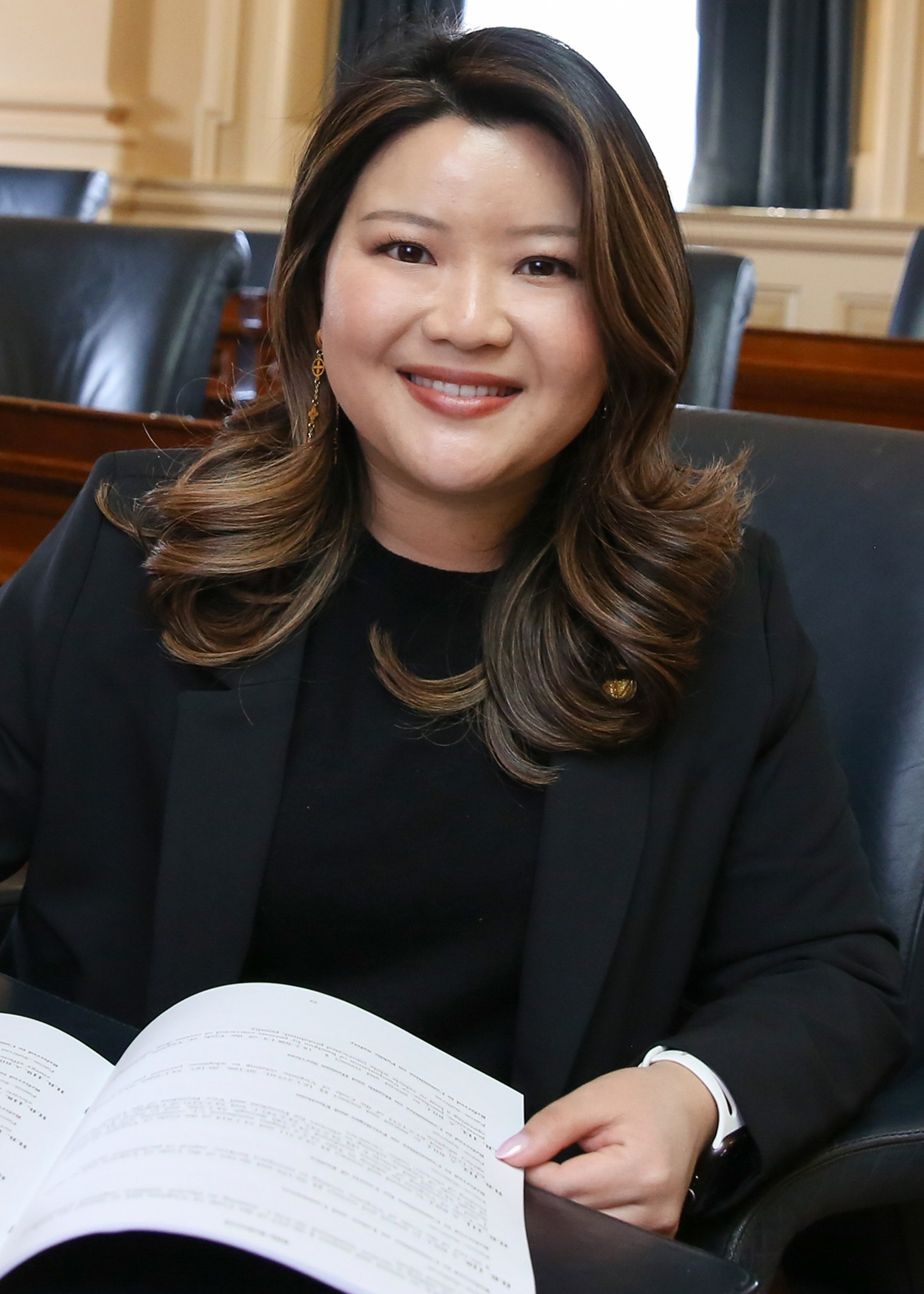
Del. Irene Shin
Sponsored bills
Elections; duties of the Department of Elections; Systematic Alien Verification for Entitlements Program (SAVE Program). Provides that the Department of Elections' use of the Systematic Alien Verification for Entitlements Program (SAVE Program) operated by U.S. Citizenship and Immigration Services of the U.S. Department of Homeland Security is for the sole purpose of individually verifying that voters listed in the Virginia voter registration system are United States citizens. The Department of Elections is prohibited from (i) using information received from the SAVE Program as the sole reason for rejecting a registration application, (ii) uploading lists of registered voters to the SAVE Program for verifying their citizenship status in bulk, or (iii) transferring any information to the U.S. Department of Homeland Security or any subdivision thereof beyond the minimum information necessary. This bill was incorporated into HB 972.
Virginia Health Care Fund; additional funding and uses; emergency. Expands allowable funding sources of the Virginia Health Care Fund to include appropriated state general fund moneys and moneys from public and private sources. The bill allows moneys from the Fund to be used for financial assistance to organizations and service providers that provide health care services, or expand the provision of health care services, to populations protected by the Virginia Human Rights Act. The bill contains an emergency clause.
Expenses of localities and constitutional offices related to presidential visits; publishing unreimbursed expenses; budget. Requires each locality and constitutional officer to determine all expenses of the locality or office of the constitutional officer, respectively, related to the provision of security for visits to the locality by the President of the United States. The bill specifies that a locality or office of a constitutional officer that incurs such expenses shall seek reimbursement from the appropriate agency of the federal government within 30 days of incurring the expenses and shall concurrently publish such expenses on its official website, if one exists. The bill also requires each locality and constitutional officer that anticipates incurring expenses in the upcoming fiscal year related to the provision of security for visits to the locality by the President of the United States to include the total anticipated expenses in the locality's budget or the constitutional officer's budget request for such fiscal year.
Virginia Residential Landlord and Tenant Act; prohibited provisions in rental agreements; landlord's maintenance responsibilities. Prohibits a rental agreement from containing any provision stating that the tenant agrees to pay (i) any fee for the maintenance of the premises, including the maintenance or provision of heating and cooling systems, pest control, trash disposal, common area utilities, and mail or package delivery; (ii) a fee for internet, cable, or any other utilities or services that amount to more than the cost paid by the landlord; or (iii) for the maintenance or security of the common areas. The bill also repeals the provision allowing the landlord and tenant to agree in writing that the tenant may perform certain duties typically assigned to the landlord and also specified repairs, maintenance tasks, alterations, and remodeling, but only if the transaction is entered into in good faith and not for the purpose of evading the obligations of the landlord and if the agreement does not diminish or affect the obligation of the landlord to other tenants in the premises.

Medical care facilities; expanded access to medical cannabis for terminally ill patients. Requires medical care facilities to permit terminally ill patients, as defined in the bill, to use medical cannabis. The bill requires medical care facilities to adopt policies facilitating the use of medical cannabis. The provisions of the bill do not apply to the provision of emergency medical services, including in emergency departments of hospitals. The bill requires compliance with applicable drug and medication requirements, specifies that compliance with its provisions shall not be a condition of obtaining, retaining, or renewing a license as a medical care facility, and establishes a protocol for noncompliance in the event of intervention by the federal government. The bill has a delayed effective date contingent on the federal rescheduling of marijuana from a Schedule I to a Schedule III drug. This bill was incorporated into HB 75.
Special license plates; QUAIL FOREVER. Authorizes the issuance of revenue-sharing special license plates for supporters of Quail Forever bearing the legend QUAIL FOREVER. The bill exempts such special license plates from requirements related to the minimum number of prepaid applications and the minimum number of active license plates after five years of issuance for special license plates.
Pesticides; manufacture, distribution, use, or sale of paraquat prohibited. Prohibits any person from manufacturing, distributing, using, or selling any pesticide containing paraquat, defined in the bill, as an active ingredient. The bill allows the Department of Agriculture and Consumer Services to seize any such pesticide containing paraquat on complaint to the circuit court in the area where the pesticide is located.
Earned income tax credit. Removes the sunset from and makes permanent the increase in Virginia's refundable earned income tax credit from 15 percent to 20 percent of the allowable federal earned income tax credit. Under current law, the Virginia refundable earned income tax credit expires in taxable year 2027, and Virginia's nonrefundable earned income tax credit, which has no expiration date, is equal to 20 percent of the federal credit.
Public schools; right to free public elementary and secondary education; discrimination based on immigration status prohibited; requirements; civil cause of action. Prohibits any child in the Commonwealth from being denied a free public education through secondary school on the basis of the actual or perceived immigration or citizenship status of the child or the child's parents, in accordance with the Constitution of Virginia and consistent with the requirements of the Fourteenth Amendment to the United States Constitution. The bill prohibits any school board or public elementary or secondary school from engaging in certain enumerated actions and practices that involve or result in the denial of a free public education, or denial of the benefits or exclusion from participation in any program or activity thereof, of a child on the basis of the actual or perceived immigration or citizenship status of the child or the child's parents. The bill also requires each public elementary and secondary school to develop and implement procedures for reviewing and authorizing requests from law enforcement agents to enter a public school or public school facility. The bill establishes a civil cause of action for any party aggrieved by conduct that violates the provisions of the bill, in accordance with the provisions of the bill. Finally, the bill directs (i) the Department of Education to develop and make available to each school board by August 1, 2026, guidance for school personnel on the requirements of the bill and training guidelines and materials for the training of all public school principals and administrators on compliance with the provisions of the bill, and (ii) each school board to (a) develop and implement by August 1, 2026, policies and procedures in accordance with the provisions of the bill and (b) require each public school principal and administrator to complete training on compliance with the provisions of the bill by the beginning of the 2026–2027 school year. This bill was incorporated into HB 836.