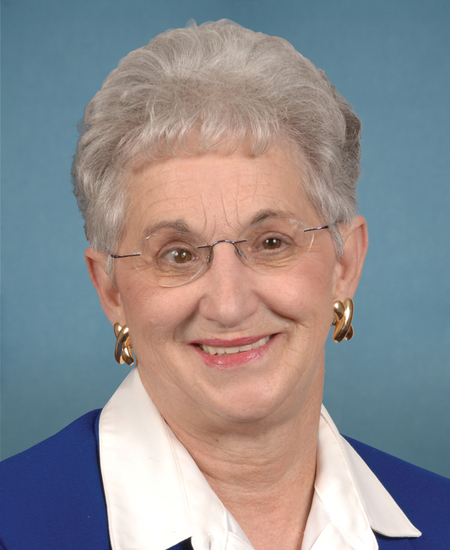
Photo of Virginia Foxx
R United States House · District 5 · North Carolina On the 2026 ballot

Rep. Virginia Foxx

Compare
Total votes
2,818
all sessions
Attendance
98%
68 missed
Higher than 86% of chamber peers
With party
95%
of cast votes
Higher than 92% of chamber peers
Bipartisan score
3%
crosses aisle rarely
Lower than 93% of chamber peers
Sponsored
467
bills & resolutions
Lower than 89% of chamber peers
Committees
5
assignments
467 bills and resolutions

Sponsored bills

Total
467
Primary
72
Co-sponsor
395
This page
467
matching current filters
Co-sponsor HR 1209
In committee · Utah House · Co-sponsor
FOCA Act of 2023

Maddy summaryThe FOCA Act of 2023 requires federal agencies to stop mandating or banning contractor agreements with labor organizations (like union contracts) in construction project bids and contracts. It directly affects federal contractors, subcontractors, and agencies managing construction projects funded by the government. The bill prohibits favoring or penalizing contractors based on their labor affiliation status, aiming to promote fair competition and reduce costs. It also mandates updates to federal contracting rules within 60 days of enactment to implement these changes.

In committee Dec 18, 2024 1 co-sponsor
Primary HR 10425
In committee · Utah House · Lead sponsor
To amend and reauthorize the Workforce Innovation and Opportunity Act and the Older Americans Act of 1965.

Maddy summary# Summary of "A Stronger Workforce for America Act" Amendments to WIOA This document presents comprehensive amendments to the Workforce Innovation and Opportunity Act (WIOA), with significant updates to workforce development programs across multiple areas. ## Key Changes: 1. **Program Structure & Terminology**: - Replaced "centers" with "campuses" throughout Job Corps provisions - Updated definitions for consistency across all programs 2. **Funding Authorization**: - Youth workforce investment: $976,573,900 annually (2025-2030) - Adult employment and training: $912,218,500 annually - Dislocated worker employment: $1,391,483,193 annually - Job Corps: $1,760,155,000 annually 3. **Job Corps Reforms**: - Updated eligibility requirements (including expanded criteria for homeless youth and foster youth) - New safety and performance standards - Revised performance assessment system with clear improvement pathways - Strengthened appeal processes for disciplinary actions - Enhanced reporting requirements with consumer-friendly data presentation 4. **Performance Accountability**: - Revised performance metrics with more specific targets - New requirements for wage record utilization in performance evaluation - Comprehensive improvement plans for underperforming programs - Annual reporting on performance metrics with public accessibility 5. **Program-Specific Changes**: - Enhanced youth workforce programs with new eligibility criteria - Updated Native American programs with specific performance standards - Modernized migrant and seasonal farmworker programs - Strengthened technical assistance provisions - Added requirements for digital literacy skills development 6. **Operational Improvements**: - New requirements for using competency-based assessments - Updated definitions for foundational skill needs - Enhanced reporting on performance and safety - Strengthened partnerships with community organizations The amendments focus on improving program effectiveness, increasing accountability, expanding access to underserved populations, and ensuring workforce programs better align with labor market needs through updated performance metrics and reporting requirements.

In committee Dec 17, 2024 0 co-sponsors
Co-sponsor HR 6114
In committee · Utah House · Co-sponsor
Maximum Pressure Act

Maddy summaryThe Maximum Pressure Act (HR 6114) is a legislative proposal that would maintain and expand U.S. sanctions against Iran. The bill would codify existing sanctions, require Iran to meet 12 specific conditions before sanctions could be lifted (including ending support for terrorism, releasing hostages, and ending nuclear enrichment), and expand sanctions on Iran's Revolutionary Guard Corps and missile programs. It also establishes new reporting requirements for the U.S. government to monitor Iran's activities and the impact of sanctions. The legislation would require congressional review before any sanctions could be lifted or modified, preventing the executive branch from unilaterally easing restrictions.

In committee Dec 17, 2024 1 co-sponsor
Co-sponsor HR 3029
In committee · Utah House · Co-sponsor
Primary Care Enhancement Act of 2023

Maddy summaryThis bill changes tax rules to treat direct primary care (DPC) membership fees as deductible medical expenses. It defines DPC as a fixed monthly fee (capped at $150 per person, $300 for families) for primary care services only, excluding procedures requiring anesthesia, prescription drugs (except vaccines), or lab tests. The law ensures these fees can be claimed on tax returns like other medical costs, while clarifying DPC arrangements aren’t considered health insurance plans. It applies to fees paid for DPC services provided through employment or directly to patients, effective for 2024 tax years.

In committee Dec 17, 2024 1 co-sponsor
Co-sponsor HR 589
Passed · Utah House · Co-sponsor
MAHSA Act

Maddy summaryHR 589, the MAHSA Act, imposes U.S. sanctions on Iran's Supreme Leader, President, and affiliated entities responsible for human rights abuses and terrorism. It targets the Supreme Leader's Office, the President's cabinet, security forces involved in the crackdown following Mahsa Amini's death, and entities financing abuses. The bill requires the President to annually determine and apply existing sanctions - like property blocking and visa bans - against these individuals and entities. This directly affects Iran's top leadership and security apparatus, aiming to hold them accountable for abuses including the Morality Police's role in Amini's detention and the subsequent violent suppression of protests.

Passed Dec 17, 2024 1 co-sponsor
Co-sponsor HR 7
In committee · Utah House · Co-sponsor
No Taxpayer Funding for Abortion and Abortion Insurance Full Disclosure Act of 2023

Maddy summaryThis bill bans federal funding for abortions in most cases, prohibiting the use of taxpayer money for abortion services or health insurance plans covering abortion. Exceptions allow funding for abortions resulting from rape, incest, or when a pregnancy endangers a woman's life. It requires health insurance plans sold through the Affordable Care Act (ACA) marketplaces to clearly disclose any separate costs for abortion coverage and prohibits ACA subsidies from being used for plans that cover abortion (except in the specified exceptions). The law directly affects federal programs like Medicaid, ACA marketplace plans, and insurers offering health coverage to individuals using federal subsidies.

In committee Dec 17, 2024 1 co-sponsor
Co-sponsor HJRES 181
In committee · Utah House · Co-sponsor
Providing for congressional disapproval under chapter 8 of title 5, United States Code, of the rule submitted by the Department of Labor relating to "Definition of 'Employer'-Association Health Plans".

Maddy summaryHJRES 181 is a congressional resolution seeking to block a Department of Labor rule that defined "Employer-Association Health Plans." The bill would prevent this specific rule - published in the Federal Register on April 30, 2024 - from taking effect. It directly affects employers and health plan administrators who use these association-based health coverage models. If passed, the rule would have no legal force, reversing the Labor Department's regulatory definition.

In committee Dec 16, 2024 1 co-sponsor
Co-sponsor HR 8932
Signed into law · Utah House · Co-sponsor
FAFSA Deadline Act

Maddy summaryThe FAFSA Deadline Act changes the deadline for processing the Free Application for Federal Student Aid (FAFSA) from January 1 to October 1 prior to a student's planned college enrollment year. This requires students and families to submit their FAFSA applications earlier each year, potentially allowing for faster financial aid decisions. The bill also mandates that the Secretary of Education certify by September 1 whether the October 1 deadline will be met, and if not, testify by September 30 about the reasons and financial impact on students and families. These changes apply directly to all students and families seeking federal financial aid for higher education.

Signed into law Dec 11, 2024 1 co-sponsor
Primary HR 10257
In committee · Utah House · Lead sponsor
Protect Economic Freedom Act

Maddy summaryThis bill requires colleges receiving federal student aid (Title IV funds) to annually certify they won't engage in "nonexpressive commercial boycotts of Israel" - defined as commercial actions limiting business with Israel or entities there, excluding certain exceptions under existing law. Non-compliant institutions must be publicly listed by the Education Department within 7 business days after July 31 each year, and they lose eligibility for federal aid. The law directly affects any institution participating in federal student aid programs that fails to submit the required certification. It establishes a clear mechanism for tracking compliance through annual certifications and public transparency, without altering other federal aid rules.

In committee Nov 26, 2024 0 co-sponsors
Primary HR 6951
In committee · Utah House · Lead sponsor
College Cost Reduction Act

Maddy summary# Summary of Proposed Higher Education Act Amendments This document outlines significant proposed amendments to the Higher Education Act of 1965, primarily as part of the "College Cost Reduction Act." The key elements include: ## Accreditation Reform - Major overhaul of accreditation standards, requiring accrediting agencies to demonstrate independence from trade associations - New requirements for accrediting agencies to assess student achievement outcomes, including median value-added earnings relative to median total price charged - Introduction of an "Alternative Quality Assurance Experimental Site Initiative" to test non-accredited institutions - Protections for religious institutions, including a new process for appealing accreditation decisions related to religious mission - Removal of "litmus tests" that would require institutions to support specific political viewpoints ## Student Success Initiatives - Establishment of "Postsecondary Student Success Grants" to increase participation, retention, and completion rates for high-need students - Focus on evidence-based practices, with tiered requirements (tier 1, 2, and 3 reforms) - Mandatory inclusion of high-need student populations (low-income, first-generation, military-connected, etc.) - Requirements for institutions to report on completion rates, retention rates, and student demographics ## Regulatory Changes - Repeal of numerous existing regulations including: * Closed school discharges * Borrower defense to repayment * Pre-dispute arbitration * False certification requirements * Ability-to-benefit rules * Financial responsibility regulations - New restrictions on incentive compensation for recruiters - Changes to third-party servicer definitions and regulations ## Transfer and Credit Policies - New requirement that institutions cannot deny transfer credit based solely on the source of accreditation - Requirements for transparent transfer policies - Changes to reverse transfer policies ## Other Key Provisions - Modifications to the National Advisory Committee on Institutional Quality and Integrity (NACIQI) - New definitions for "total price" and "value-added earnings" - Changes to the process for institutions to change accrediting agencies - New requirements for institutions to report on student outcomes The overall focus of these proposed amendments is to reduce regulatory burden on institutions, promote transparency, improve student outcomes (particularly for high-need students), modernize accreditation processes, and protect religious institutions' rights in accreditation decisions.


In committee Nov 18, 2024 0 co-sponsors
Showing 141 to 150 of 467 bills
Previous 1 14 15 16 47 Next