

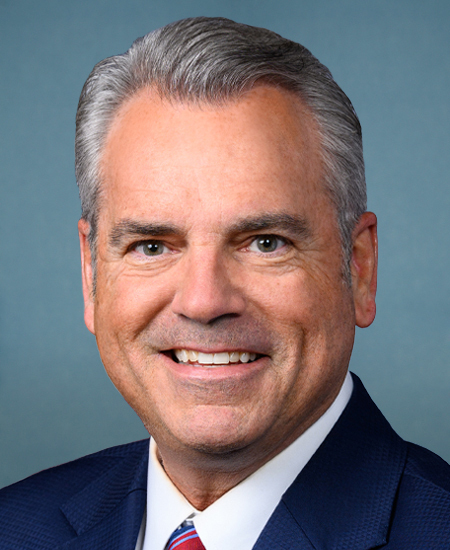
Photo of Mark Alford
R United States House · District 4 · Missouri On the 2026 ballot

Rep. Mark Alford

Compare
Total votes
1,860
all sessions
Attendance
99%
18 missed
Near the chamber average
With party
96%
of cast votes
Near the chamber average
Bipartisan score
3%
crosses aisle rarely
Near the chamber average
Sponsored
440
bills & resolutions
Near the chamber average
Committees
8
assignments
440 bills and resolutions

Sponsored bills

Total
440
Primary
53
Co-sponsor
387
This page
440
matching current filters
Primary HR 6836
In committee · Utah House · Lead sponsor
Beginning Farmer Tax Incentive Act

Maddy summaryThe Beginning Farmer Tax Incentive Act (HR 6836) creates tax benefits for beginning farmers by excluding 40% of capital gains from selling qualifying farmland and up to $25,000 annually from lease income. Qualifying farmland must have been farmed by the seller’s family for at least 5 years. Beginning farmers are defined as new individuals with 1-10 years of farming experience (reported on Schedule F), those with beginner farm loans, or those with substantial farming knowledge. The policy directly supports new agricultural entrants through targeted tax relief, applying to land used for farming with specific ownership history requirements.

In committee Dec 18, 2025 0 co-sponsors
Co-sponsor HR 6766
In committee · Utah House · Co-sponsor
Essential Caregivers Act of 2025

Essential Caregivers Act of 2025   This bill prohibits certain health care facilities from limiting the access of essential caregivers to residents of those facilities, including during designated emergency periods.   Specifically, the bill generally prohibits Medicare skilled nursing facilities, Medicaid nursing facilities, Medicaid intermediate care facilities, and associated inpatient rehabilitation facilities from restricting the access of essential caregivers to residents of the facilities, including during emergency periods in which visitation rights are otherwise restricted. During emergency periods, facilities may restrict access for an initial period of up to seven days and for one additional maximum seven-day period (if the additional period is approved by the state health department). Facilities may restrict access for a total of 7 days (or 14 days with the approval of the state health department) during an emergency period. Essential caregivers must agree to comply with any safety protocols set by the facility, which may be no more stringent for caregivers compared to those for staff. Caregivers who fail to comply with these requirements may be denied access, subject to an appeals process.

In committee Dec 16, 2025 1 co-sponsor
Co-sponsor HR 6718
In committee · Utah House · Co-sponsor
Professional Student Degree Act

Maddy summaryHR 6718, the Professional Student Degree Act, amends the Higher Education Act to clarify the definition of a "professional degree" for federal education purposes. It replaces the previous definition with a new section listing specific degrees that meet the criteria, including Pharmacy (Pharm.D.), Law (J.D.), Medicine (M.D.), Dentistry (D.D.S.), Veterinary Medicine (D.V.M.), and others like Nursing (D.N.P.) and Business Administration (M.B.A.). This definition requires degrees to signify both completion of academic requirements for professional practice (often requiring licensure) and skills beyond a bachelor's level. The bill directly affects students pursuing these designated degrees by formally recognizing them under federal education law, without creating new programs or changing funding.

In committee Dec 15, 2025 1 co-sponsor
Co-sponsor HR 6687
In committee · Utah House · Co-sponsor
DRIVER Act

Maddy summaryThe DRIVER Act requires car manufacturers and fleet owners to give vehicle owners free, real-time access to their vehicle's data (like location, driving habits, and sensor information) through standard ports or wireless connections. Owners can control how this data is used or shared with third parties (except for foreign adversaries), delete stored data, and cannot be charged for access or decryption. Manufacturers and fleet owners must provide clear opt-out options before selling owner data and are banned from selling data to specific countries like China, Russia, or Iran. The Federal Trade Commission enforces these rules under existing laws, and states cannot create conflicting laws.

In committee Dec 12, 2025 1 co-sponsor
Co-sponsor HR 452
Signed into law · Utah House · Co-sponsor
Miracle on Ice Congressional Gold Medal Act

Miracle on Ice Congressional Gold Medal Act This act provides for the award of Congressional Gold Medals to the members of the 1980 U.S. Olympic men's ice hockey team in recognition of the team's achievement at the 1980 Winter Olympic Games.

Signed into law Dec 12, 2025 1 co-sponsor
Co-sponsor HR 6511
In committee · Utah House · Co-sponsor
Affordable Homeownership Access Act

Maddy summaryThe Affordable Homeownership Access Act exempts small property owners who provide direct financing (owner financing) from certain mortgage licensing requirements if they make no more than 24 loans per year for properties they own. It also amends federal definitions to exclude these owner financers from "mortgage originator" rules, requiring loans to be fully amortizing, have reasonable interest rate caps, and include buyer ability-to-pay assessments. The bill mandates a study by HUD and Treasury on owner financing usage - particularly for homes under $150,000 or 60% of local median value - to evaluate its potential to boost homeownership and wealth creation in underserved communities.

In committee Dec 9, 2025 1 co-sponsor
Co-sponsor HR 1949
Passed · Utah House · Co-sponsor
Unlocking our Domestic LNG Potential Act of 2025

Maddy summaryThis bill amends the Natural Gas Act to give the Federal Energy Regulatory Commission (FERC) exclusive authority to approve U.S. LNG export terminal projects, requiring FERC to deem such exports consistent with the public interest. It directly affects natural gas companies seeking to build or expand export facilities and streamlines FERC's review process by removing prior requirements for interagency coordination. The bill clarifies that FERC's decisions won't override existing sanctions laws, including restrictions on trade with countries designated as state sponsors of terrorism under current law. This change aims to accelerate domestic LNG export projects while maintaining legal safeguards for national security and foreign policy.

Passed Dec 8, 2025 1 co-sponsor
Co-sponsor HR 6439
In committee · Utah House · Co-sponsor
Border Patrol Supervisors Retention Act

Maddy summaryThis bill amends federal pay rules to expand higher overtime pay rates for U.S. Border Patrol supervisors. It changes the eligibility from only GS-12 agents to include all supervisors classified from GS-12 through GS-15. The key provision modifies Section 5550(h) of Title 5, U.S. Code, to apply the higher overtime pay rate to these higher-grade supervisory positions. The bill aims to improve retention for experienced Border Patrol supervisors by increasing their overtime compensation.

In committee Dec 4, 2025 1 co-sponsor
Co-sponsor HR 4397
In committee · Utah House · Co-sponsor
Muslim Brotherhood Terrorist Designation Act of 2025

Maddy summaryThis bill would amend the Anti-Terrorism Act of 1987 to designate the Muslim Brotherhood as a terrorist organization and prohibit its operations within the United States. It would require the President to designate the Muslim Brotherhood as a foreign terrorist organization under immigration law and impose new visa restrictions, including immediate revocation of current visas, for individuals identified as members. The bill mandates annual reports from the Secretary of State identifying Muslim Brotherhood branches worldwide and determining which should be designated as terrorist organizations under existing laws. These provisions would directly affect Muslim Brotherhood members, branches, and affiliated organizations seeking entry to or operating within the United States.

In committee Dec 3, 2025 1 co-sponsor
Co-sponsor HR 5710
In committee · Utah House · Co-sponsor
Bridge the Gap for Rural Communities Act

Maddy summaryThis bill suspends payment limits for agricultural subsidies for the 2025 crop year, removing caps on payments to farmers. It also establishes a new option for farmers to receive 50% of their expected 2025 crop payments as an advance by December 1, 2025, if they opt in. The remaining balance is paid later after the marketing year ends, with farmers required to repay any overpayment if the final amount exceeds the advance. The bill directly affects farmers growing covered commodities (like corn, soybeans) who choose to participate in the advance payment program.

In committee Dec 2, 2025 1 co-sponsor
Showing 81 to 90 of 440 bills
Previous 1 8 9 10 44 Next