

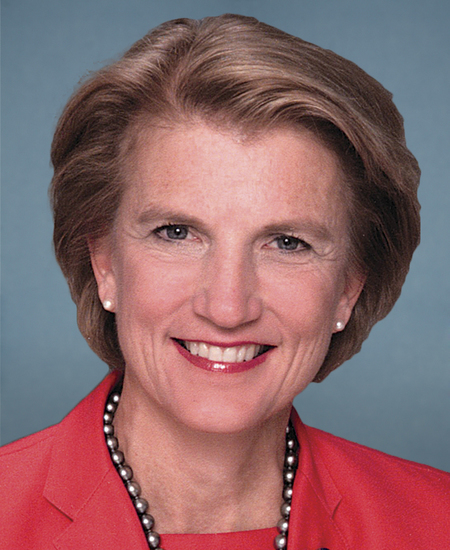
Photo of Shelley Moore Capito
R United States Senate · West Virginia On the 2026 ballot

Sen. Shelley Moore Capito

Compare
Total votes
1,054
all sessions
Attendance
99%
15 missed
Near the chamber average
With party
91%
of cast votes
Near the chamber average
Bipartisan score
5%
crosses aisle rarely
Near the chamber average
Sponsored
1,328
bills & resolutions
Near the chamber average
Committees
18
assignments
1,328 bills and resolutions

Sponsored bills

Total
1,328
Primary
75
Co-sponsor
1,253
This page
1,328
matching current filters
Primary S 559
In committee · United States Senate · Lead sponsor
AIMM Act

Maddy summaryThe AIMM Act (S 559) permanently extends a tax rule allowing businesses to include depreciation, amortization, or depletion when calculating the limit on business interest deductions. This change removes a previous expiration date (for taxable years after 2021), making the provision applicable indefinitely for all future tax years. The bill directly affects businesses subject to the business interest deduction rules under the Internal Revenue Code. The key mechanism is a simple amendment to the tax code that eliminates the sunset clause, ensuring consistent treatment without altering other tax provisions.

In committee Feb 13, 2025 0 co-sponsors
Co-sponsor SJRES 4
In committee · United States Senate · Co-sponsor
A joint resolution providing for congressional disapproval under chapter 8 of title 5, United States Code, of the rule submitted by the Department of Energy relating to "Energy Conservation Program: Energy Conservation Standards for Consumer Gas-fired Instantaneous Water Heaters".

Maddy summaryThis joint resolution would block a Department of Energy rule setting new efficiency standards for gas-fired instant water heaters. The rule, published in the Federal Register on December 26, 2024, would have required manufacturers to produce more energy-efficient models. If passed, the resolution would prevent this rule from taking effect, keeping current efficiency standards in place. The direct impact is on water heater manufacturers and consumers purchasing these products.

In committee Feb 12, 2025 1 co-sponsor
Co-sponsor SRES 75
In committee · United States Senate · Co-sponsor
A resolution expressing the sense of the Senate that member countries of NATO must commit at least 2 percent of their national gross domestic product to national defense spending to hold leadership or benefit at the expense of those countries who meet their obligations.

Maddy summaryThis resolution expresses the Senate's view that NATO members not spending at least 2% of GDP on defense should face consequences. It specifically prohibits such countries from holding NATO leadership roles (like Secretary General or military commands above 2-star rank) or hosting major events (such as NATO Summits or ministerial meetings). The resolution targets members who fail to meet the 2% target, as 23 of 31 members did meet it in 2024. It is a symbolic statement, not a binding law, aiming to pressure non-compliant nations ahead of the June 2025 NATO Summit.

In committee Feb 12, 2025 1 co-sponsor
Co-sponsor S 537
In committee · United States Senate · Co-sponsor
Protecting Access for Hunters and Anglers Act of 2025

Maddy summaryThis bill prohibits federal agencies (like the Fish and Wildlife Service and Forest Service) from banning lead ammunition or tackle on public lands and waters used for hunting or fishing, directly affecting hunters and anglers who use federal lands. It blocks new federal regulations on lead levels in hunting gear, except in limited cases where a specific area's wildlife decline is linked to lead use and the state wildlife agency approves the restriction. The law requires federal agencies to explain in notices how any exception meets state wildlife department requirements or state law. It does not change existing state laws or allow federal bans on lead where states already prohibit it.

In committee Feb 12, 2025 1 co-sponsor
Co-sponsor S 541
In committee · United States Senate · Co-sponsor
ELITE Vehicles Act

Maddy summaryThe ELITE Vehicles Act repeals three key tax credits for electric vehicles under the Internal Revenue Code: the clean vehicle credit (Section 30D), the credit for previously-owned clean vehicles (Section 25E), and the credit for qualified commercial clean vehicles (Section 45W). It also excludes electric vehicle recharging property from the alternative fuel vehicle refueling credit. These changes directly affect individuals and businesses purchasing new or used electric vehicles, as well as those installing EV charging infrastructure, by eliminating the associated tax benefits. The repeal applies to vehicles purchased or under binding contract after 30 days following the bill's enactment.

In committee Feb 12, 2025 1 co-sponsor
Co-sponsor S 556
In committee · United States Senate · Co-sponsor
Enhanced Iran Sanctions Act of 2025

Maddy summaryThis bill imposes new sanctions on foreign entities (including banks, insurers, and logistics companies) that knowingly facilitate Iran's oil, gas, LNG, or petrochemical exports. It blocks U.S. property of sanctioned entities and bars targeted individuals from entering the U.S. via visa restrictions or revocation. Exceptions cover goods imports and certain international obligations, while the President may grant limited 180-day waivers for national security reasons, subject to congressional reporting. The law aims to disrupt Iran's energy revenue streams used for terrorism, weapons programs, and repression, with enforcement coordinated through a new interagency working group.

In committee Feb 12, 2025 1 co-sponsor
Co-sponsor S 522
In committee · United States Senate · Co-sponsor
Credit Union Board Modernization Act

Credit Union Board Modernization Act This bill revises the required frequency of meetings held by a credit union's board of directors. Specifically, new credit unions and credit unions with a low soundness rating must meet monthly. All other credit unions must hold at least six meetings annually, with at least one meeting held during each fiscal quarter. Currently, all credit union boards must meet at least once a month.

In committee Feb 11, 2025 1 co-sponsor
Co-sponsor S 526
In committee · United States Senate · Co-sponsor
Pharmacy Benefit Manager Transparency Act of 2025

Maddy summaryS 526, the Pharmacy Benefit Manager Transparency Act of 2025, requires pharmacy benefit managers (PBMs) - the middlemen managing drug coverage for health plans - to disclose financial details and stop unfair practices. It prohibits PBMs from keeping price differences between what they charge health plans and pay pharmacies, arbitrarily clawing back payments, or inflating fees to offset government-mandated changes. PBMs must annually report to the FTC and HHS on rebate sharing, fee structures, formulary changes, and reimbursement differences, including whether drug tier shifts were influenced by manufacturers. This directly affects PBMs, pharmacies, health plans, and patients by increasing transparency in drug pricing and reimbursement.

In committee Feb 11, 2025 1 co-sponsor
Co-sponsor S 502
In committee · United States Senate · Co-sponsor
Rural Hospital Closure Relief Act of 2025

Maddy summaryThis bill allows states to waive the 35-mile rule for certain rural hospitals seeking Critical Access Hospital (CAH) designation under Medicare. It targets hospitals that are sole community hospitals, Medicare-dependent small rural hospitals, low-volume hospitals, or subsection (d) hospitals located in high-poverty or health professional shortage areas, with two consecutive years of negative margins. To qualify, hospitals must commit to adding high-demand services like obstetrics or behavioral health and submit annual reports on these services. The bill caps total CAH designations at 120 nationwide (5 per state) and requires transition to new payment models after 9 years. It also mandates studies by GAO and MedPAC to evaluate impacts on access and costs.

In committee Feb 10, 2025 1 co-sponsor
Co-sponsor SJRES 16
In committee · United States Senate · Co-sponsor
A joint resolution proposing an amendment to the Constitution of the United States to require that the Supreme Court of the United States be composed of nine justices.

Maddy summaryThis joint resolution proposes a constitutional amendment to permanently set the number of justices on the Supreme Court at nine. It would require the Supreme Court to always consist of exactly nine justices, directly affecting the Court's composition. The amendment would become part of the Constitution only if ratified by three-fourths of state legislatures within seven years. This is a procedural change to the Constitution's structure, not a policy affecting other areas.

In committee Feb 6, 2025 1 co-sponsor
Showing 341 to 350 of 1,328 bills
Previous 1 … 34 35 36 … 133 Next