Veterans Claim Transparency Act of 2021 This bill requires the Department of Veterans Affairs (VA) to provide the representative of a veteran with an opportunity to review a proposed determination regarding a claim for compensation or benefits before such determination becomes final. The VA must notify the representative in writing that a proposed determination is ready for review and may not make a final determination until the review period has ended. Under the bill, a representative has up to 48 hours to review the proposed determination.
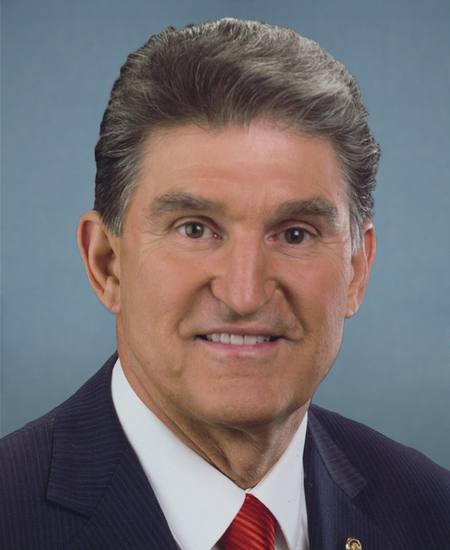
Sen. Joe Manchin, III
Sponsored bills
Advancing Uniform Transportation Opportunities for Veterans Act or the AUTO for Veterans Act This bill authorizes the Department of Veterans Affairs (VA) to provide (or assist in providing) an eligible veteran or service member with an additional automobile or other conveyance under the VA automobile allowance and adaptive equipment program. Currently, a veteran or service member with a specified service-connected disability or impairment may not receive more than one automobile or other conveyance under the program. The bill authorizes the additional benefit for such veterans and service members if 10 years have passed since the person last received such benefit.
Veterans Burn Pits Exposure Recognition Act of 2021 This bill requires the Department of Veterans Affairs (VA) to concede, for the purposes of health care benefits and wartime disability compensation, that a veteran was exposed to certain toxic substances, chemicals, and hazards from burn pits if such veteran served on active duty in a covered location during a specified time frame (unless there is affirmative evidence to establish that the veteran was not exposed during such service). A burn pit is an area used for burning solid waste in open air without equipment. Specifically, the bill covers the following locations and corresponding time periods: Iraq between August 2, 1990, and February 28, 1991, as well as from March 19, 2003, until burn pits are no longer used in this location; Southwest Asia (including Kuwait, Saudi Arabia, Oman, and Qatar) from August 2, 1990, until burn pits are no longer used in these locations; and Afghanistan, Syria, Jordan, Egypt, Lebanon, Yemen, and Djibouti from September 11, 2001, until burn pits are no longer used in these locations. Under the bill, if an exposed veteran submits insufficient evidence to establish a service-connection for purposes of disability compensation, the VA shall provide a medical examination and request a medical opinion regarding a causal link between the disability and a toxin, chemical, or hazard.

This resolution designates April 2021 as Financial Literacy Month.
This bill establishes deadlines for the Bureau of Land Management and the Forest Service to complete the federal permitting and review process with respect to critical mineral production on federal lands. It also establishes related requirements to expedite the process and remove impediments to the production of critical minerals and the mineral security of the United States.
This resolution extends condolences to the family and friends of former Vice President Walter Mondale. The resolution acknowledges Mondale's lifetime service to the United States, including as a U.S. Senator and as the first presidential candidate from a major party to select a woman, Geraldine Ferraro, as his running mate.
Non-Opioid Directive Act This bill requires the Department of Health and Human Services (HHS) to develop a non-opioid pain management directive. This is a form that an individual may use to inform health care providers of the individual's choice to avoid opioid medications for pain management. The bill also sets out requirements for the execution, use, and revocation of these forms. HHS must make the form available on its website, and health insurers must make it available to their plan enrollees. Insurers must also share an enrollee's choice about opioid treatment with health care providers during pre-authorization processes. The bill allows health care providers to override a patient's form in specified circumstances. It also extends liability protections for providers who reasonably and in good faith administer or prescribe an opioid to a patient with an executed form in place.
Time to Rescue United States Trusts Act of 2021 or the TRUST Act of 2021 This bill establishes congressional rescue committees to develop recommendations and legislation to improve critical social contract programs. A critical social contract program is a federal program for which a federal trust fund is established (e.g., Social Security, Medicare, and federal highway programs), with outlays of at least $20 billion during the year preceding the year in which this bill is enacted, and for which the amount of dedicated federal funds and federal trust fund balances will be inadequate to meet the total amount of outlays of the program that would otherwise be made. Each rescue committee may develop recommendations and legislation to improve the program for which it was established, including by (1) increasing the duration of positive balances of the federal trust fund established for the program, and (2) providing for the solvency of the federal trust fund established for the program during a 75-year period. Congress must use specified expedited legislative procedures to consider legislation that is approved and submitted by the rescue committees.
This resolution designates April 17, 2021, through April 25, 2021, as National Park Week. The resolution also encourages the people of the United States and the world to responsibly visit, experience, and support the treasured national parks of the United States while protecting public health during the coronavirus pandemic.
Eliminating Global Market Distortions To Protect American Jobs Act of 2021 This bill addresses unfair trade practices by making various changes to U.S. antidumping and countervailing duty law. Antidumping provides relief to U.S industries and workers that are materially injured or threatened with injury due to imports of like products sold in the U.S. market at less than fair value, while countervailing duty provides such relief from imports of products subsidized by a foreign government or public entity. Specifically, the bill establishes a process for successive antidumping and countervailing duty investigations. Successive investigations may be concurrent (an ongoing investigation of the same product from different countries) or recently completed (not more than two years before the date of the initiation of the successive investigation). Further, the bill establishes a time line for the Department of Commerce to issue determinations in successive investigations. Among other provisions, the bill authorizes Commerce to apply countervailing duty law to subsidies provided by a foreign government or public entity to a company operating in a different country, use another method for calculating the cost of production in specific circumstances, and require importers to provide a certification that the imported merchandise is not subject to an antidumping or countervailing duty order. Additionally, the bill establishes procedures for Commerce to conduct circumvention inquiries, including by specifying the deadlines for preliminary and final determinations.