

Maddy summaryThis bill amends the Natural Gas Act to give the Federal Energy Regulatory Commission (FERC) exclusive authority to approve or deny applications for LNG terminal construction, expansion, or operation for exporting or importing natural gas. It requires FERC to deem LNG exports consistent with the public interest when making decisions, streamlining the approval process for energy companies seeking to build or expand export facilities. The bill clarifies that this change does not affect other federal agencies' responsibilities regarding LNG facilities or existing laws governing imports/exports. It directly affects LNG terminal developers, energy exporters, and the federal regulatory process for natural gas trade.
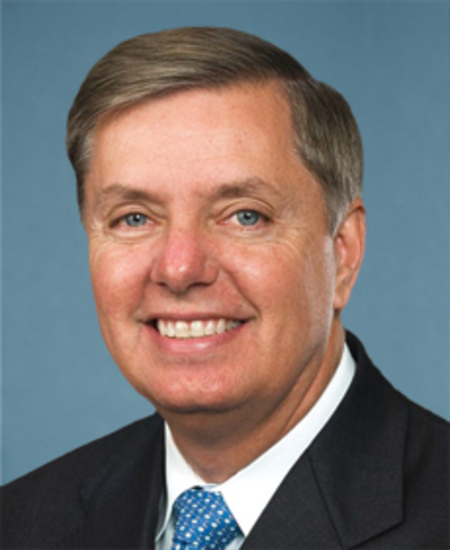
Sen. Lindsey Graham
Sponsored bills
Maddy summaryThis bill requires the U.S. Secretary of Energy to study and publicly report on greenhouse gas emissions intensity (emissions per unit of product) for 22 specific product categories, including aluminum, cement, lithium-ion batteries, and solar panels. It mandates comparing U.S. production emissions with those of "covered countries" (like G7 nations, U.S. trade partners, and major exporters). The study must create a public database of findings every five years, detailing methodology, data sources, and gaps in emissions data for both U.S. and foreign production. This is a data-gathering measure only - it does not impose new emissions regulations or affect current policies.
Maddy summaryS.1108, the Death Tax Repeal Act of 2023, repeals the federal estate tax and generation-skipping transfer tax for estates of people who die after the bill's enactment. It also modifies the gift tax by establishing a $10 million lifetime exemption (adjusted for inflation) and creating a new tax rate schedule for gifts. This bill directly affects high-net-worth individuals who would have paid estate or gift taxes on large transfers of wealth. The changes take effect after the bill's passage, with the exemption adjusted annually for inflation.
Maddy summarySRES 523 is a Senate resolution honoring the late Senator Herb Kohl of Wisconsin. The resolution expresses the Senate's sorrow at his death, directs the Secretary of the Senate to communicate it to the House of Representatives and send a copy to his family, and instructs the Senate to adjourn as a mark of respect. This procedural resolution does not create new laws or affect policy, but formally commemorates Kohl's service and legacy. It was introduced by a bipartisan group of Senators and passed unanimously on January 11, 2024.
Maddy summaryThis Senate resolution (SRES 521) expresses the U.S. Senate's support for Taiwan's democratic institutions and its history of free elections. It commends Taiwan for holding 7 presidential and 9 legislative elections since transitioning to democracy in the late 1980s, including peaceful transfers of power between political parties. The resolution specifically highlights Taiwan's upcoming 2024 elections and reaffirms U.S. commitment to existing policy frameworks like the Taiwan Relations Act. As a symbolic resolution, it has no binding effect but formally recognizes Taiwan's democratic achievements and expresses concern over potential interference in its elections.
Maddy summary# Summary of "Secure the Border Act of 2023" (Employment Eligibility Verification Provisions) This legislation (primarily Sections 801-816) fundamentally reforms the U.S. employment eligibility verification system by replacing the current E-Verify program with a new, mandatory verification system for employers. ## Key Provisions: 1. **Mandatory Verification System**: Requires all employers to verify the work authorization of new hires through a new verification system established under Section 274A(d). 2. **Phased Implementation Timeline**: - Large employers (10,000+ employees): 6 months after enactment - Medium employers (500-10,000 employees): 12 months after enactment - Small employers (20-500 employees): 18 months after enactment - Very small employers (<20 employees): 24 months after enactment - Agricultural workers: 36 months after enactment 3. **Verification Process**: - Requires examination of specific documents to verify identity and work authorization - Establishes a verification system with confirmation or tentative nonconfirmation within 3 business days - Requires secondary verification process for tentative nonconfirmations 4. **Penalties for Non-Compliance**: - Civil penalties ranging from $2,500 to $25,000 per violation - Criminal penalties for pattern or practice violations ($5,000 per unauthorized alien) - Potential debarment from federal contracts for repeat violators 5. **Fraud Prevention Measures**: - Blocks social security account numbers subject to unusual multiple use - Allows suspension of compromised social security numbers - Protects children's identities from being used for employment verification 6. **Agricultural Workforce Provisions**: - Extended timeline for agricultural workers (36 months) - Specific definitions of agricultural labor - Study on agricultural workforce composition and recommendations 7. **Good Faith Defense**: - Allows employers to avoid penalties if they can demonstrate good faith compliance - Requires reasonable security measures for identity verification This legislation represents a significant expansion of employer verification requirements with substantial penalties for non-compliance, designed to strengthen enforcement against unauthorized employment while establishing a more comprehensive verification system. The phased approach aims to give employers time to adjust to the new requirements based on business size.
Maddy summaryThe Alan T. Shao II Fentanyl Public Health Emergency and Overdose Prevention Act (S 1532) suspends the admission of individuals attempting to enter the U.S. unlawfully from Canada or Mexico without proper travel documents. It requires that such individuals be rapidly returned to their country of origin or the country they entered from to reduce the risk of fentanyl trafficking. The Secretary of Homeland Security may use repatriation flights for this purpose, on a space-available basis.
Maddy summaryThis bill (SJRES 32) seeks congressional disapproval of a specific rule issued by the Bureau of Consumer Financial Protection (CFPB) on May 31, 2023. The rule, published as Regulation B under the Equal Credit Opportunity Act (ECOA), addressed how lenders must evaluate small business loan applications to prevent discrimination. If passed, the resolution would block this rule from taking effect, meaning lenders would not be required to follow these specific small business lending provisions. The bill directly affects the CFPB's regulatory authority and financial institutions that process small business loans under ECOA.
Maddy summaryThis bill retroactively restores pay, benefits, and seniority for senior military officers (O-7 rank or higher) whose promotions were delayed due to a Senate confirmation suspension starting in February 2023. It applies specifically to officers confirmed between December 5-31, 2023, who faced delays because the Senate paused its advice-and-consent process for such appointments. The bill requires the Secretary of Defense to pay retroactive compensation from a defined date (the later of 30 days after Senate calendar placement or the original appointment date) and use that date for determining the officer's seniority in their new rank. It directly affects military personnel whose career progression was impacted by the confirmation delay, without creating new policy or changing appointment procedures.
Maddy summarySRES 497 is a Senate resolution (introduced December 13, 2023) expressing the Senate's view that the slogan "From the river to the sea, Palestine will be free" and similar phrases are antisemitic and constitute a call for genocide against the Jewish state. It does not create new laws or affect any individuals or policies; it is solely a symbolic statement of the Senate's position. The resolution formally declares the Senate's "sense" on the meaning of the slogan, based on the signers' interpretation. As a non-binding resolution, it has no legal effect on citizens, government actions, or future legislation.