

Maddy summaryS 3923 requires state and local law enforcement to hold criminal aliens for up to 48 hours to transfer to U.S. Immigration and Customs Enforcement (ICE), if ICE issues a detainer. It mandates that states cannot restrict sharing immigration status information with ICE and prohibits local agencies from blocking detainer compliance. The bill also creates a federal compensation program, funding states $750 million in 2025 (rising to $950 million annually through 2031) for detaining eligible criminal aliens - defined as those convicted of felonies or multiple misdemeanors who entered without inspection or violated visa status. States must comply with detainer requests to receive funding, with non-compliant jurisdictions losing eligibility.
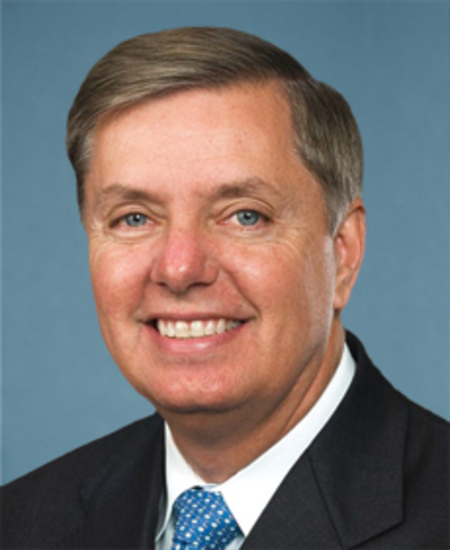
Sen. Lindsey Graham
Sponsored bills
Maddy summaryThis bill creates a private right for victims (or their families) of serious crimes committed by aliens to sue states or local governments that failed to comply with federal immigration detainer requests. It allows lawsuits for compensatory damages if a state/local entity did not follow DHS requests regarding an alien convicted of murder, rape, or a felony (1+ year sentence), and the victim would not have been harmed had the alien been detained. States accepting certain federal grants (like community development funds) must waive sovereign immunity to be sued under this law, with a 10-year statute of limitations from the crime or victim's death. The bill directly affects states or localities with "sanctuary policies" that restrict sharing immigration status or complying with detainers.
Maddy summaryS 3933, the Laken Riley Act, amends immigration law to require mandatory detention for non-citizens charged with certain crimes like theft or burglary, rather than allowing release. It directly affects individuals facing these charges and gives state attorneys general the legal standing to sue federal agencies (like DHS or the State Department) if they claim immigration policies caused the state or residents financial harm exceeding $100. Key provisions include requiring Homeland Security to take custody of such individuals and establishing new court procedures for states to seek injunctions against federal immigration enforcement actions. The bill does not change border policies but focuses on detention requirements and state legal challenges to federal immigration enforcement.
Maddy summaryThis joint resolution (SJRES 63) seeks to block a specific rule issued by the Department of Labor (DOL) concerning worker classification under the Fair Labor Standards Act (FLSA). The DOL rule (published January 10, 2024) aimed to clarify how businesses must classify workers as employees or independent contractors for purposes of minimum wage and overtime pay. If passed, this resolution would formally disapprove the rule under a statutory process (Chapter 8 of Title 5, U.S. Code), preventing it from taking effect. The rule directly affects employers across industries who use independent contractors and their workers, as it would change how worker status is determined under federal labor law.
Maddy summaryThis bill extends the current minimum wage rate for H-2A agricultural workers through December 31, 2025. It directly affects farm employers who hire temporary foreign workers under the H-2A visa program, ensuring they continue paying the wage rate in effect as of December 31, 2023. The key provision maintains the existing wage rate without modification for two additional years, avoiding potential increases. It also clarifies that job duties will be evaluated to determine the applicable wage rate for workers performing multiple tasks.
Maddy summaryThis bill (S 3812, the FIREARM Act) changes firearm licensing enforcement by requiring the Attorney General to give licensees (like dealers) 30 business days to correct self-reported violations before taking action to revoke or deny license renewals. It adds a new 10-day judicial review option: licensees can bypass a hearing and request a federal court review of a revocation notice, with the revocation stayed during the court process. The bill also clarifies that minor or clerical errors are not considered "willful" violations and defines "self-reported violation" as one a licensee discloses before the Attorney General discovers it. These changes directly affect firearm license holders and the enforcement process under federal law.
Maddy summarySRES 553 is a ceremonial Senate resolution honoring Jean A. Carnahan, who served as Missouri’s first female U.S. Senator from 2001 to 2002 after her husband’s passing. The resolution expresses the Senate’s sorrow over her death, recognizes her service as First Lady of Missouri and U.S. Senator, and her advocacy for families and veterans. It directs the Senate Secretary to share the resolution with the House and Carnahan’s family, with no substantive policy changes or affected parties. This is a standard commemorative measure with no legislative impact.
This resolution supports the designation of February 17-February 24, 2024, as National FFA Week. It also (1) recognizes the important role of the National FFA Organization (Future Farmers of America) in developing the next generation of globally conscious leaders who will change the world; and (2) celebrates the 10th anniversary of the Give the Gift of Blue program, which has donated more than 17,000 FFA blue jackets to FFA members in need.
Maddy summaryS. 3427, the Overtime Pay for Protective Services Act of 2023, extends the authority for U.S. Secret Service protective services staff to receive overtime pay beyond standard federal limits through 2028. It directly affects Secret Service personnel providing protective services (excluding routine administrative work), allowing them to earn overtime pay without hitting typical pay caps. Key provisions include updating the law’s expiration date to 2028, clarifying that "protective services" excludes administrative tasks, and requiring the Secret Service Director to submit annual reports on overtime usage and strategies to reduce reliance on overtime. These reports must detail staffing levels, operational demands, and quarterly projections for 2024-2027, plus annual effect assessments through 2029. The bill focuses on maintaining operational capacity for high-demand protective duties while adding oversight mechanisms.
Maddy summaryS 2669 requires digital asset service providers - including unhosted wallet providers, validators, miners, and digital asset kiosks (crypto ATMs) - to register with the Financial Crimes Enforcement Network (FinCEN) and verify customer identities. It mandates that entities handling anonymity-enhancing tools (like mixers that obscure transactions) implement anti-money laundering controls and report holdings over $10,000 abroad. The bill sets deadlines for implementing these rules: registration within 180 days, identity verification for kiosks within 18 months, and reporting requirements within 18 months of enactment. These provisions directly affect crypto businesses, wallet services, and kiosks operating in the U.S., aiming to reduce illicit finance risks in digital asset transactions.