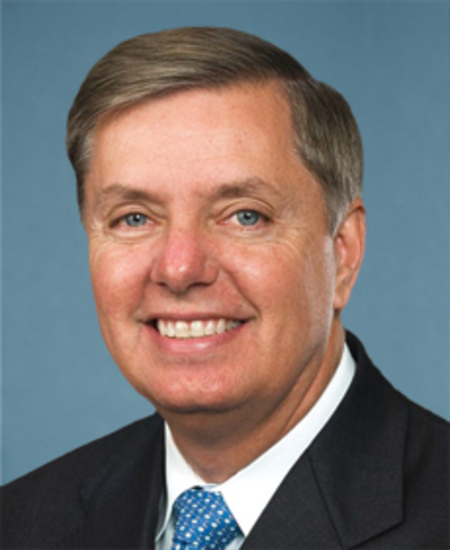
Photo of Lindsey Graham
R United States Senate · South Carolina

Sen. Lindsey Graham

Compare
Total votes
1,020
all sessions
Attendance
96%
44 missed
Near the chamber average
With party
93%
of cast votes
Near the chamber average
Bipartisan score
4%
crosses aisle rarely
Near the chamber average
Sponsored
739
bills & resolutions
Lower than 92% of chamber peers
Committees
0
assignments
739 bills and resolutions

Sponsored bills

Total
739
Primary
105
Co-sponsor
634
This page
739
matching current filters
Co-sponsor S 478
In committee · United States Senate · Co-sponsor
Veterans 2nd Amendment Protection Act of 2025

Veterans 2nd Amendment Protection Act of 2025 This bill prohibits the Department of Veterans Affairs (VA) from transmitting certain information to the National Instant Criminal Background Check System (NICS) utilized by licensed importers or dealers of firearms. Specifically, the bill prohibits the VA from transmitting personally identifying information of a veteran or a beneficiary to the NICS solely on the basis that such veteran or beneficiary has an appointed fiduciary to manage their benefits, unless there is an order or finding of a judicial authority that such veteran or beneficiary is a danger to themselves or others.

In committee Mar 11, 2025 1 co-sponsor
Co-sponsor S 124
In committee · United States Senate · Co-sponsor
Restore VA Accountability Act of 2025

Maddy summaryThe Restore VA Accountability Act of 2025 establishes new rules for disciplining VA supervisors and management officials (excluding senior executives and political appointees) for poor performance or misconduct. It requires the VA Secretary to use specific, written criteria - like the offense's severity, the employee's role, and past record - when deciding on removal, demotion, or suspension, and mandates decisions within 15 business days. The bill creates an internal grievance process for affected employees and strengthens whistleblower protections by requiring Special Counsel approval before disciplining someone who disclosed wrongdoing. It also limits judicial review to cases of arbitrary or capricious decisions and explicitly prohibits courts from reducing penalties. The law applies to VA employees covered under the bill's definition, effective from the 2017 VA Accountability Act's enactment date.

In committee Mar 11, 2025 1 co-sponsor
Co-sponsor S 9
Introduced · United States Senate · Co-sponsor
Protection of Women and Girls in Sports Act of 2025

Maddy summaryThis bill amends federal education law to prohibit federally funded athletic programs from allowing individuals assigned male at birth to participate in sports designated for women or girls. It defines "sex" for this purpose as biological sex at birth, based on reproductive anatomy and genetics. The law directly affects schools, colleges, and sports organizations receiving federal funding. Violations would constitute a breach of Title IX, requiring programs to exclude individuals whose sex is male from women's or girls' athletic teams.

Introduced Mar 3, 2025 1 co-sponsor
Primary SRES 101
In committee · United States Senate · Lead sponsor
A resolution affirming the threats to world stability from a nuclear weapons-capable Islamic Republic of Iran.

Maddy summaryThis resolution (SRES 101) is a symbolic Senate statement affirming that Iran's nuclear activities - specifically its enrichment of uranium to 83.7% (close to weapons-grade 90%) and stockpiling of 274.8 kilograms of 60% enriched uranium - pose a credible threat to U.S. security and an existential threat to Israel and Middle Eastern allies. It demands Iran cease uranium enrichment, nuclear weapons development, and delivery systems, while emphasizing the Senate supports all options to address the threat. The resolution explicitly states it does not authorize military force, as noted in its rule of construction. This is a declarative statement with no binding policy changes or new legislation.

In committee Feb 27, 2025 0 co-sponsors
Primary S 775
In committee · United States Senate · Lead sponsor
SAFE Act of 2025

Maddy summaryThis bill prohibits the slaughter of horses, ponies, and other equines for human consumption by amending existing federal law. It directly affects businesses or individuals currently involved in slaughtering equines for food, making such activity illegal under the Agriculture Improvement Act of 2018. The key change updates a provision that previously banned slaughtering dogs and cats to now include equines, expanding the existing prohibition. This is a concrete policy change that bans a specific practice under federal law.

In committee Feb 27, 2025 0 co-sponsors
Co-sponsor SJRES 24
In committee · United States Senate · Co-sponsor
A joint resolution providing for congressional disapproval under chapter 8 of title 5, United States Code, of the rule submitted by the Environmental Protection Agency relating to "National Emission Standards for Hazardous Air Pollutants: Rubber Tire Manufacturing".

Maddy summarySJRES 24 is a joint resolution that would block an Environmental Protection Agency (EPA) rule setting new standards for reducing harmful air pollutants from rubber tire manufacturing facilities. If passed, the resolution would prevent the rule - published in the Federal Register on November 29, 2024 - from taking effect, meaning tire manufacturers would not have to comply with the new requirements. The bill directly affects the rubber tire manufacturing industry by removing a specific regulatory obligation. This resolution uses a congressional disapproval process under federal law to stop the EPA rule without creating new regulations.

In committee Feb 25, 2025 1 co-sponsor
Co-sponsor S 691
In committee · United States Senate · Co-sponsor
Leveling the Playing Field 2.0 Act

Maddy summaryThe Leveling the Playing Field 2.0 Act establishes special rules for handling successive antidumping and countervailing duty investigations, requiring the Department of Commerce to consider prior injury determinations when making new findings. It addresses market distortions from foreign government subsidies and currency undervaluation by expanding how the U.S. calculates fair trade values for imported goods. The bill also creates new procedures to prevent circumvention of existing duties (such as by changing product descriptions to avoid tariffs) and requires importers to certify that merchandise isn't subject to existing duties. These changes primarily affect U.S. Customs and Border Protection, the Department of Commerce, and importers of goods from countries that may be engaging in trade-distorting practices.

In committee Feb 24, 2025 1 co-sponsor
Primary SCONRES 7
Passed · United States Senate · Lead sponsor
An original concurrent resolution setting forth the congressional budget for the United States Government for fiscal year 2025 and setting forth the appropriate budgetary levels for fiscal years 2026 through 2034.

This concurrent resolution establishes the congressional budget for the federal government for FY2025, sets forth budgetary levels for FY2026-FY2034, and provides reconciliation instructions for legislation that increases or decreases the deficit by specified amounts.  The resolution recommends levels and amounts for FY2025-FY2034 for federal revenues, new budget authority, budget outlays, deficits, public debt, debt held by the public, and the major functional categories of spending. It also recommends levels and amounts for Social Security and Postal Service discretionary administrative expenses for the purpose of budget enforcement in the Senate. The resolution includes reconciliation instructions that direct several House and Senate committees to report legislation that will increase or decrease the deficit over FY2025-FY2034 by specified amounts. The committees must submit the legislation to the applicable congressional budget committee by March 7, 2025.  (Under current law, reconciliation bills are considered by Congress using expedited legislative procedures that prevent a filibuster and restrict amendments in the Senate.) In addition, the resolution establishes reserve funds that allow certain adjustments to committee allocations and other budgetary levels to accommodate (1) reconciliation legislation, and (2) legislation that would not increase the deficit over FY2025-FY2034. The resolution also exempts reconciliation legislation that complies with this resolution from various budget points of order. Finally, the resolution sets forth budget enforcement procedures that address issues such as adjustments to committee allocations and the budgetary treatment of the discretionary administrative expenses for the Social Security Administration and the U.S. Postal Service.


Passed Feb 21, 2025 0 co-sponsors
Co-sponsor S 679
In committee · United States Senate · Co-sponsor
LEOSA Reform Act

Maddy summaryS 679 amends federal law to clarify that active and retired law enforcement officers meeting specific criteria can carry concealed firearms in more locations, including national parks and certain federal facilities like public areas of federal buildings. The bill requires retired officers to have completed recent firearms training (within 12-36 months) and provide certification from their former agency, state, or a certified instructor. It also specifies that these provisions do not apply to property used by common carriers (such as airports) or public property. These changes update the Law Enforcement Officers Safety Act of 2004 to expand officers' ability to carry concealed weapons under federal law.

In committee Feb 20, 2025 1 co-sponsor
Primary SRES 78
In committee · United States Senate · Lead sponsor
An original resolution authorizing expenditures by the Committee on the Budget.

Maddy summarySRES 78 is a procedural Senate resolution authorizing the Committee on the Budget to spend funds for its operations. It grants the committee authority to make expenditures from the Senate's contingent fund, hire staff, and use other government agency resources (with approval) from March 2025 through February 2027. The resolution sets specific spending limits: $4.6 million for the first period (March-September 2025), $7.9 million for fiscal year 2026, and $3.3 million for the final period (October 2026-February 2027), with caps on consultant fees and staff training costs. This resolution directly affects only the Committee on the Budget's internal budgeting and administrative functions.

In committee Feb 13, 2025 0 co-sponsors
Showing 161 to 170 of 739 bills
Previous 1 … 16 17 18 … 74 Next