

Maddy summaryThis bill prohibits states from automatically removing voters from registration lists due to factors like not voting or not responding to mail. It requires states to use only objective evidence (such as death records or proof of permanent move out of state) for removals and mandates 48-hour notice to voters with reinstatement options. Voters who move within a state can update their address through election day to vote at their new location. The law directly affects registered voters and election officials who must implement these verification and notice requirements.
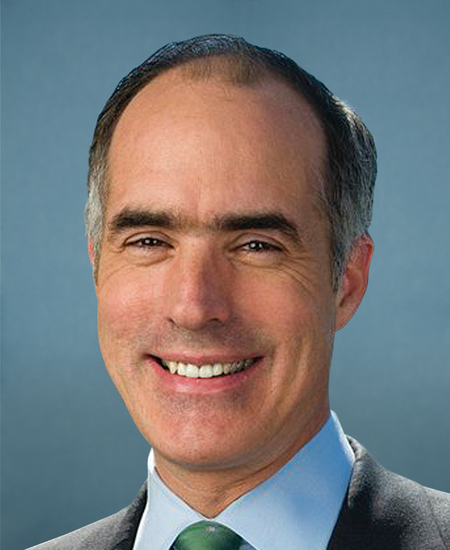
Sen. Robert P. Casey, Jr.
Sponsored bills
Maddy summaryThe Schedules That Work Act requires employers in retail, food service, hospitality, and cleaning industries to provide 14 days' advance notice of work schedules and pay predictability pay for last-minute changes. It gives eligible nonexempt workers the right to request schedule adjustments for family care, health needs, education, or second jobs, with employers required to grant these requests unless they have a bona fide business reason for denial. The law applies to covered employers with 15 or more workers and prohibits retaliation against employees who exercise these rights. The legislation aims to address widespread issues with unpredictable scheduling that disproportionately affect low-wage workers, particularly women and people of color, by providing greater schedule stability and control.
Maddy summaryThe Register America to Vote Act of 2023 would require states to automatically register eligible citizens to vote when they turn 18 or when they interact with state motor vehicle authorities for services like license applications, with an option to decline. States would need to establish electronic systems to transfer registration information from motor vehicle offices to election officials, updating voter registration without requiring additional action from citizens. The bill includes strong privacy protections for voter information and requires states to modernize registration systems to improve accuracy and accessibility, particularly benefiting young people, individuals with disabilities, and racial and ethnic minorities. It also provides $3 billion in federal funding to help states implement these changes by 2024.
Maddy summaryThis bill requires the Federal Aviation Administration (FAA) to hire the maximum number of new air traffic controllers each year from 2024 through 2028, based on the training capacity of the FAA Academy. It directly affects the FAA, which must set annual hiring targets aligned with its ability to train new controllers. The law does not change existing hiring rules but mandates that the FAA utilize its full training capacity each year for new controller hires during this period. It excludes certain individuals specified under federal law, but the core provision focuses on maximizing new controller recruitment within available training resources.
Maddy summaryThis resolution designates the week beginning September 11, 2023, as "National Hispanic-Serving Institutions Week" to recognize institutions that enroll at least 25% Hispanic students. It directly affects Hispanic-Serving Institutions (HSIs), which serve over 5 million students across 28 states, the District of Columbia, and Puerto Rico. The resolution calls for public observance through ceremonies and activities during that week to honor HSIs' role in advancing educational access, economic mobility, and Hispanic Heritage Month. As a ceremonial resolution, it has no binding policy impact but formally acknowledges these institutions' contributions.
Maddy summaryThis proposed constitutional amendment would give Congress and states the authority to regulate campaign contributions and spending, including setting limits and prohibiting corporations from spending money to influence elections. It explicitly protects freedom of the press by stating the amendment cannot be used to abridge it. If ratified by three-fourths of state legislatures, it would establish a new constitutional standard for campaign finance regulation.
Maddy summaryThis Senate resolution (SRES 345) designates September 15, 2023, as "National Concussion Awareness Day" to highlight the health impact of concussions. It cites CDC data showing millions of annual sports-related concussions, particularly among youth, and emphasizes the need for better diagnosis, management, and awareness. The resolution encourages federal, state, and local policymakers to collaborate on raising public awareness and improving concussion care protocols. It does not create new laws or allocate funds but serves as a symbolic effort to promote education and prevention. The resolution was introduced by Senators Hassan, Capito, and Casey and unanimously adopted on September 14, 2023.
Maddy summaryS 2816, the Medicaid for Every Child Act, would expand Medicaid coverage to all children from birth through age 19 in the U.S., regardless of immigration status. It requires states to automatically enroll newborns in Medicaid at birth (with a parent/guardian opt-out option if the child has other qualifying health coverage), ensures continuous eligibility through age 19, and removes immigration status barriers for coverage. The bill also provides 100% federal funding for these children's medical assistance, excluding Medicaid coverage from counting as "minimum essential coverage" under tax law. Most provisions would take effect two years after enactment. This directly affects all children under 19 in the U.S., including those with undocumented immigration status.
Maddy summaryS 2804, the Protection of Social Security Benefits Restoration Act, prohibits the government from withholding Social Security, Railroad Retirement, and Black Lung benefits to pay off unrelated debts like federal student loans or tax obligations. It amends the Social Security Act and related laws to nullify provisions allowing such administrative offsets, restoring protections that previously existed before a 2020 change. The bill ensures Railroad Retirement and Railroad Unemployment Insurance benefits receive identical protections to Social Security benefits. These changes apply to all offset collections occurring after the bill's enactment date.
Maddy summaryS 2776, the Disarm Hate Act, prohibits firearm sales, possession, shipment, or transport for individuals convicted of a misdemeanor hate crime or receiving an enhanced sentence for such a crime. It directly affects people convicted under state, federal, or tribal law of a misdemeanor involving bias motivation (based on race, religion, gender, sexual orientation, gender identity, or disability) and physical threat or force. The bill amends federal gun laws (18 U.S.C. §§922(d) and 922(g)) to add this restriction, while excluding cases where convictions were expunged, pardoned, or where legal rights were waived improperly. This is a concrete policy change affecting firearm access for a specific category of offenders, not a broader hate crime prevention measure.