

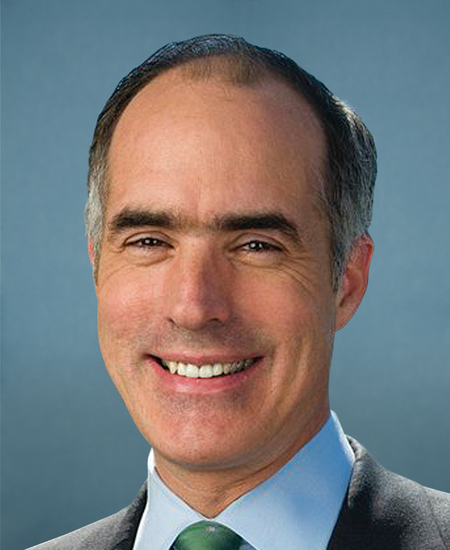
Photo of Robert P. Casey, Jr.
D United States Senate · Former member · Pennsylvania

Sen. Robert P. Casey, Jr.

Compare
Total votes
597
all sessions
Attendance
99%
5 missed
Near the chamber average
With party
97%
of cast votes
Higher than 76% of chamber peers
Bipartisan score
2%
crosses aisle rarely
Lower than 77% of chamber peers
Sponsored
1,299
bills & resolutions
Higher than 84% of chamber peers
Committees
0
assignments
1,299 bills and resolutions

Sponsored bills

Total
1,299
Primary
284
Co-sponsor
1,015
This page
1,299
matching current filters
Primary S 2906
In committee · United States Senate · Lead sponsor
Child Poverty Reduction Act of 2023

Maddy summaryThe Child Poverty Reduction Act of 2023 sets a national goal to reduce child poverty in the U.S. by half within five years. It requires the federal government to track child poverty using an annual inflation-adjusted measure (the "anchored Supplemental Poverty Measure") and produce yearly reports analyzing how federal policies affect child poverty rates, including deep poverty and racial disparities. The bill also mandates an online clearinghouse to share data and resources, and directs updates to existing federal strategies for reducing child poverty. These provisions apply to federal agencies and programs, focusing on measurement and analysis rather than direct policy implementation.

In committee Sep 21, 2023 0 co-sponsors
Co-sponsor S 2859
In committee · United States Senate · Co-sponsor
Social Security Child Protection Act of 2023

Maddy summaryThis bill allows children under 14 to get a new Social Security number if their original card was lost or stolen, compromising the number's confidentiality. Parents or guardians must provide verified evidence (under penalty of perjury) to the Social Security Commissioner showing the card was lost or stolen during delivery. The Commissioner would then reissue a new number and update the child's records to note the security breach. The change applies only to children whose numbers were issued under specific provisions for minors, not to all Social Security numbers.

In committee Sep 20, 2023 1 co-sponsor
Co-sponsor SCONRES 14
In committee · United States Senate · Co-sponsor
A concurrent resolution expressing the sense of Congress supporting the State of Israel.

Maddy summaryThis non-binding resolution expresses Congress's support for Israel by declaring it is not a racist or apartheid state, rejecting antisemitism and xenophobia, and affirming the U.S. as a steadfast partner. It serves as a symbolic statement of bipartisan backing without creating new laws, funding, or obligations. Introduced by Senators Cotton, Cruz, and others in July 2023, it reflects congressional sentiment rather than policy change.

In committee Sep 19, 2023 1 co-sponsor
Co-sponsor SRES 350
In committee · United States Senate · Co-sponsor
A resolution designating September 2023 as "National Voting Rights Month".

Maddy summaryThis Senate resolution symbolically designates September 2023 as "National Voting Rights Month" to raise awareness about voting rights history and current challenges. It recommends Congress pass specific voting rights legislation (like the Freedom to Vote Act and Democracy Restoration Act) and encourages public education on voting accessibility, registration, and historical voter suppression. The resolution has no binding effect on policy or funding - it serves as a symbolic recognition and call to action for voting rights advocacy.

In committee Sep 19, 2023 1 co-sponsor
Co-sponsor SRES 352
Passed · United States Senate · Co-sponsor
A resolution designating September 2023 as "National Childhood Cancer Awareness Month".

Maddy summaryThis resolution designates September 2023 as "National Childhood Cancer Awareness Month" in the U.S. Senate. It requests federal, state, local governments, and nonprofits to observe the month with programs aimed at increasing public awareness about childhood cancer risks. The resolution also encourages ongoing health monitoring for childhood cancer survivors and honors children facing cancer, while acknowledging the disease's significant impact (over 15,500 annual diagnoses and 1,700 deaths in children under 19). As a symbolic measure with no legal force, it does not change policies or allocate funding but seeks to raise national attention on childhood cancer.

Passed Sep 19, 2023 1 co-sponsor
Primary S 2837
In committee · United States Senate · Lead sponsor
Expanded Coverage for Former Foster Youth Act

Maddy summaryThis bill extends Medicaid coverage to former foster youth until age 26, directly affecting individuals who aged out of foster care at 18 or left for legal guardianship/emancipation before 18. It amends eligibility rules to allow these individuals to qualify for coverage regardless of income if they were in foster care at 18, removing previous income barriers. States must also establish outreach programs by January 2024 to help eligible former foster youth enroll in Medicaid. The policy change applies to those turning 18 on or after January 1, 2024, ensuring continuous health coverage during a critical transition period.

In committee Sep 19, 2023 0 co-sponsors
Primary S 2836
In committee · United States Senate · Lead sponsor
Foster Youth Mental Health Act of 2023

Maddy summaryThe Foster Youth Mental Health Act of 2023 establishes a national navigation program providing a 24-hour text line and toll-free hotline staffed by former foster youth and mental health experts. This service supports current and former foster youth (up to age 28), foster parents, kinship guardians, and adoptive parents in accessing mental health resources, housing, education, and substance use disorder services. It also requires states to dedicate at least 10% of their foster care mental health funding to develop comprehensive systems including peer specialists, trauma-informed staff training, privacy protections for mental health sessions, and continuity of care plans during placement changes or transitions out of foster care. The bill mandates states to evaluate program accessibility and increase outreach to underserved populations. The amendments take effect immediately for most states, with a 3-month delay for states needing legislative changes.

In committee Sep 19, 2023 0 co-sponsors
Co-sponsor S 2843
In committee · United States Senate · Co-sponsor
Same Day Registration Act

Maddy summaryThis bill requires states to allow eligible voters to register or update their registration at polling places on election day for federal elections, starting with the November 2024 general election. It mandates that polling places provide the necessary forms for registration or changes, directly affecting voters and state election systems. States already without voter registration requirements for federal elections are exempt. The law includes a phased implementation for states needing time, requiring at least one compliant location per 15,000 voters in each jurisdiction before November 2026.

In committee Sep 19, 2023 1 co-sponsor
Primary S 2849
In committee · United States Senate · Lead sponsor
Fostering Success in Higher Education Act of 2023

Maddy summaryThe Fostering Success in Higher Education Act of 2023 creates a federal grant program to improve higher education access and success for foster youth and homeless youth. It authorizes $150 million annually for states to use 25% of funds for direct outreach and support services (including financial aid guidance, career exploration, and summer preparation programs) and at least 70% for subgrants to colleges to improve services for these students. The bill requires states to develop plans for identifying and supporting these students, coordinate with child welfare and homeless services, and submit annual reports on program outcomes. This legislation directly affects foster youth (those who were in state or tribal care) and homeless youth (as defined by the McKinney-Vento Act), aiming to address barriers they face in accessing and completing postsecondary education.

In committee Sep 19, 2023 0 co-sponsors
Co-sponsor S 2850
In committee · United States Senate · Co-sponsor
Part-Time Worker Bill of Rights Act

Maddy summaryThe Part-Time Worker Bill of Rights Act would expand protections for part-time and temporary workers by reducing the eligibility requirement for family and medical leave from 12 months to 90 days. It prohibits employers from discriminating against employees based on their work hours, requiring equal treatment in compensation, benefits, and scheduling for part-time and full-time workers. The bill also requires employers to offer preferred work schedules to existing part-time employees before hiring new workers or using temporary staffing services. Employers who violate these provisions could face civil penalties and be required to compensate affected workers. This legislation applies to most private sector employers as well as federal, state, and local government employees.

In committee Sep 19, 2023 1 co-sponsor
Showing 341 to 350 of 1,299 bills
Previous 1 … 34 35 36 … 130 Next